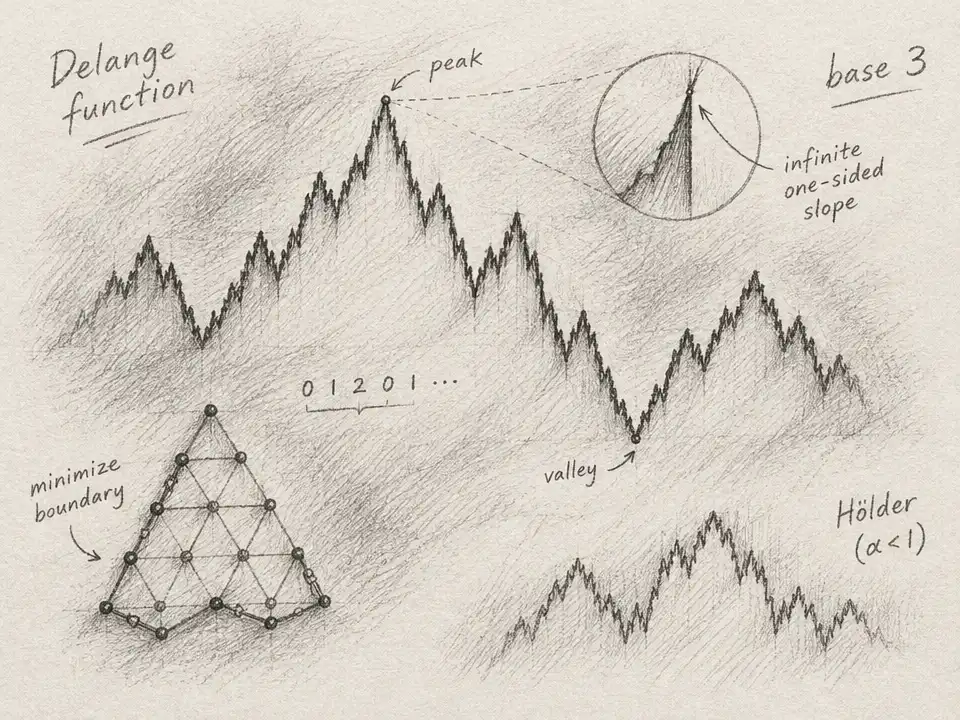
Here is a curve with a peculiar alibi: it never has an ordinary, finite slope at any point. Yet it is continuous. If you zoom in, it does not break apart or jump. Instead, its tiny rises and falls keep rearranging. So where are its peaks? Where are its valleys? And can the digits of a number tell you what the curve is doing right beside it?
A study posted to arXiv on October 15, 2026, takes up that puzzle in the base-three Delange function, a self-similar curve built from number digits. The construction sounds almost too orderly to produce such unruly behavior: start with a repeating wave, then add smaller copies, each one a third as tall and three times as tightly packed. The wave rises, levels off, and falls. Repeat the process at finer scales, and every close-up contains more structure.
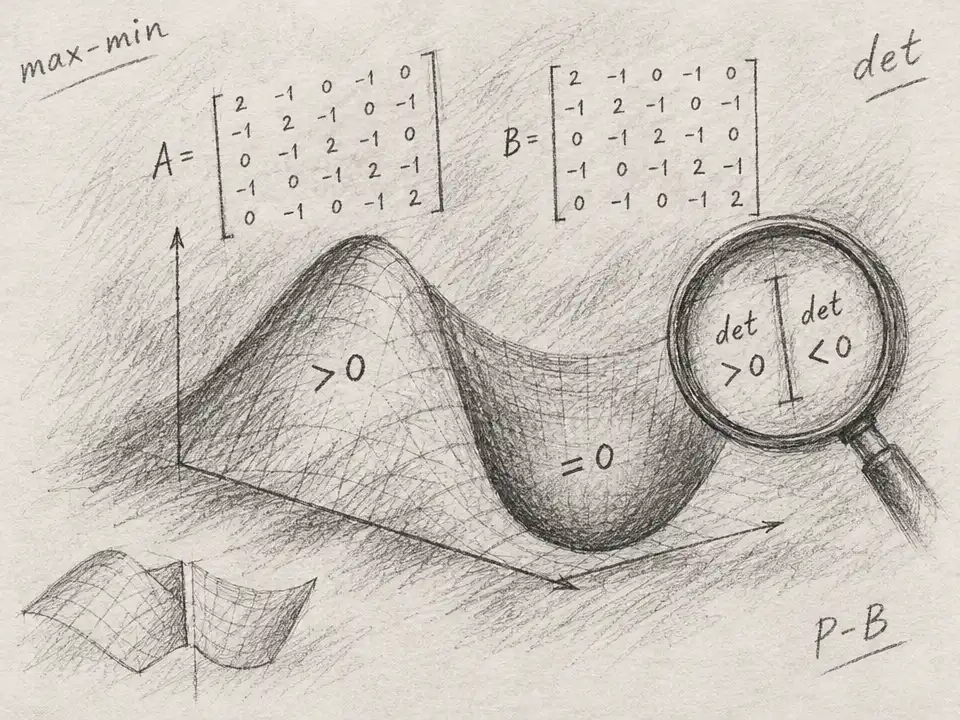
The first clue comes from a finite puzzle. Imagine a collection of strings, each made of n digits chosen from zero, one, and two. Two strings are connected if they differ in just one position. Choose m strings and ask: what is the smallest number of connections that cross from your chosen group to the rest? This is a counting problem on a three-symbol cube, but its answer carries an unexpected fingerprint: after rescaling, the minimum counts become samples of the same continuous curve.
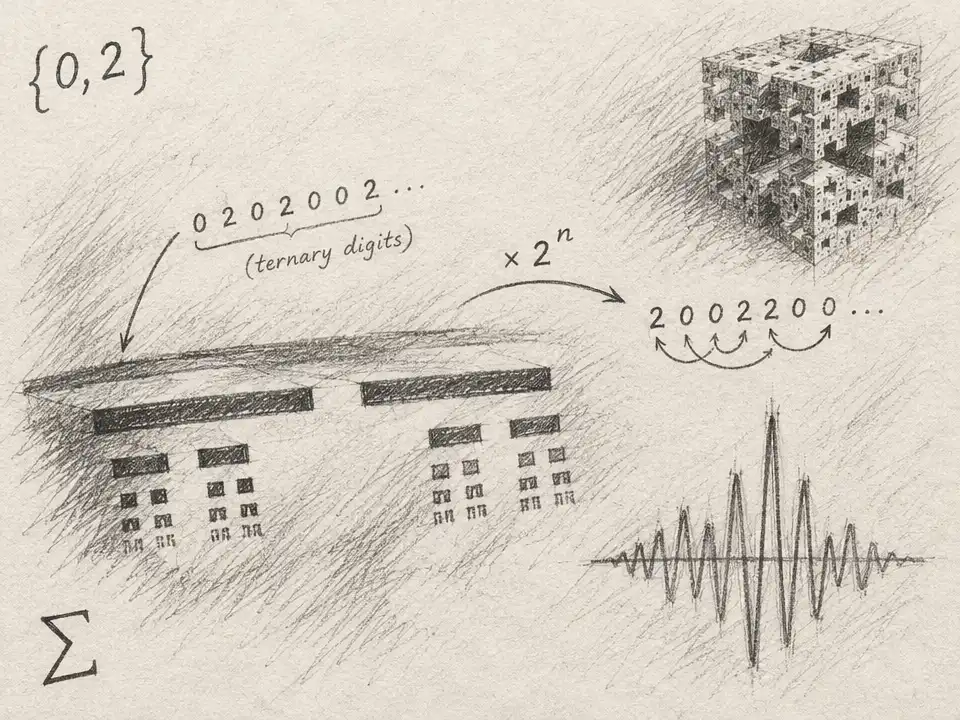
That connection gives the graph a hidden ruler. At each level of detail, the curve is made of straight pieces whose slopes depend on the ternary digits of the interval they occupy. A zero pushes the slope upward, a one contributes nothing, and a two pushes it downward. The digits are not decorative labels attached after the fact; their running balance steers the curve.
Now test the obvious guess: perhaps the turning points follow a simple schedule. The researchers show that the local valleys occur exactly at ternary rationals, numbers that can be written with a finite number of ternary digits. At such a point, the curve rises infinitely steeply from the right and falls infinitely steeply from the left. It is a valley, but not a rounded one. The graph stays continuous while its sides become vertical in the limiting sense.
The peaks have a different code. A point is a local maximum when, after some finite stretch of ternary digits whose sum matches the length of that stretch, every later digit is a one. There is no final list of a few special locations: both the peaks and valleys are countable and dense. Zoom in anywhere, and you can find one of each nearby. The curve’s turning points are everywhere, but their addresses are written in base three.
That sounds like periodic digits might solve the rest of the mystery. They do not. Consider one quarter: in base three, its digits repeat as zero-two, zero-two, over and over. The repeating block balances its zeros and twos, and the curve’s upper and lower one-sided slope limits there stay finite. They still do not settle on one ordinary slope. By contrast, at certain other non-ternary rational points, a repeating block with unequal numbers of zeros and twos produces an infinite derivative.
So periodicity is a clue, not a verdict. The paper’s more careful test tracks the digit balance as the expansion continues. For some directions, that balance is enough: if the slopes of finer and finer straight approximations grow without bound, the curve’s one-sided derivative becomes infinite. For other directions, long runs of zeros or twos matter too. A point can look steep from one side and behave differently from the other, because those long runs bring it unusually close to a nearby ternary rational.
There is an important distinction here. “No finite derivative anywhere” does not mean “infinite slope everywhere.” At many points, the slopes simply fail to settle into a limit, whether finite or infinite. The curve is continuous, but the usual categories—smooth, steep, flat—cannot describe each location with one simple label. To crack the puzzle, you have to ask which side you approach from and read the digits that come next.
A second study, posted to arXiv on April 20, 2026, tests whether this digit-driven roughness is peculiar to base three. Shintaro Suzuki examines a related family of Takagi-style functions built from expansions in noninteger bases between one and two. The result is not that every point has the same kind of infinite slope. Rather, at almost every point, the function obeys a local Hölder bound for every exponent below one, yet fails the stricter Lipschitz bound. In plain language, it can be controlled by nearly linear rules at every sublinear scale, but not by a truly linear one.
This second clue widens the investigation. In the ternary curve, the digits explain specific peaks, valleys, and one-sided blowups. In Suzuki’s different family, digit dynamics help explain why almost every point is gently bounded at all exponents below one while still resisting a linear bound. These are related mathematical constructions, not the same curve or the same theorem. Together, they suggest that a number’s expansion can organize roughness in ways that ordinary visual inspection misses.
One last clue comes from measuring the curve’s length more and more finely. The total vertical variation across a ternary grid grows in proportion to the square root of the grid’s depth. The polygonal paths through those increasingly detailed samples therefore keep getting longer without bound, even though the graph has dimension one. A curve need not fill a higher-dimensional space to have infinite length.
The answer to the opening puzzle is not a single rule like “rational points are cusps” or “repeating digits make peaks.” The decisive evidence is a longer record: the balance of the digits, their order, the direction of approach, and sometimes the length of a run. A finite boundary-counting puzzle and an endlessly refined curve turn out to share that code. The graph keeps its continuity; what it refuses to give us is a tame slope.