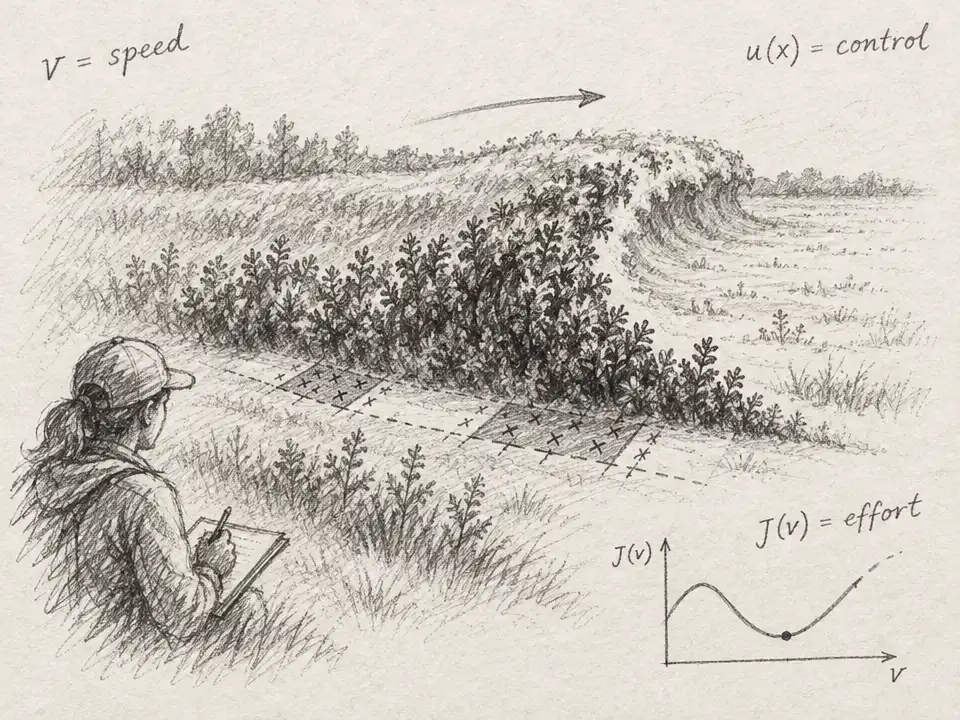
Picture an invasion front as a boundary sliding across a landscape: on one side, a species is established; on the other, it has not arrived. Now imagine trying to slow that boundary by removing some of the population along its path. How much intervention would it take to make the front move at a chosen speed? A mathematical study by Stefano Bianchini and Chiara Trifone turns that ecological question into a problem in optimal control—and finds that the price of speed behaves less simply than intuition might suggest.
Their starting point is a deliberately spare model. A number between zero and one represents the species’ relative density: zero means absent, while one is a saturated population. Two processes shape the pattern. Reproduction changes the density locally; diffusion spreads it through space. In the model’s chosen growth regime, very low densities tend toward extinction, while densities above a threshold tend toward saturation. The researchers add a control that removes a fraction of the population, then ask for the least total control effort needed to sustain a traveling front at a specified speed.
That “effort” has a precise mathematical meaning: it is the control intensity accumulated across space. It is not a count of animals removed, a dollar estimate, or a field-tested prescription. The setup isolates a question about how intervention and spreading interact, without trying to represent every feature of a real landscape or species.
The key move is to stop watching the whole front move. Instead, the authors describe its shape as a route through a phase plane. One coordinate tracks population density; the other tracks how sharply that density changes across space. A traveling wave becomes a path that starts at the absent-population state and ends at saturation. Dynamical-systems theory supplies special routes into and out of those endpoints—the stable and unstable manifolds—which constrain what a wave can do.
Control theory then asks which connecting path costs least. The answer is not simply to remove population everywhere, or to apply a uniform amount along the front. The researchers prove that, for a fixed target speed in the model, there is a unique optimal profile. Its control switches on only over portions of the front where the profile lies along a particular critical curve. Away from those portions, the optimal path proceeds without active control. In effect, the mathematics identifies where intervention can change the shape of the traveling wave most efficiently.
This is the crossover at the heart of the work: an ecological spreading problem becomes legible through the geometry of dynamical systems. In the phase plane, the optimal intervention is not a vague instruction to “push harder” against the invasion. It is a carefully constrained route between two population states. The authors derive first-order conditions that identify the optimal path and show that, among the candidate paths they study, those conditions are sufficient as well as necessary.
A follow-up paper by the same researchers, posted in October 2026, examines the geometry more closely. It studies how the stable and unstable routes shift when the target speed or the species’ growth law changes, and when those routes cross the critical curve. For generic choices of the model, the crossings are transversal: the curves meet cleanly rather than merely brushing against each other. The paper also analyzes a special critical speed where the geometry loses regularity. That matters because a small change in speed or growth assumptions does not always produce an equally smooth change in the optimal profile.
The most counterintuitive result concerns the cost curve. In the model, faster fronts require strictly more control effort. But the effort does not rise in the neat, steadily accelerating way that a convex curve would describe. The authors construct examples where the cost is not convex—even with a standard cubic growth law. Non-convexity means the extra effort associated with increasing speed can itself change unevenly: the marginal price need not simply climb in a predictable fashion. The cost also does not, in general, obey the useful-looking rule that the effort for a combined speed is bounded by adding the efforts for two smaller speeds.
Why should a curve on a graph matter beyond the model? The researchers are interested in what happens when fine-scale spreading is viewed at a much larger scale. A thin moving front can then be treated as a boundary, and its speed-dependent control effort becomes part of the boundary’s effective cost. Mathematical approaches to that kind of scaling can rely on assumptions such as convexity. Showing that convexity can fail does not invalidate those approaches wholesale; it shows that the assumption needs to be checked rather than taken for granted.
There are clear limits to the result. The analysis is theoretical and built around a simplified, one-dimensional reaction-diffusion model with a particular bistable growth pattern. It does not establish that a specific pest can be controlled this way, or that the calculated effort predicts the outcome of an eradication campaign. Its contribution is more foundational: it shows how to find an optimal intervention profile in a model, and reveals that the relationship between speed and effort can bend in unexpected ways.
The invasion front may look like one smooth line moving across a map. Underneath, the mathematics sees a constrained path, a critical curve, and a control that matters only in selected stretches. Ecology supplies the question; dynamical systems and optimization supply a way to trace the answer. The surprising lesson is that faster spread costs more—but the bill does not have to grow smoothly.