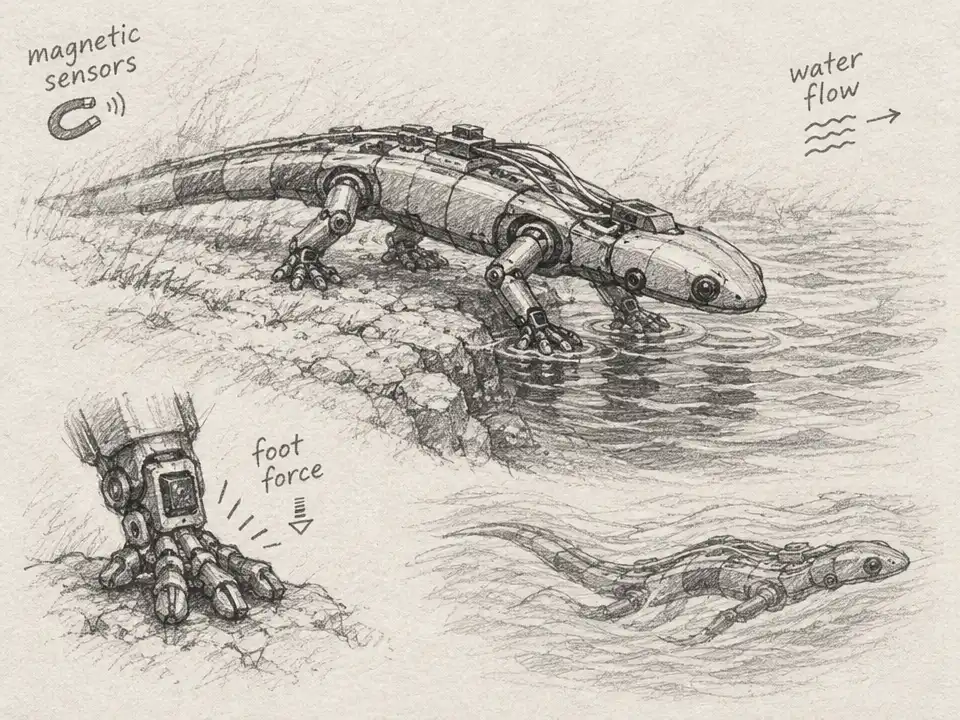
On the lab floor, a four-legged robot walks with its spine rippling behind it. Then it reaches the water. The floor stops pushing back against its feet; the body begins to float. For a robot built to travel across both worlds, that change is more than a splash. It is a question: can the machine sense that the ground has disappeared—and change how it moves?
A team of researchers built a way to ask that question with Polymander II, a salamander-inspired amphibious robot. The project brings two kinds of expertise together: animal locomotion research, which offers clues about how a body can switch between walking and swimming, and sensor engineering, which gives a machine a way to feel the forces around it. The result is not a robot that copies a salamander’s sense organs. It is a test of whether compact magnetic sensors can give an amphibious machine useful information in both environments.
The challenge is easy to underestimate. A robot on land can use its feet to feel contact with the ground. In water, the important cues are different: moving water pushes against the body, especially as it bends and swims. Many amphibious robots can move through both settings, but sensing their interactions with both is harder. Conventional force sensors can be bulky, and keeping sensors and wiring waterproof adds another layer of trouble.
Polymander II’s sensors use a small Hall-effect device, which measures changes in a magnetic field. The sensor sits near a magnet attached to a flexible part. When an outside force bends or shifts that part, the magnet moves, changing the field the sensor detects. The electronics can therefore read movement without needing to touch the moving piece directly—a useful separation when one side of the assembly must meet water and the other must stay protected.
Four custom sensors sit inside the robot’s feet. Each foot’s flexible silicone structure lets it move in three ways, allowing the sensor to estimate a vertical force and twisting forces as the foot presses or slides against a surface. Six more sensors sit beneath the robot’s spine. Each uses a small fin on a spring: water flowing past turns the fin, moves its magnet, and changes the magnetic signal. Together, the two sensor types give the robot a way to register both ground contact and water flow.
There is a second biological idea at work: a control pattern that can produce more than one gait. Researchers studying animal movement use central pattern generators—networks of coupled oscillators that can create rhythmic actions such as stepping or swimming. In Polymander II, a controller based on this approach coordinates the robot’s joints. Changing its drive signal shifts the pattern: at a lower setting, the legs and body work together for walking; at a higher one, the limbs drop out of the rhythm and a wave travels down the spine for swimming.
That controller provides a bridge between biology and the hardware experiment. The movement model supplies a way to make the robot walk and swim; the sensors let the team investigate whether feedback from the environment can help it switch modes. Before testing that feedback, the researchers checked the sensors while the robot replayed motions generated in simulation. On the floor, foot readings rose and fell in repeatable patterns with the steps. In the pool, signals from the flow sensors traveled along the body in step with the swimming wave.
The robot is about 1.11 meters long and weighs 2.71 kilograms. During walking tests, its sensors were read at about 590 times per second, while the 16 motors were read at about 100 times per second. The team also demonstrated a simple transition rule: begin in walking mode, then switch to swimming when the combined forward-direction forces measured at the four feet fall below 7 newtons. As the robot stepped into the pool and floated, that threshold triggered the change.
There is an important limit to what the demonstration shows. The robot did not independently navigate the pool: a person used a gamepad to steer it away from the walls. For the feedback test, the sensor stream was limited to 100 readings per second and the control loop ran at 50 times per second, slower than the sensors’ fastest measurements. The authors describe the work as a foundation for more capable feedback controllers, not as a finished system for autonomous rescue or exploration.
That distinction makes the experiment more interesting, not less. The sensors did not merely record motion after the fact; they supplied a practical cue for a change in locomotion. At the same time, the flow measurements suggest a future role beyond detecting the shoreline: water pushing on different parts of the body could help a controller adjust its swimming, rather than relying only on planned joint angles. The researchers say that kind of richer feedback still needs to be tested.
For now, Polymander II demonstrates a small but consequential crossover. Animal locomotion research helps pose the control problem—how to coordinate a body that must walk, swim, and move between them. Magnetic sensing and waterproof mechanical design offer a way to supply the robot with information about the forces that distinguish those worlds. A foot losing contact with the floor becomes a signal, not just a mechanical mishap. The next challenge is teaching the machine to make more of what it feels.