A scientific simulation can finish without crashing, produce convincing pictures, and still be wrong. That is what makes one recent AI-assisted computing experiment so intriguing: the clues were not a spectacular failure, but small differences between two versions of a program that were supposed to give exactly the same answers.
The program models mass flows—material moving downslope in events such as landslides. Researchers set out to make its aging, 12,693-line solver run faster by splitting work across processor cores. They imposed a demanding rule before changing the code: the parallel version had to reproduce the serial program’s exported results bit for bit. Any mismatch, even one that looked like ordinary computer-number noise, needed an explanation.
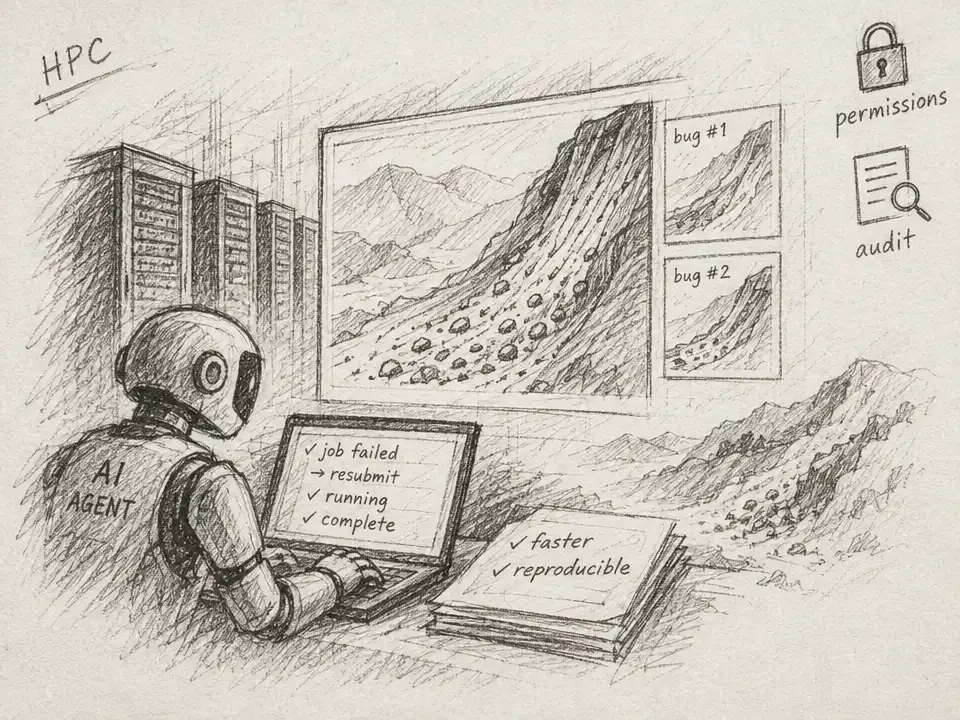
An AI agent helped carry out the work on shared research computers. It profiled the solver, examined how its loops handled data, and helped add parallel processing. In a reported production run, a simulation covering 360 simulated minutes on a 120-meter grid went from about twelve hours to about two. The faster version was not accepted merely because it finished sooner. Its outputs were checked against the serial version, giving the team a way to ask a more revealing question: if the answers differ, what changed?
At first, differences looked like the kind of numerical variation that can arise when computations happen in a new order. But the changes could not be explained by the parallel code. Following that mismatch led to two defects already present in the original solver. Neither had been introduced by the AI-assisted parallelization.
The first was a misplaced initialization in the code that tracks the start time of a flow. Instead of initializing values inside a loop, the program attempted a write just after the loop ended, at a position beyond the array’s boundary. The intended entries were left uninitialized. An address-sanitizing tool—a kind of software detector for memory errors—flagged the problem.
The second bug had a more visible effect on the simulated world. Two quantities used in a friction calculation were assigned only under a particular condition, but the program read them even when that condition was absent. Usually, a later calculation could make the stale values harmless. But if they happened to be infinite or “not a number,” the affected cell could be silently set to zero. In the production run, that erased cells along the advancing flow front. After two simulated minutes, the buggy version had 13 percent fewer wet cells; after thirty, some local flow heights differed by as much as 33 meters.
Those figures do not mean the agent discovered a universal weakness in scientific software, or that AI can now certify simulations. They describe one codebase and specific tested configurations. The researchers repaired both defects, then checked that the repaired serial and parallel versions produced identical exported outputs at matched compiler settings. That check concerns the values written out by the program; it does not establish that every internal value matched at every moment.
The work also illustrates a possible payoff beyond faster computing. In another case, the agent reconstructed parts of an incompletely described weather-forecast evaluation from released data and a published figure. The reproduced curves came within a mean absolute deviation of 2.1 percent for one measure and 2.4 percent for another. The exercise surfaced discrepancies in the paper’s prose and released data, though the authors cautioned that matching a figure cannot independently prove they reconstructed the original evaluation convention correctly.
These are promising demonstrations, not a reliability trial. The authors supervised the reported cases, and they did not retain the agent’s detailed session transcripts. That means readers cannot independently determine how much of each repair came from the agent, how often a person intervened, or how reliably the system would handle other failures. A broader, controlled test of the full recovery process remains outstanding.
There is also a practical price to putting an agent near valuable computing infrastructure: permissions matter. In this setup, the remote language model did not hold cluster credentials, but the local agent worked with the researcher’s ordinary account access. The policy-checking submission tool was optional, not a mandatory gate, and the reported scientific cases used ordinary scheduler commands instead. The authors emphasize that a request checker is not the same as a sandbox that limits what submitted code can do.
The next frontier is therefore not simply asking whether an AI can fix a failed job. It is building a system that knows when a run is genuinely correct, can show its work, respects resource limits, and hands control back when the repair might change the science. This experiment offers a vivid reason to pursue that goal: a strict reproducibility rule turned an optimization project into a software investigation. But before researchers can safely delegate more of that work, the evidence must grow from a handful of supervised cases into repeatable tests with clear audit trails and enforceable boundaries.