Under a carefully controlled light cycle, tiny tadpoles sat in dishes at the center of a magnetic-field apparatus. The researchers were not testing whether the animals could swim north. They were watching a smaller, slower change: the number of dark pigment cells around each eye. In a study posted to arXiv, the team found that weak magnetic fields could alter that count—and that the effect depended on both light and the eye.
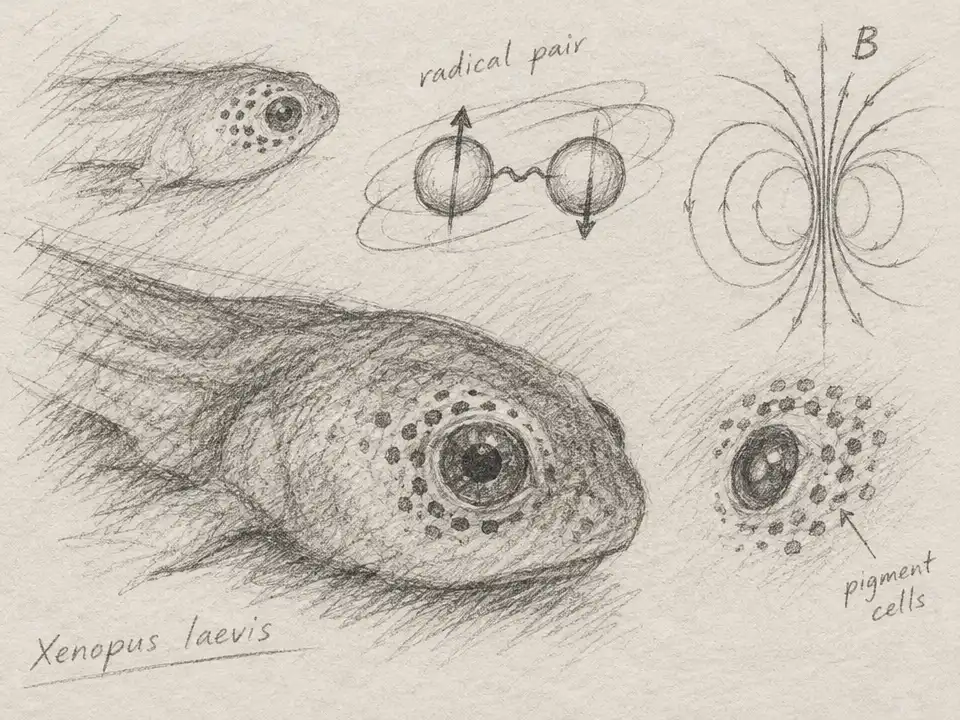
The animals were Xenopus laevis, African clawed frogs often used in developmental research. The cells, called melanophores, contain pigment and help give skin its color. In three independent experiments, exposure to a 0.5-millitesla field for two days increased the number of perioptic melanophores by 37 percent compared with controls. The researchers kept temperatures nearly identical, maintained a 12-hour light and 12-hour dark schedule, and counted the cells without knowing which tadpoles had been exposed.
This was not the quick rearrangement of pigment inside existing cells that makes some animals change shade against a light or dark background. It was a change in morphological pigmentation: the number of melanophores in a defined region. The distinction matters. A shift in cell number unfolds over development, offering a way to watch a subtle physical signal leave a longer-lasting mark on an animal’s biology.
Several tests narrowed the route by which the signal might travel. When researchers removed the eyes, the magnetic-field response disappeared. And in constant darkness, the tadpoles’ baseline pigmentation rose, but adding a magnetic field produced no further significant increase. The field’s effect appeared only while light-dependent regulation was active. The response also became measurable after the tadpoles’ retinas began functioning, consistent with the eye acting as part of a sensory pathway.
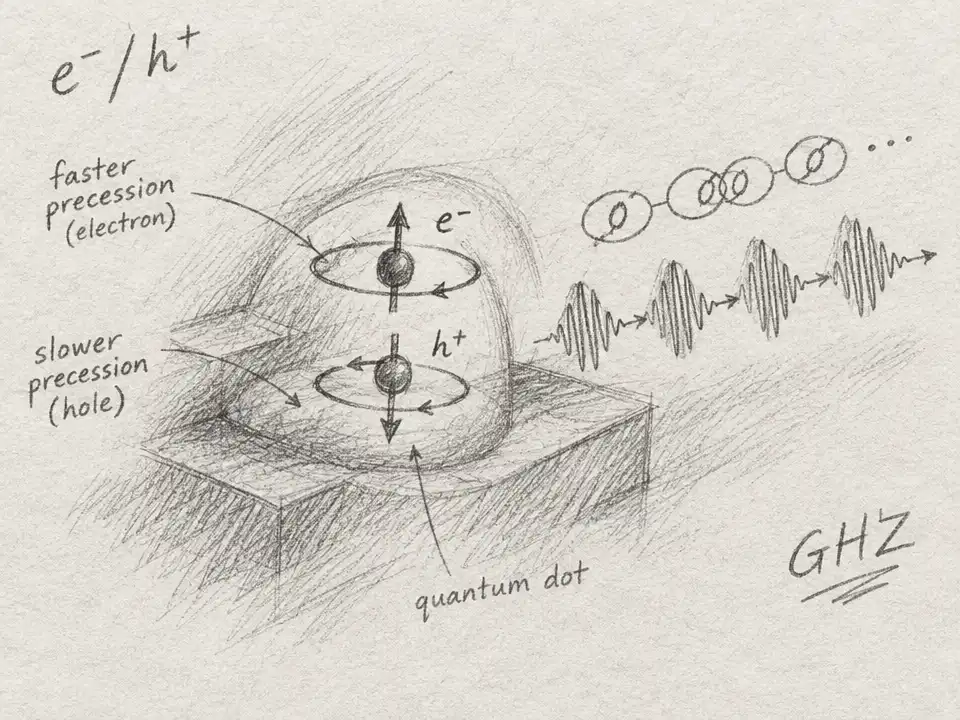
Here the story crosses from developmental biology into quantum physics. One proposed way for living tissue to sense a magnetic field begins with a pair of reactive molecules, each carrying an unpaired electron. Their electron spins can start in a singlet arrangement, then shift toward a triplet arrangement as the electrons interact with nearby nuclear spins and an external magnetic field. Because the two arrangements can lead to different chemical outcomes, a tiny change in spin dynamics could alter the balance of reaction products.
The idea is striking because the magnetic interaction is extremely small beside the thermal jostling inside a warm organism. In the radical-pair picture, the field does not supply energy to build a new cell. Instead, it may subtly tune the odds of competing chemical reactions. A biological pathway would then have to carry that small molecular difference forward, until it affects a visible outcome such as melanophore development.
The researchers tested whether this quantum mechanism could reproduce the tadpoles’ measured response. They modeled one candidate pair associated with cryptochrome, a light-sensitive protein studied in connection with birds’ magnetic sense. They also modeled a generic radical pair that was not assigned to a particular molecule. Both could match the pattern across the four magnetic-field strengths tested. The pigmentation response rose sharply between 0.125 and 0.25 millitesla, then leveled near 40 percent through 1 millitesla.
That agreement is evidence of compatibility, not identification. The experiment measured only four field strengths, and both models fit. The data therefore cannot establish that cryptochrome is the sensor, or even identify which radical pair might be involved. The cryptochrome-based model required a biological amplification factor of about 15 to match the observed change. The generic model fit about as well with a factor near 1.6. How a molecular spin signal would connect to the eventual change in cell number remains an open question.
The field threshold is another important boundary. The lowest strength that reliably produced a measurable effect in the main analysis was 0.25 millitesla—several times the local geomagnetic field reported for Calgary, about 0.055 millitesla. At 0.125 millitesla and 0.06 millitesla, the researchers did not find a significant difference from controls at the tested time point. And because they held the field direction fixed, the experiment says nothing about whether tadpoles can sense direction or use Earth’s field to navigate.
The models do suggest ways to push the test further. They predict that at higher magnetic fields the response should eventually turn over and reverse, though the precise point depends on the model parameters. The researchers also identify experiments that could distinguish a cryptochrome-based pathway from other possibilities, including testing the effect of different colors of light, disrupting the candidate protein, or applying a weak radiofrequency field. Measuring how the response changes when the field’s direction is varied would address a separate question the current study leaves open.
The crossover is useful in both directions. Quantum spin chemistry offers biologists a specific mechanism to test, rather than a vague appeal to quantum effects. Meanwhile, a visible, measurable change in a living vertebrate gives physicists a route to probe whether molecular spin dynamics can shape whole-animal physiology. The tadpole’s skin is not proof that a quantum compass is at work. It is a readable clue—and a promising way to make the next experiment more decisive.