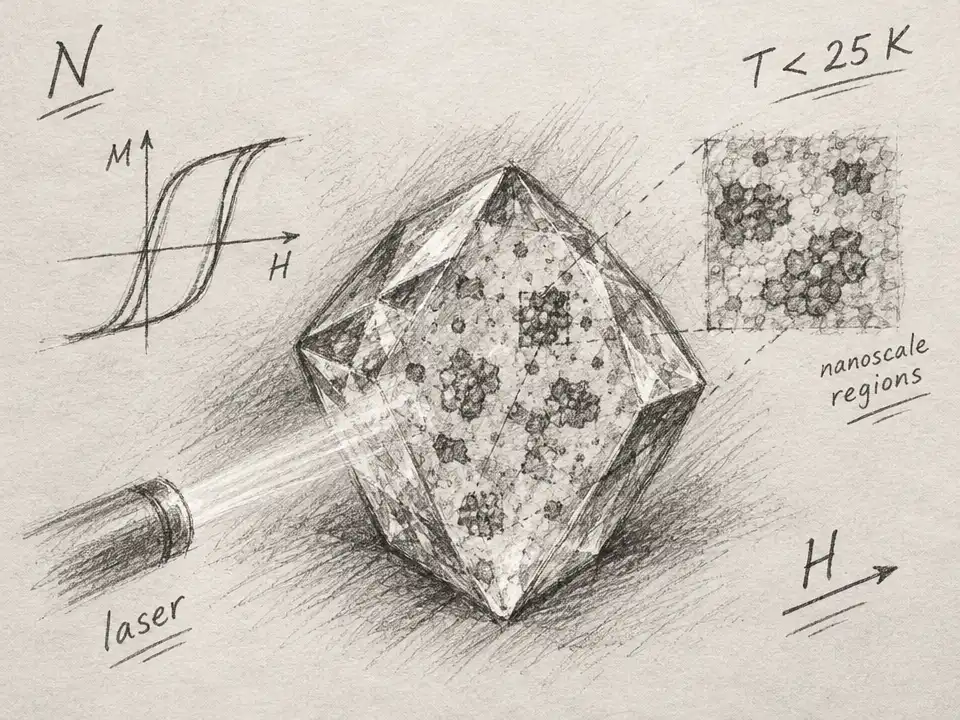
A diamond can look like one flawless piece of crystal. But chill one nitrogen-doped specimen below about 25 K, place it in a magnetic field, and its response begins to look less like a uniform material than a landscape of different neighborhoods. The researchers report magnetic signals consistent with tiny superconducting regions sharing the crystal with regions that act like superparamagnets—small magnetic clusters whose moments respond to an applied field. The intriguing part is that a faint beam of light can largely erase one of those signals while leaving the other behind.
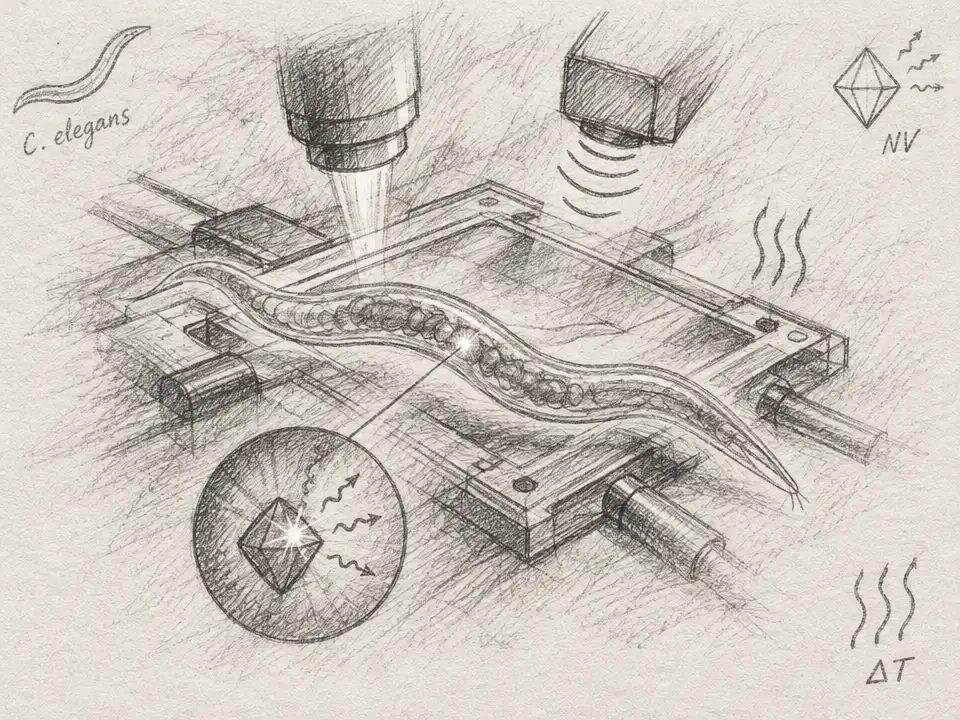
This is not a direct photograph of superconductivity inside a diamond. The experiment measures the magnetic moment of the whole sample, so the microscopic picture has to be pieced together from how that total response changes. The team studied a synthetic, nitrogen-doped type Ib diamond, cooling it in a magnetic-field instrument and tracking its magnetization. They also shone monochromatic light at three wavelengths: 403, 633, and 840 nm. In the dark, below about 25 K, the field-dependent magnetic curves formed unusual loops that did not resemble a simple, ordinary ferromagnet or a straightforward superconductor.
Think of the measured curve as a chorus: several physical processes contribute to the same magnetic reading. The authors fit it as a combination of the diamond’s ordinary diamagnetism, a superparamagnetic response, and a superconducting contribution. That last ingredient is inferred, not isolated in a direct image. But the fit gives researchers a way to ask a revealing question: if light changes the chorus, which part is singing differently?
The answer is striking. Under illumination, the unusual magnetic hysteresis—the difference between a material’s response as the magnetic field rises and falls—nearly disappears. The effect was similar across the three tested wavelengths. Meanwhile, the contribution attributed to superparamagnetism remained largely intact or increased slightly. The difference between measurements taken after cooling with and without a magnetic field also almost vanished under illumination. In another test, the team watched the magnetic signal for about 58 minutes while holding the sample at 0.5 T; the slow, flux-creep-like change seen in darkness was strongly altered by light.
Heating would be an obvious explanation: shine light on a cold object and it warms up. But the researchers estimate that the illumination, with an intensity of 160 µW/cm², could raise the sample’s temperature by less than 0.01 K below 25 K. The diamond was thermally anchored in liquid helium, and the light-induced changes ran opposite to what simple warming would predict. The magnetic behavior in darkness returned after the sample was warmed above roughly 50 K and cooled again. The authors therefore interpret the light as changing the electronic and magnetic processes in the sample, rather than simply warming the whole crystal.
To probe the superconducting interpretation further, the team measured a second, similar diamond sample in fields up to ±14 T. After accounting for the other magnetic contributions, they identified two characteristic fields: a penetration field of about 2.6 T and an upper critical field of about 10.6 T at 1.8 K. The first is associated with magnetic flux fully penetrating the links between proposed superconducting grains; the second marks the field at which superconductivity within a grain is suppressed. A temperature-dependent fit gave a critical temperature of 26 ± 2 K. These values are evidence for the proposed picture, not a direct view of superconducting grains—and the high-field measurements used a different sample from the one tested under illumination.
Where might such grains come from? The diamond’s nitrogen is not necessarily spread evenly. Raman measurements, which reveal clues from the crystal’s vibrations, suggested nitrogen content averaging 415 ppm and internal pressure averaging 0.314 GPa. Birefringence images—patterns produced when light passes through stressed regions—also showed that the crystal contains internal strain. Those methods support the idea that nitrogen concentration and stress vary within the sample, but they do not map each magnetic region or prove that a particular patch is superconducting.
The researchers propose that growth left behind small, nitrogen-rich, stressed regions in the diamond. In their model, a superconducting core and a superparamagnetic outer region could coexist within some of these patches. They estimate a grain diameter of approximately 198 nm, but this is a model-based estimate that relies on a critical-current value reported for similar samples; the grains were not directly measured at that size. The proposed arrangement is a way to make sense of the data, not a settled microscopic explanation. The origin of the superparamagnetic response, in particular, remains unclear.
That caution matters because the claim is surprising: the paper argues that superconducting behavior may appear in selected regions of a low-nitrogen diamond, even though the crystal as a whole is not uniformly doped into a superconductor. Further experiments will need to test the interpretation and connect the magnetic signals to the locations and composition of individual regions. For now, the shift in perspective is the discovery’s appeal. A transparent crystal can conceal a patchwork too small to see, where temperature, stress, and a little light may determine which magnetic state comes to the fore.