Mix two fluids that do not fully blend, and the boundary between them usually has a simple job: shrink. Surface tension pulls interfaces taut, encouraging scattered patches to merge into larger domains and smoothing away unnecessary edges. In a computer simulation, researchers added a new kind of capillary force—and watched that familiar cleanup stall. The fluid kept moving, droplets kept breaking apart, and the pattern stopped growing coarser.
The proposed ingredient is called odd capillarity. “Odd” here does not mean merely unusual. It describes a response that changes direction when the system is reflected in a mirror, a signature of broken spatial symmetry. Nadia Bihari Padhan and Axel Voigt built this response into equations describing a two-dimensional mixture of fluids. Their study is a numerical investigation, not a report of a laboratory discovery.
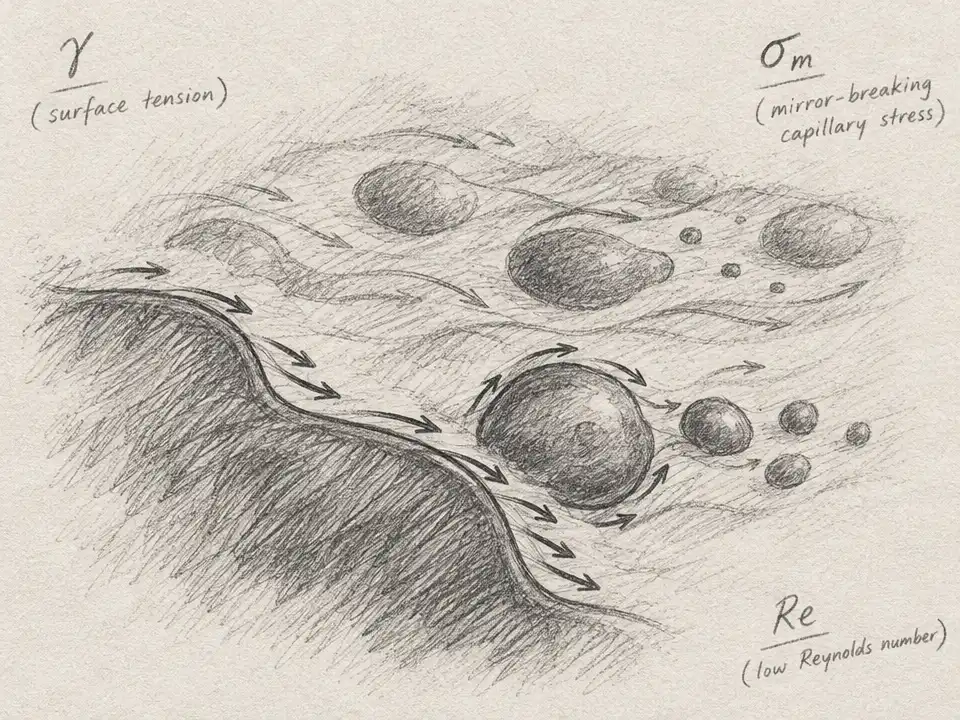
Ordinary capillary forces pull perpendicular to an interface, like a stretched elastic skin trying to shorten its edge. The added force points sideways, along the boundary. On a flat interface, it pushes one way on one side and the opposite way on the other. The pair does not shove the whole fluid in one direction; instead, it creates a shear, a sliding motion between neighboring layers.
That sideways action changes the energy story, too. In an ordinary passive mixture, capillary forces trade energy with the fluid’s motion: as the boundary smooths and the mixture settles, the system loses free energy. The proposed odd stress can do mechanical work that is not paid back by a corresponding change in the mixture’s free energy. In the model, it acts as an independent source of energy for motion. Its microscopic origin, if it occurs in real materials, remains to be established.
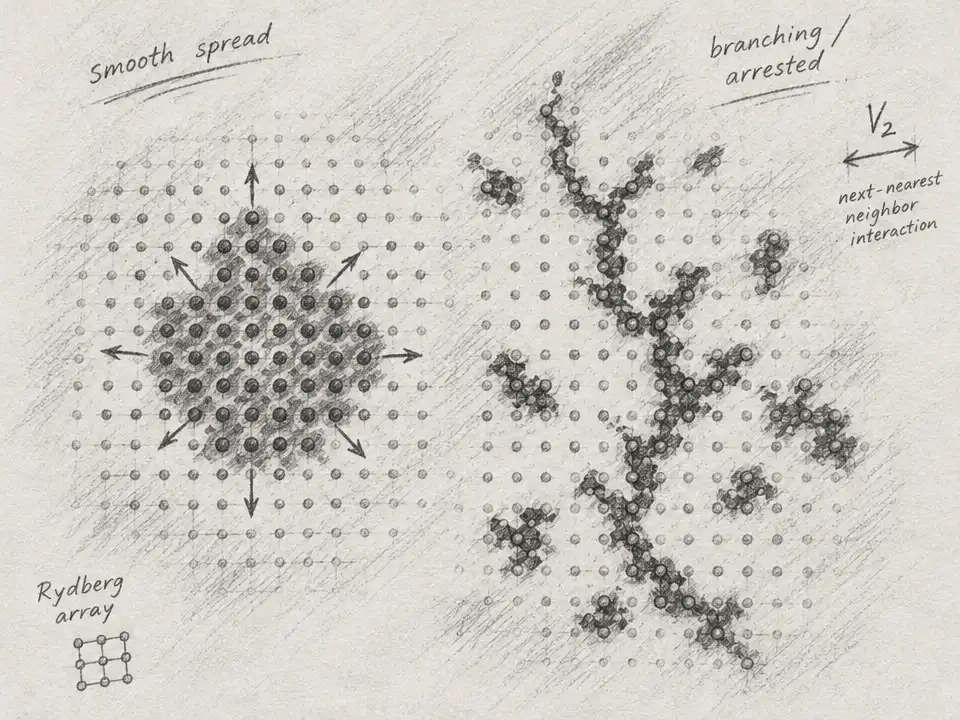
The researchers began their simulations with a nearly uniform mixture, then let it separate into two phases. Without odd capillarity, the familiar process played out: domains grew, with their characteristic size increasing approximately linearly over the observed period. Turning up the new sideways response slowed that growth. At a dimensionless chirality setting of 2, the characteristic domain size stopped increasing systematically; at settings of 4 and 10, the arrested domains were smaller still.
“Arrested” does not mean frozen. Interfaces continued to bend and rearrange. Narrow necks thinned, connections broke, and domains reconnected. In a mixture rich in droplets, some small droplets still disappeared while larger ones grew through a process called Ostwald ripening. But the larger droplets could deform and split, while the sideways interfacial flows hindered neighboring droplets from merging. Growth and breakup pulled against each other, keeping the pattern in motion without letting droplets simply swell unchecked.
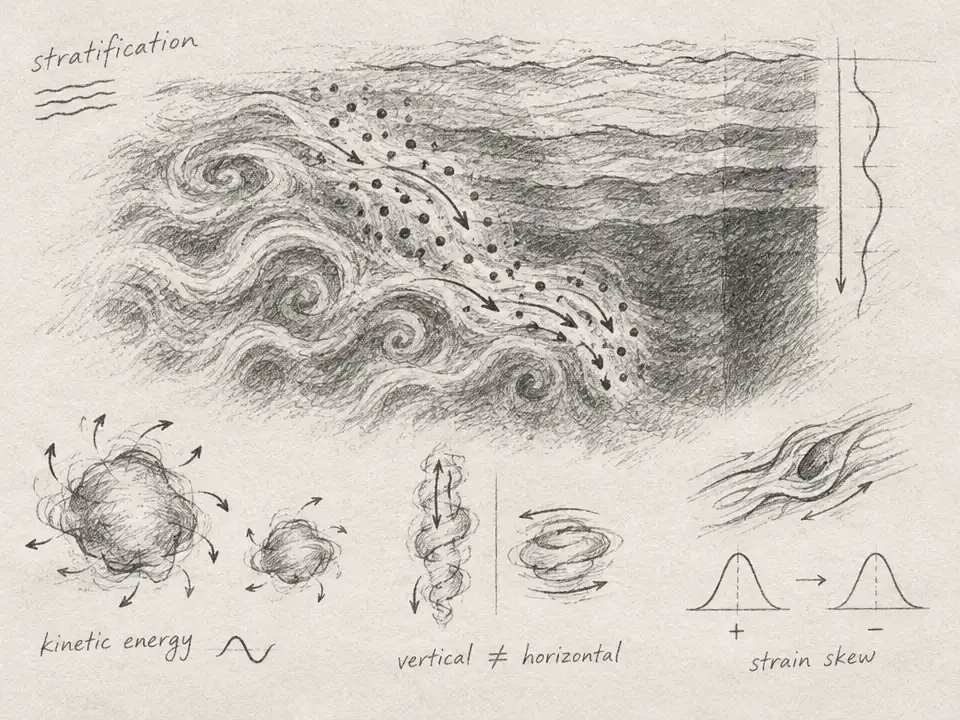
Here is the result that most sharply overturns expectations: the simulations produced persistent, complex flow even at low Reynolds numbers—0.20, 0.23, and 0.28 in the tested arrested states. Reynolds number measures the influence of inertia relative to viscosity. At such low values, inertia is weak. And the energy did not behave as it does in the familiar picture of turbulence, where motion transfers energy from large swirls down to smaller ones before viscosity dissipates it.
Instead, the simulations showed odd capillarity feeding energy into the flow at interfaces, with viscosity dissipating most of it at roughly the same scales. The researchers describe this as odd-capillary-driven turbulence, but it is not turbulence powered by a conventional inertial cascade. The flow’s energy budget showed that the nonlinear transfer between scales was negligible. Most of the energy supplied by the new stress went straight to viscous dissipation; only a small fraction—about 1 percent—went into rebuilding interfacial free energy lost through diffusion.
The droplet-rich simulations showed another surprise: large-scale fluctuations became unusually muted. The researchers call this hyperuniformity. In plain language, a random arrangement can have big empty patches and crowded clumps; a hyperuniform pattern suppresses those broad, long-wavelength variations. In the model, the droplet-rich composition developed this kind of large-scale order, alongside suppressed large-scale fluctuations in the flow’s rotation.
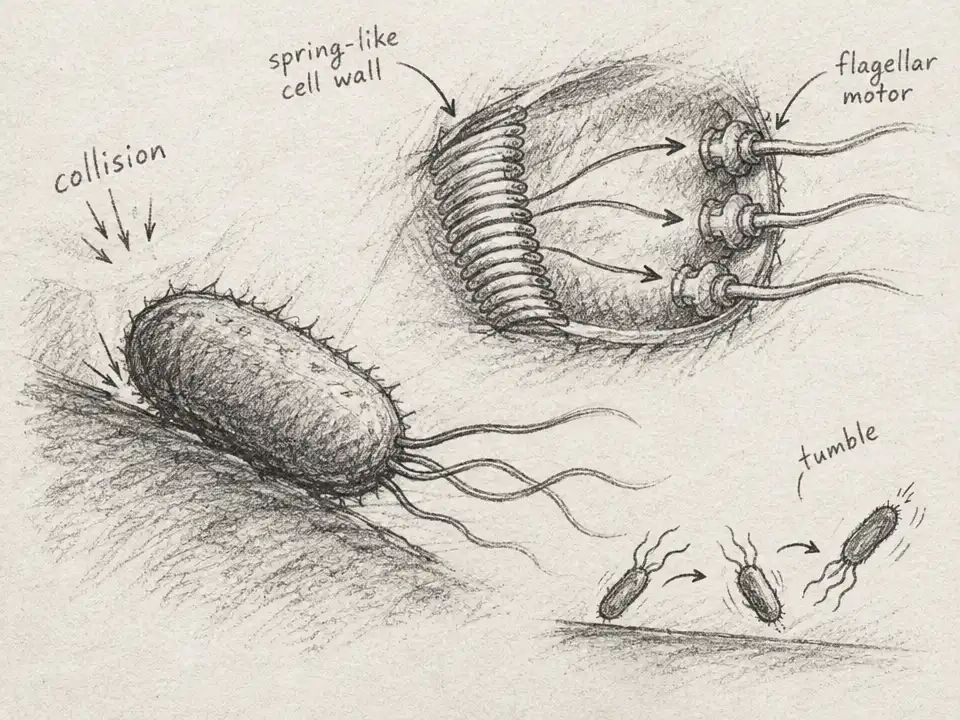
There are important limits to the result. The calculations treated an incompressible, two-dimensional fluid with matched densities and viscosities, in a periodic box represented by a 1024-by-1024 grid. The odd capillary stress was introduced as a proposed ingredient, not derived from a detailed model of molecules or particles. The authors point to chiral colloids and bacteria interacting with fluid interfaces as possible routes worth investigating, while emphasizing that whether such microscopic ingredients produce the proposed stress is still an open question.
So this is not yet a new recipe for keeping real droplets small. It is a demonstration that the boundary between two fluids might do more than resist stretching: if its mechanical response has a sideways, mirror-breaking component, the interface could help drive the very flow that keeps it unsettled. A force meant to be transverse to ordinary capillary action turns the fluid’s edge into a possible engine—and leaves experimenters with the next question: can nature build one?