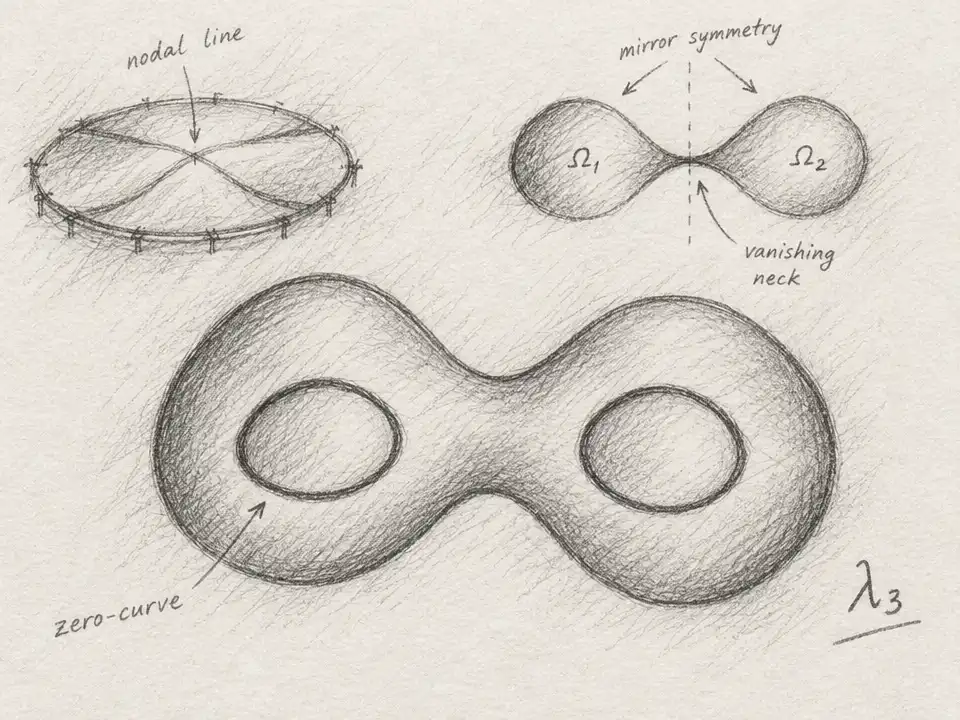
Imagine striking a drum and watching its skin vibrate. Some places move up and down; others remain still. The still places trace the mode’s nodal lines. Must those lines reach the drum’s rim? For the third vibration mode, mathematicians had a precise reason to suspect they must—at least if that mode is simple, meaning it is not tied with another. Zikang Deng’s new construction answers with a counterexample: a smooth, connected shape whose third mode has exactly two closed nodal loops, both entirely inside.
The question is subtler than it first sounds. A drumhead fixed at its boundary has no motion along its rim, but that does not require every interior still line to connect to the rim. A closed nodal line can instead surround a pocket where the membrane moves one way, while the surrounding region moves the other. Such patterns are called nodal domains: connected regions separated by places where the vibration is zero.
There was already a clue from the second mode. A conjecture by Payne, dating to 1967, said that its nodal line must meet the boundary. Researchers later found exceptions on carefully shaped, multiply connected domains. One such shape, established with computer-assisted estimates, has a second-mode eigenfunction that is positive at a point but negative along a closed curve around it. That sign pattern traps a positive region inside a negative ring—a useful starting piece for a more ambitious puzzle.
In 2003, Levitin and Yagudin proposed a related claim about the third mode: if its eigenvalue is simple, its nodal lines cannot all be closed. Could two copies of the second-mode trick defeat that claim? Simply placing two copies side by side would not do. The result would be disconnected, and identical copies could produce tied vibration frequencies. The challenge is to connect them without losing control of which mode comes third—or letting its nodal lines wander out toward the boundary.
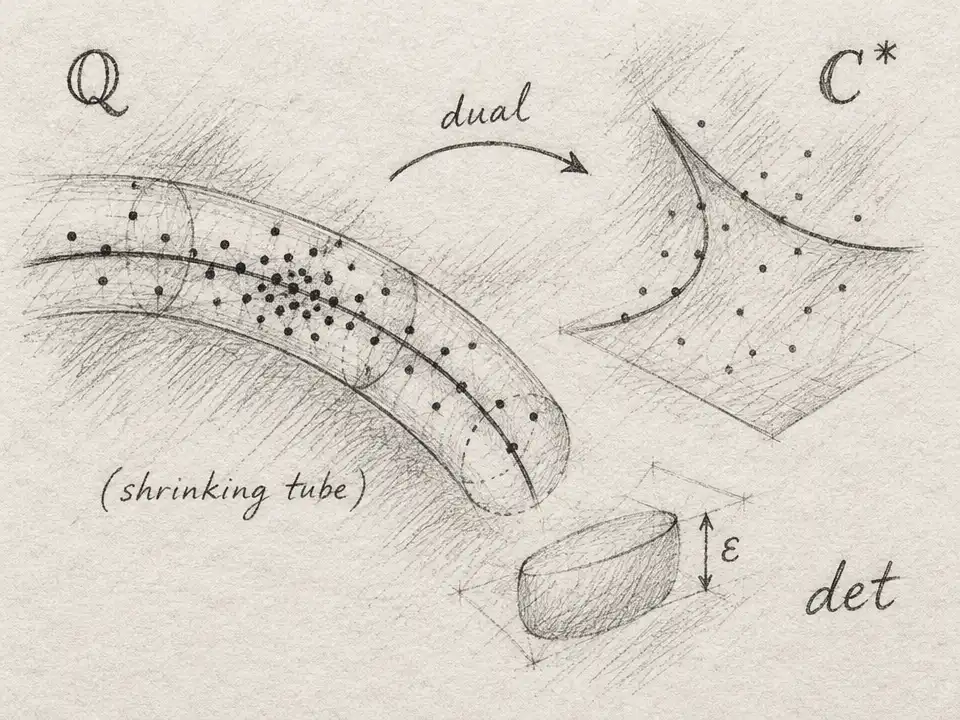
Deng’s strategy is to join mirror-image copies with a long, extremely narrow neck. Picture two rooms linked by a corridor that is almost, but not quite, pinched shut. Reflection symmetry lets the researchers divide the vibrations into two families. In one, the motion matches across the center of the neck; in the other, it reverses. On one half of the shape, these become different boundary rules at the centerline: a Neumann condition for the matching family and a Dirichlet condition for the reversing one. In plain language, one family can have a nonzero value at that cut, while the other must be zero there.
But symmetry alone does not settle the puzzle. Connecting two shapes, even with a narrow passage, can reorder their vibration frequencies. The key clue is what happens as the neck narrows: for each fixed position in the spectrum, both families’ eigenvalues approach those of a single copy of the original shape. The paper proves this using a Poincaré inequality, which controls how much a low-energy vibration can live inside the narrow corridor. As the passage shrinks, it cannot hold much of the mode’s energy or mass, so the two halves behave increasingly like separate copies.
Convergence gets the researchers close, but it leaves an ambiguity: paired frequencies from the two families approach the same value. Which one comes first? Deng proves that, at each matching index, the Neumann-family eigenvalue is strictly lower than the Dirichlet-family one. The reason is a uniqueness trap. If a vibration had the same frequency under both rules, then at the cut it would have both zero displacement and zero normal slope. Those two conditions would force it to vanish everywhere, impossible for a genuine mode.
Now the ranking falls into place. When the neck is sufficiently narrow, the first three modes of the connected shape are: the first matching mode, the first reversing mode, and then the second matching mode. The last of these is the one Deng needs. It sits at the third spectral position, with a gap separating it from neighboring modes, so it is simple. Crucially, its vibration on either half closely resembles the second mode of the original shape.
That resemblance preserves the telltale signs. In each copy, the mode stays positive at a point inside the old loop and negative all along the loop. The negative ring walls off a positive island on each side. The rings also guarantee that there is negative motion somewhere, so the pattern already has at least three nodal domains: two positive pockets and a negative region.
Here another clue becomes a hard limit. Courant’s nodal-domain theorem says that a mode at the third spectral position can have no more than three nodal domains. The two positive pockets and the negative region have used up the entire allowance. If a zero line escaped those pockets, it would have positive motion nearby—interior zeros of these eigenfunctions must change sign—and that would create another positive domain. There is no room for one. So every nodal line is trapped inside one of the two pockets.
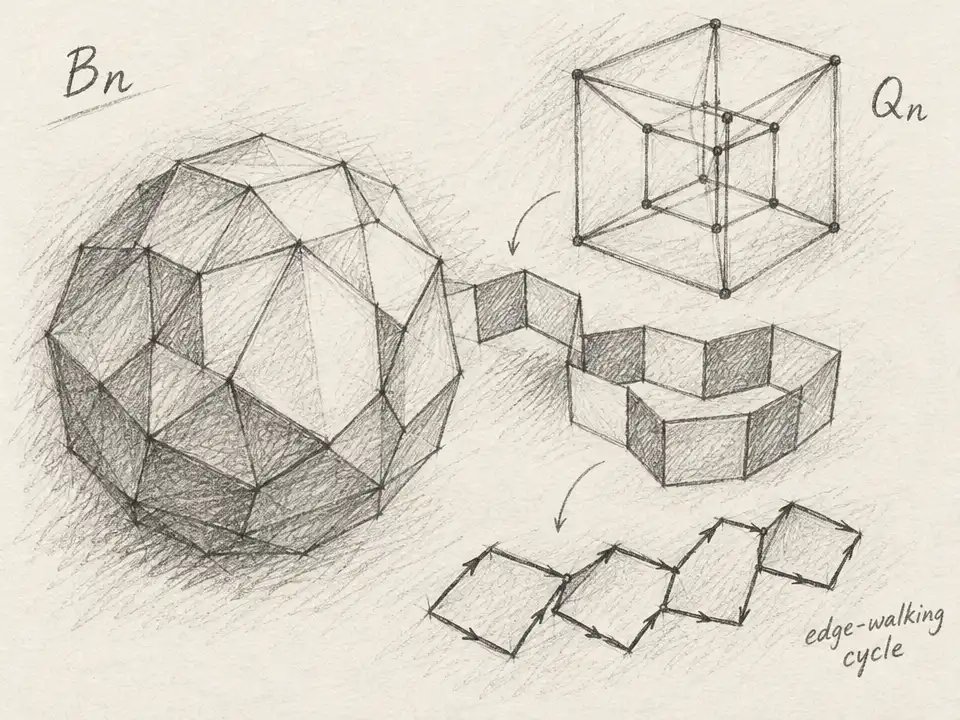
The authors then ask a final, finer question: are those trapped zero sets really two clean loops, or could they branch or form a more complicated tangle? In two dimensions, the zero set can be treated as a planar graph. A count using Euler’s formula shows that, with exactly three regions and two separated pockets, the graph must have precisely two components and no branching points. Each component is therefore a simple closed curve.
One last obstacle is cosmetic but mathematically important: the initial construction has polygonal boundaries, while the result calls for a smooth shape. Deng trims away progressively thinner layers near the edges and corners. The spectral gap and the sign pattern persist through this smoothing, so the final domain has a smooth boundary and retains the same two interior loops. The counterexample does not say that every drum can hide such a pattern. It shows something more precise: even at the third mode, boundary contact is not guaranteed. A narrow connection can make two separate local patterns belong to one connected shape—and the careful ordering of its vibrations decides what the still lines can do.