Imagine trying to identify a key by looking only at its outline. You might notice its curves and notches, but miss whether it is thick, hollow, or shaped to fit a lock from the inside. Protein models face a version of that problem: many learn from a molecule’s exposed surface, even though binding depends on the three-dimensional material beneath it, too.
A new approach brings a tool from geometric modeling into protein science. Instead of describing only the outside of a protein, the researchers build a mathematical map of the volumes associated with its amino-acid residues. Their method, called Protein-TetSphere, gives a learning system a way to compare those irregular interior shapes on shared terms.
The challenge is that proteins are not tidy solids. Each residue occupies a different nook in a folded chain; some are exposed, some buried, and their surrounding volumes vary in size and shape. You cannot simply stack the same box around every residue and expect the boxes to describe the molecule faithfully. Nor is it easy for a computer to compare two wildly different mesh shapes if every one has its own layout.
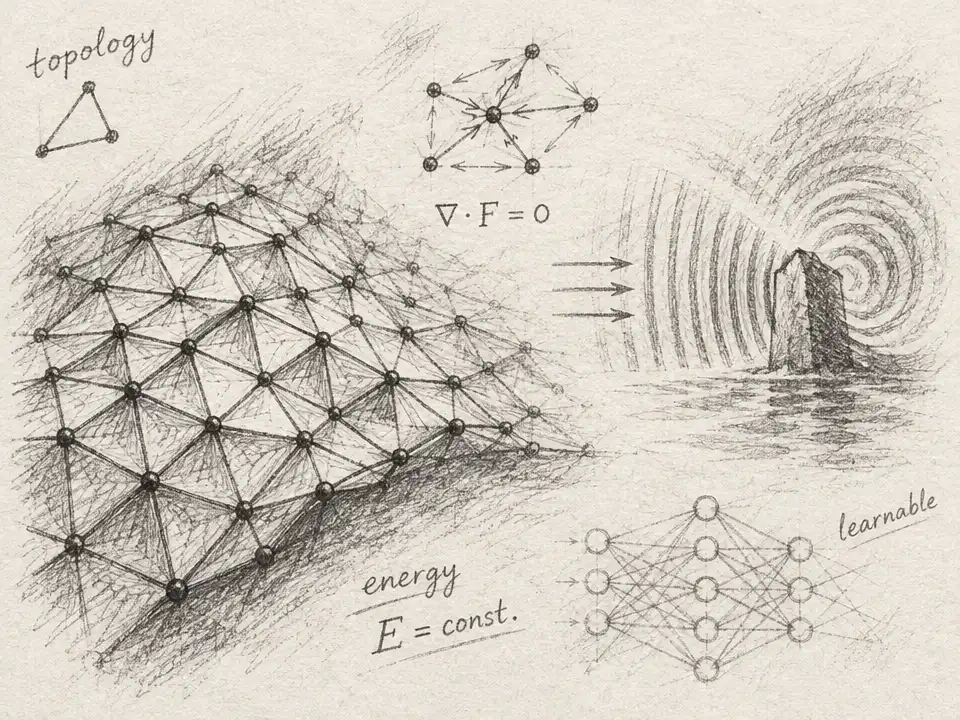
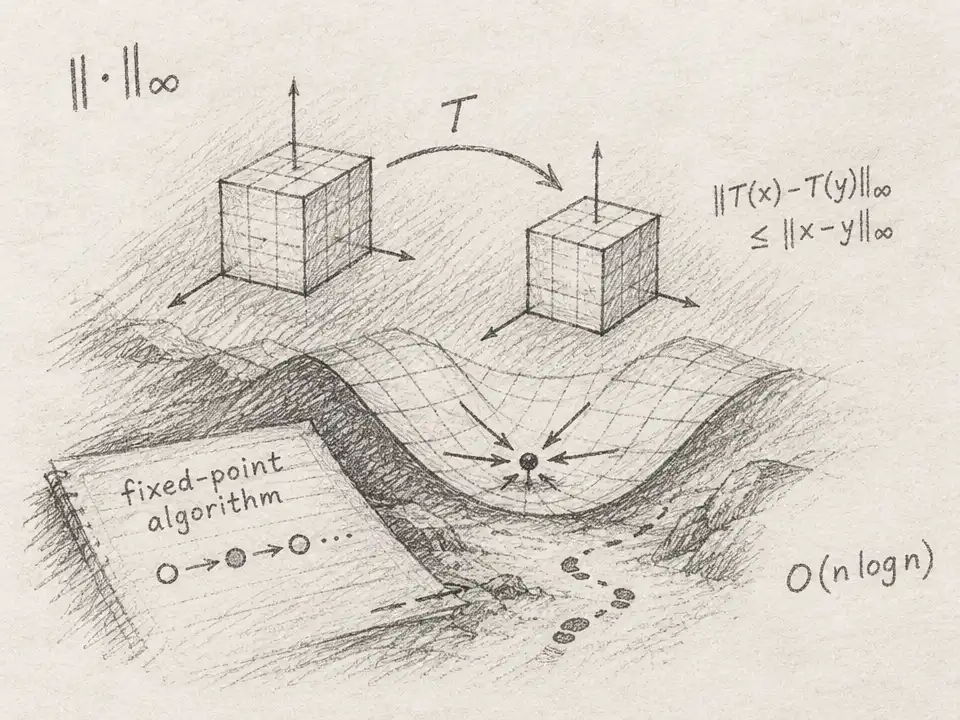
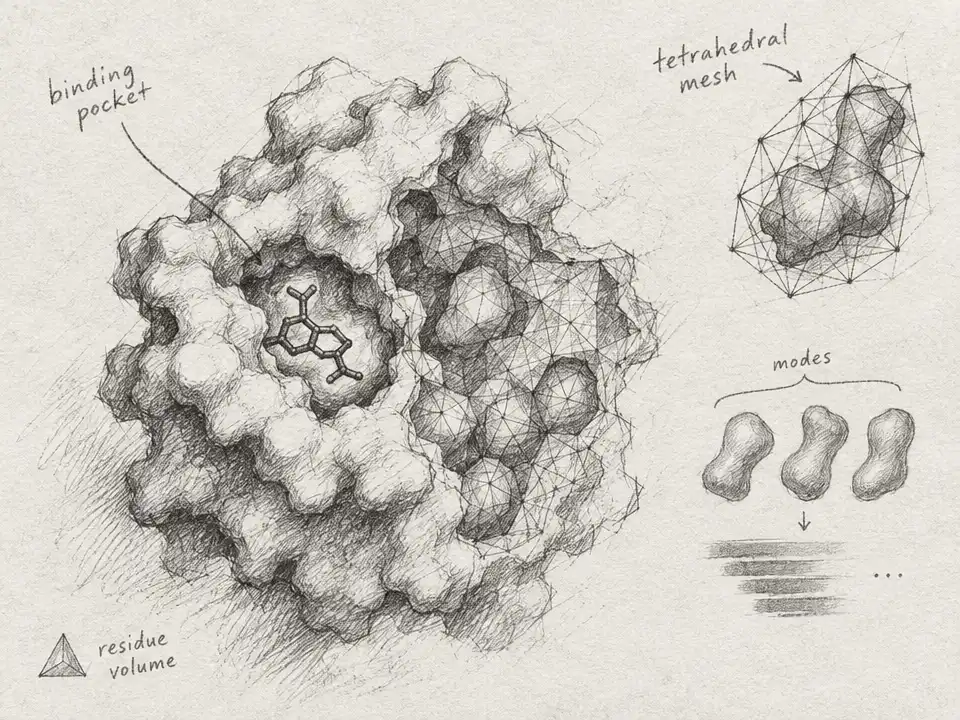
The researchers tackle this as a problem of registration: fit many local shapes into a common geometric framework, so that a feature in one can be compared with a corresponding feature in another. First, they fill a protein’s overall shape with tetrahedra—small four-sided three-dimensional cells. They then carve out residue-associated regions from that mesh. Each region is fitted to a copy of the same tetrahedral template, whose connectivity stays fixed even as its vertices move to match the local shape.
Think of it as giving every residue a copy of the same flexible wire sculpture. One copy bends to fit a crowded, buried region; another stretches around a more open one. Because the underlying connections are shared, the computer can describe their differences using the same set of shape patterns. The method’s reference template has 532 vertices and 1,727 tetrahedra. That common structure is not a claim that residues are alike; it is what makes their differences consistently measurable.
To compress each fitted shape, the team borrows another mathematical idea: the graph Laplacian. In simple terms, it identifies patterns of variation across a connected network, much as a musical instrument’s possible vibrations can be described as modes. Here, the network is built from the template’s tetrahedral connections. The model records how each residue’s fitted volume departs from the template as a combination of shared modes, rather than storing every tiny bend separately.
Just 64 of these nonconstant modes reconstruct the fitted volumes to within about two percent of a residue’s longest extent. That compact description becomes one ingredient in a broader representation that also includes surface and chemical information. During training, the system sometimes has parts of those inputs hidden and must reconstruct them from what remains. This encourages it to connect internal volume with the other clues in a protein’s structure.
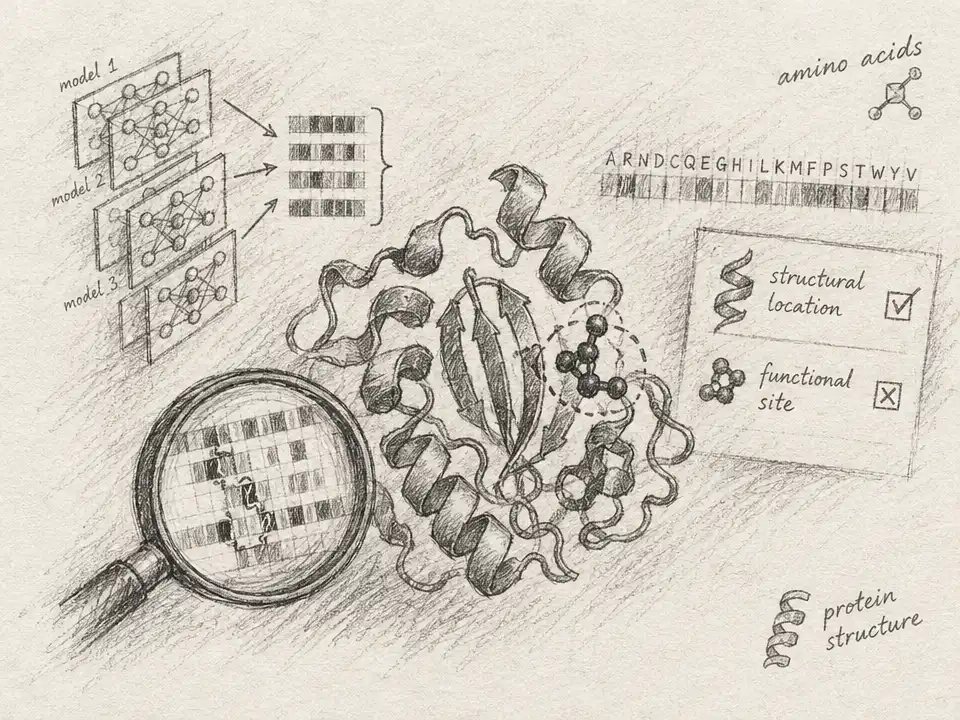
Why might the hidden volume matter? Consider a binding pocket: a small molecule must fit into a cavity, not merely touch its rim. In one example from the study, the model examined a pocket that binds FAD and compared its geometry with other candidate molecules. FAD fit the residue-associated volumes; ADP left parts of the pocket underfilled, while HEM intersected the fitted shells. The internal map made those distinctions available to the model alongside the surface view.
On a benchmark that asks which of seven cofactors occupies a pocket, the researchers’ full model reached a balanced accuracy of 0.826, compared with 0.795 for the surface-and-graph baseline. A control that kept the new model pathway but removed its residue-volume input reached 0.807, suggesting that the geometric information—not just a larger network—contributed to the improvement.
The same idea helped with protein-protein interfaces, where the task is to identify residues that touch across two molecules. On the study’s benchmark, the area-under-the-curve score for predicting residue-pair contacts rose from 0.914 to 0.932; for identifying interface residues, it rose from 0.852 to 0.866. These are computer-evaluation scores, not a demonstration that the method has found new biological interactions in the lab.
The most striking crossover comes in protein design. A generator cannot be handed the finished binder’s interior geometry before it has created that binder. So the researchers use the geometric model as a teacher during training: the generator learns to align its internal representations with the teacher’s, but does not need that teacher as an input when generating new candidates.
On the BoltzGen Challenge Set, the share of designed candidates passing the study’s computational filters increased from 14.95 percent to 19.90 percent. On ProtDBench, backbone-level success rose from 27.62 percent to 32.19 percent. That backbone-level measure counts a design as successful if at least one of eight sequences made for it passes the criteria. At the sequence level, the result was more modest: 14.67 percent, compared with 13.99 percent for the baseline and 14.80 percent for a continued-training control.
Those distinctions matter. The results suggest that a richer account of shape can help computational systems recognize pockets, predict contacts, and guide the search for candidate binders. They do not establish that the designed proteins work in experiments, and the study uses static structures rather than tracking how proteins flex over time. The authors identify dynamic and multiscale representations as directions for future work.
The deeper lesson is about what a mathematical representation lets a model notice. A protein’s surface is a useful map, but it leaves much of the terrain unmarked. By importing a shared geometric language—tetrahedral meshes and their modes of deformation—Protein-TetSphere makes the buried landscape easier to compare. Sometimes a new way into a problem begins not with a new molecule, but with a better map of the one already there.