Imagine watching two neighboring blood vessels slowly change diameter. One widens; the other narrows. Is that just local adjustment to the flow, or are the vessels responding to one another? The distinction matters: blood moves through a connected network, but each vessel remodels in response to conditions at its own walls.
A new mathematical study brings two fields together to investigate that puzzle: network biology, which asks how vessel structure adapts, and nonequilibrium thermodynamics, which describes systems that keep changing while energy flows through them. The result is not a new experiment on living blood vessels. It is a framework that turns existing ideas about vessel remodeling into sharper predictions that future measurements could test.
The starting point is a trade-off. Wider vessels generally let blood flow more easily, reducing the energy lost to friction. But building and maintaining vessel tissue costs the body resources. A network must therefore transport blood while staying within a maintenance budget.
Vessels can sense wall shear stress: the frictional force exerted by flowing blood along the vessel wall. Earlier mathematical work showed that, for a particular family of maintenance costs, there is a shear “set-point” that can guide local changes in vessel radius toward a network-wide transport optimum. The rule is strikingly local: each vessel adjusts according to its own shear, yet the resulting network can reduce overall dissipation. The new paper’s contribution is to explain that rule using the mathematics of irreversible thermodynamics—and to ask what else the explanation predicts.
One key idea comes from separating the system into two clocks. Blood flow responds quickly to a fixed vessel network; structural remodeling is far slower. In the model, flow settles in seconds, while changes to vessel structure take hours or days. That gap lets the researchers treat the flow as having already settled while the vessels themselves continue to adapt.
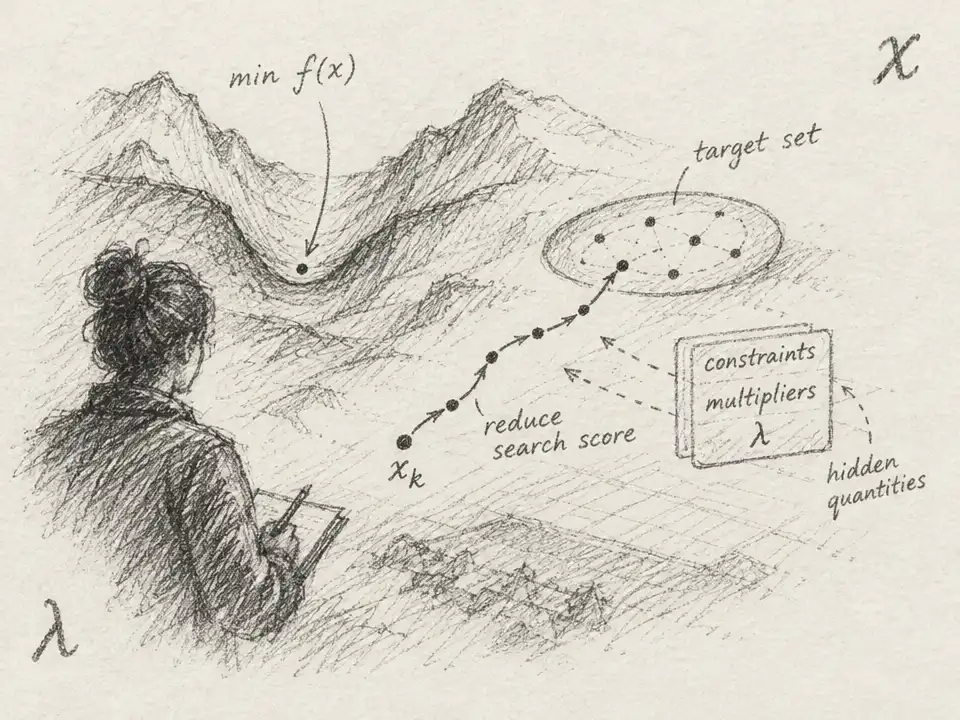
For the fast part, the mathematics has a familiar physical form: pressure differences drive flow, and the network settles into the flow pattern that minimizes energy dissipation for its fixed geometry. For the slow part, the authors show that vessel remodeling can be written as a kind of downhill motion. A mathematical quantity combining transport dissipation and maintenance cost acts like a landscape; as the modeled vessels remodel, they move toward lower values of that quantity.
This thermodynamic view does more than give the adaptation rule a new description. It identifies a “mobility”—a measure of how readily a vessel’s radius responds to the force pushing it to change. The model predicts that mobility should decrease as a vessel’s local maintenance cost increases: costly-to-maintain vessels should be structurally stiffer. In simulations, the predicted inverse relationship appears. But that is a consistency check, not an independent biological confirmation: the same adaptation rule determines the mobility in the model. The authors’ proposed test is to compare vessel-radius fluctuations with maintenance costs in real vascular tissue.
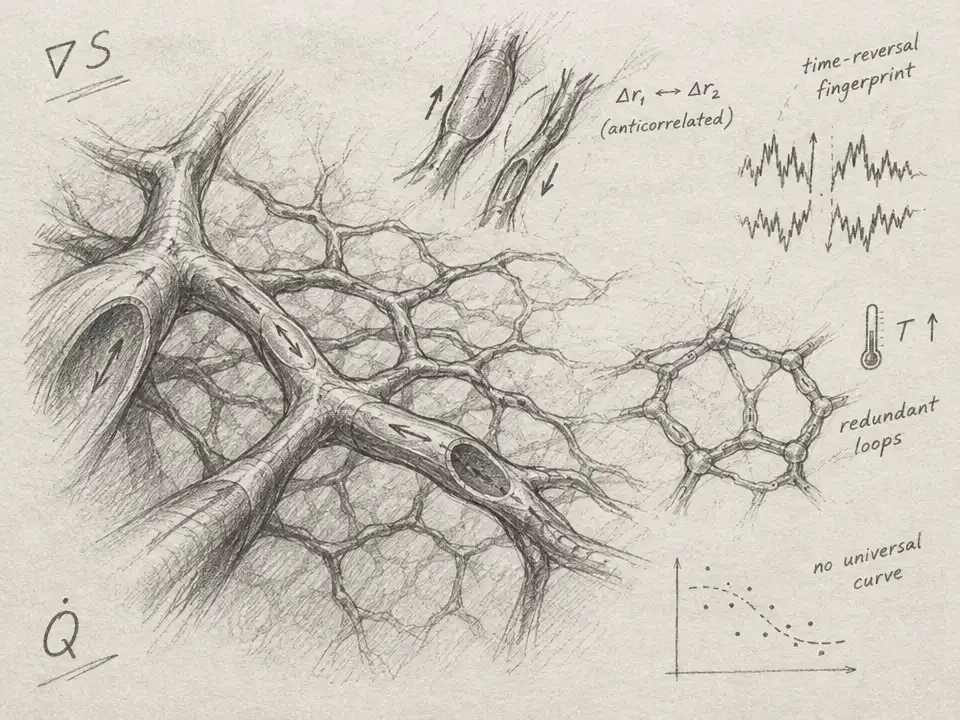
Then comes a less obvious connection between neighboring vessels. When a vessel changes radius, it changes the volume inside it and displaces fluid. Accounting for that displaced fluid couples the slow remodeling process back to the fast flow. The mathematics predicts that hydraulically connected vessels should have anticorrelated radius fluctuations: when one expands, its neighbors tend to contract, as the pressure and flow adjust. This coupling is reciprocal—the influence of one vessel on another matches the reverse influence in the model.
In simulations of fluctuating vessel networks, the predicted cross-couplings agreed closely with measured ones. That gives researchers a possible way to distinguish passive hydraulic effects from active biological signaling. Some vessels can respond to signals conducted along the network, not only to local shear. In the model, such directional signaling breaks the time-reversal symmetry expected from passive, reciprocal coupling. In plain terms, the order of a pair’s fluctuations matters: watching which vessel changes first can reveal a directional influence that ordinary correlations might miss.
The proposed test is demanding. In simulations, a relatively strong modeled signal could be detected after dozens of structural-relaxation times, or roughly a hundred when measurement noise matched the natural fluctuations. A weaker signal required about 300 relaxation times. Since remodeling in mature vessels may take days, the paper estimates that testing the idea there would require imaging over months. These are predictions from a model, not evidence that such a signal has already been detected.
The framework also asks what fluctuations might do to the network’s shape. A tree-like network has no redundant routes; a network with loops has alternate paths for blood to travel. The authors use a statistical-mechanics approach—a partition function—to describe how the number of loops might vary with an effective structural temperature, a measure of the modeled fluctuations. In this picture, loops become more common as fluctuations grow.
Here the researchers report a result that complicates the appealing story. They tested whether loop counts for different maintenance-cost assumptions would collapse onto one universal curve when plotted against effective temperature. In their simulations, they did not. The number of loops also depended strongly on the radius threshold used to decide whether a vessel counted as present. The authors therefore caution that loop selection is not yet summarized by a single universal rule, and that a less threshold-dependent measure of network redundancy is needed.
That restraint is part of the study’s value. Thermodynamics supplies a way to derive predictions about the mechanics of adaptation, but it does not make every biological complexity disappear. The work points toward concrete questions: Do costly vessels fluctuate less? Do neighboring branches show the predicted anticorrelation? Do time-ordered fluctuations expose active signaling? And can researchers count network loops without making the answer hinge on an arbitrary cutoff?
A vessel’s local adjustment may look simple. But once flow, wall motion, energy use, and signaling are linked, the network becomes a system with its own dynamics. By borrowing tools from nonequilibrium physics, the researchers turn that complexity into quantities that can, in principle, be measured—and into clear places where the theory may fail.