Imagine laying tiles across a table, matching each edge to its neighbors. The pattern may never settle into a repeating wallpaper: slide it any distance in any direction, and it will not land exactly on itself. Yet look closer, at the corners where tiles meet, and a quiet arithmetic rule may be ticking away beneath the geometry.
That is the strange invitation of a frieze pattern. In its familiar form, numbers sit in rows on a regular grid, and every little diamond of four numbers passes the same test: multiply one diagonal pair, multiply the other, and the first product exceeds the second by exactly one. A single local rule ties the whole pattern together. A paper posted July 23, 2026, asks what happens when the grid itself refuses to repeat.
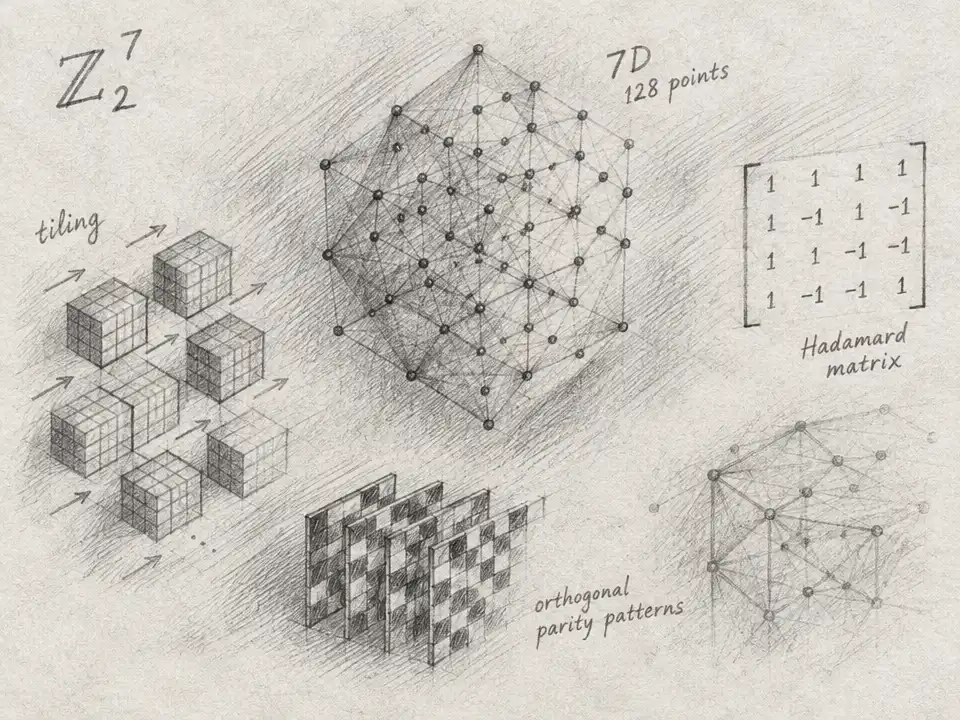
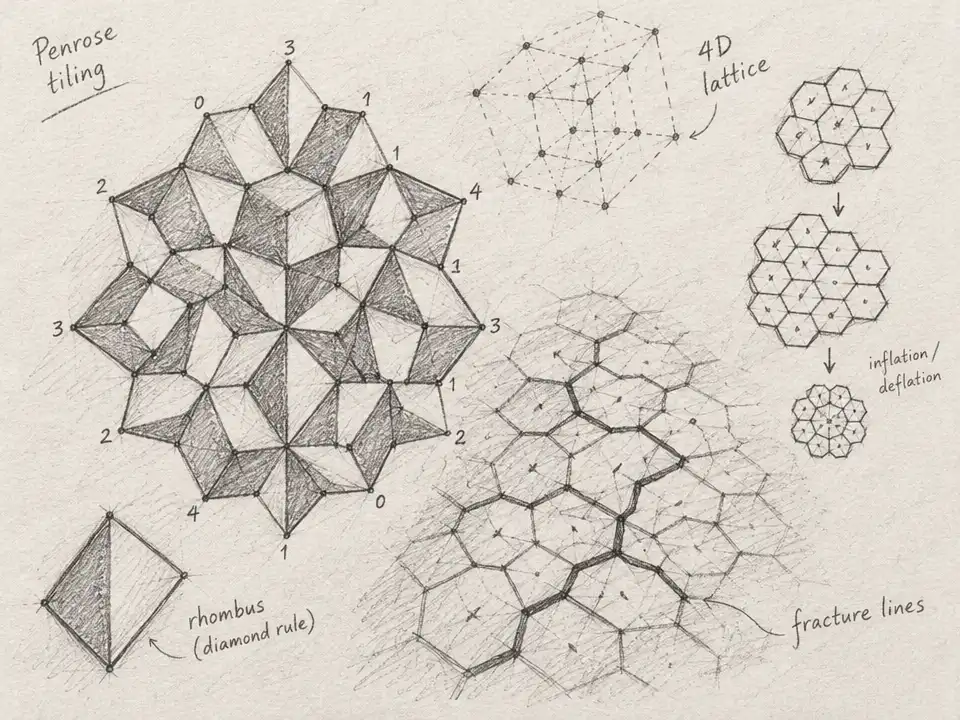
The answer begins with Penrose tiles: two kinds of rhombus, one broader and one narrower, fitted together in a mosaic with no repeating translation. The researchers Dirk Frettlöh and Jan Mazáč show that each vertex can still receive an integer label so every rhombus obeys the diamond rule. The labels are not guessed one tile at a time. They come from a hidden address system: each point in the flat tiling can be traced back to a point with four integer coordinates, then projected down from a four-dimensional lattice.
Those four coordinates leave a small arithmetic fingerprint. Add them and keep track of the remainder after dividing by five. The relevant vertices fall into four nonzero classes, which can serve as four distinct labels. The geometry supplies another clue: every rhombus has one special vertex, called a shallow hole in the tiling’s geometric language. That point determines how the number pattern sits on the tile. With the orientations aligned, neighboring rhombi share labels consistently, and the diamond rule holds throughout the mosaic.
Nothing in this construction makes the Penrose pattern periodic. The tiles do not secretly form a large repeating block. Instead, the number labels reveal a different kind of order: each corner carries information about its place in a higher-dimensional lattice, and that information survives the projection into the plane. The surface looks like a wandering patchwork; underneath, its vertices have addresses precise enough to coordinate an arithmetic rule across the entire tiling.
A second tiling in the same study hides its structure another way. The Godrèche–Lançon–Billard, or GLB, tiling uses the same two rhombuses, but assembles them through a different replacement process. Here the researchers’ labels follow a hierarchy. The construction lets them identify larger “supertile” regions, each built from smaller tiles, and each tile belongs to one such region in a unique way. Mark the supertiles’ key vertices with one, nearby vertices with two, and the rest with three: again, every rhombus passes the diamond test.
The contrast is revealing. On the Penrose tiling, a vertex’s number comes from its four-dimensional address. On the GLB tiling, it comes from the tile’s place in a nested architecture. One pattern hides its bookkeeping in a lattice projection; the other hides it in a stack of larger and larger pieces. Both carry exact arithmetic without acquiring a repeating beat. The researchers also show that each construction permits infinitely many such friezes while using only four labels for Penrose or three for GLB.
A separate paper, posted October 14, 2026, approaches the same broad mystery from a different scale. Arnaud Chéritat studies a marked regular hexagon whose curved lines can close into circles. At first, those marks look like decoration. But they also reveal whether a tiling can be shrunk into a smaller version of itself—a process called deflation. Certain tiles, marked by a mismatch in the circle pattern, form fracture lines. These lines divide the tiling into bubble-like regions, and the paper proves that only a restricted set of bubble arrangements is possible.
Now zoom out and back in. Inflation doubles the distances between tile centers and fills the new gaps; deflation tries to reverse that step. For this hexagon tile, a tiling repeats under translation exactly when repeated deflation eventually reaches one of a few classified repeating arrangements. A tiny local mark can therefore signal something global: whether the whole infinite pattern can ever return to itself after a shift. The cracks are not damage in the everyday sense; they are clues to how the tiling’s hidden scale is organized.
These studies do not turn aperiodic tilings into disguised wallpaper. Their central surprise is subtler: a pattern can lack repetition and still obey rules that are exact, global, and surprisingly legible. A number at one corner may remember a four-dimensional address. A curved stroke may announce that a tiling can—or cannot—be deflated. The more closely we inspect the apparent irregularity, the more the mosaic begins to look less like noise and more like a world with its own concealed map.