A nearly invisible adjustment to a chip’s settings made light do something dramatic: stay near where it started, or leap across several channels and return in a steady rhythm. The difference was not a shove or a new pathway. It was resonance—a precise match between the energy pattern programmed into the chip and the conditions for movement.
The experiment offers a new way to explore a classic problem in physics: how a small correction to a simple model can reshape a system’s behavior. In a programmable photonic circuit, researchers recreated a lattice in which light could move between neighboring sites. Then they tuned the lattice until light began to jump between sites much farther apart. The same delicate effect may help researchers study strongly driven quantum systems, but the price of using it is precision: even a slight detuning can shut the long-range motion down.
Imagine a row of stepping-stones, each one a little higher than the last. Now give alternating stones an extra lift. A traveler moving along this tilted, two-level landscape would usually remain near the starting point or wander among nearby stones. But at special settings, the energy differences line up so that a distant stone becomes a resonant destination.
That is the basic picture behind the team’s “binary lattice.” Each site is represented by an optical channel on a programmable silicon chip. A steady tilt assigns a rising energy across the chain, while an alternating mismatch raises one type of site and lowers the other. Light entering one channel can then spread through the network according to the programmed connections and energy pattern.
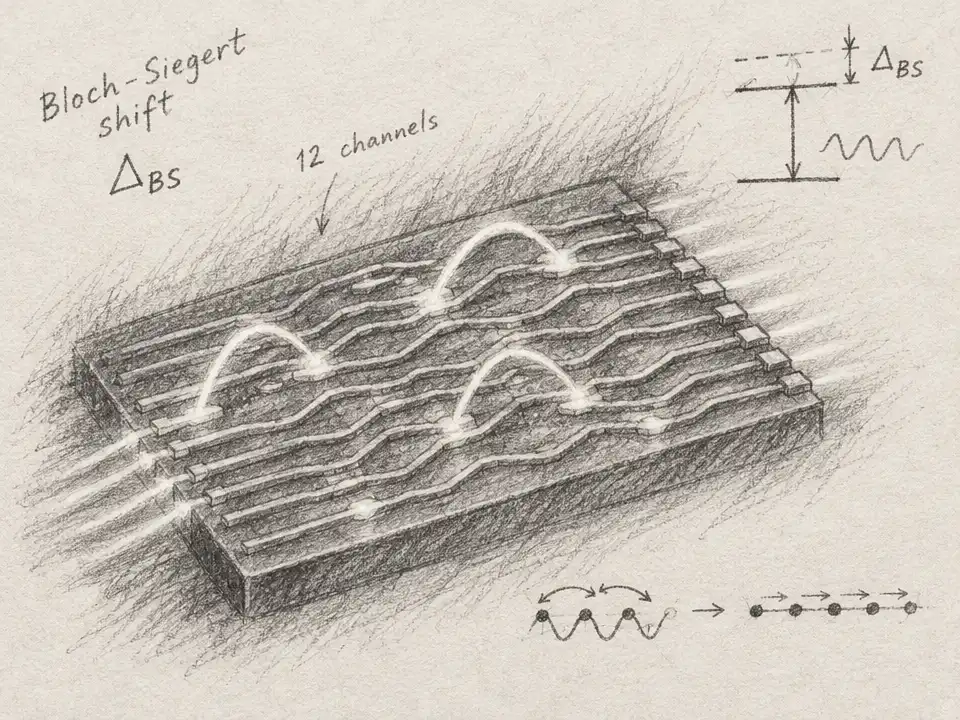
At particular resonances, the light does not simply drift down the chain. It oscillates coherently between a starting site and a partner several sites away. The team observed four resonance orders. In one striking example, light moved back and forth between site 4 and site 9, five lattice steps apart. With almost the same settings, but slightly off resonance, the light mostly stayed put.
The surprising connection is to the Bloch–Siegert shift, a correction first associated with a driven two-level system. In that setting, a basic approximation neglects parts of the interaction that oscillate in the opposite sense to the system’s natural motion. The neglected terms can shift the true resonance. The shift is often small, but when the system is tuned close to resonance, small can matter enormously.
Here, the researchers showed that the lattice’s long-range jumps carry the same underlying physics. A mathematical mapping links the tilted binary lattice to the driven two-level model. What looks like tunneling across a row of sites can therefore reveal the same kind of resonance shift and energy-level structure studied in strongly driven quantum systems. The lattice gives that abstract connection a visible signature: light moves between particular channels, and the timing of its return can be measured.
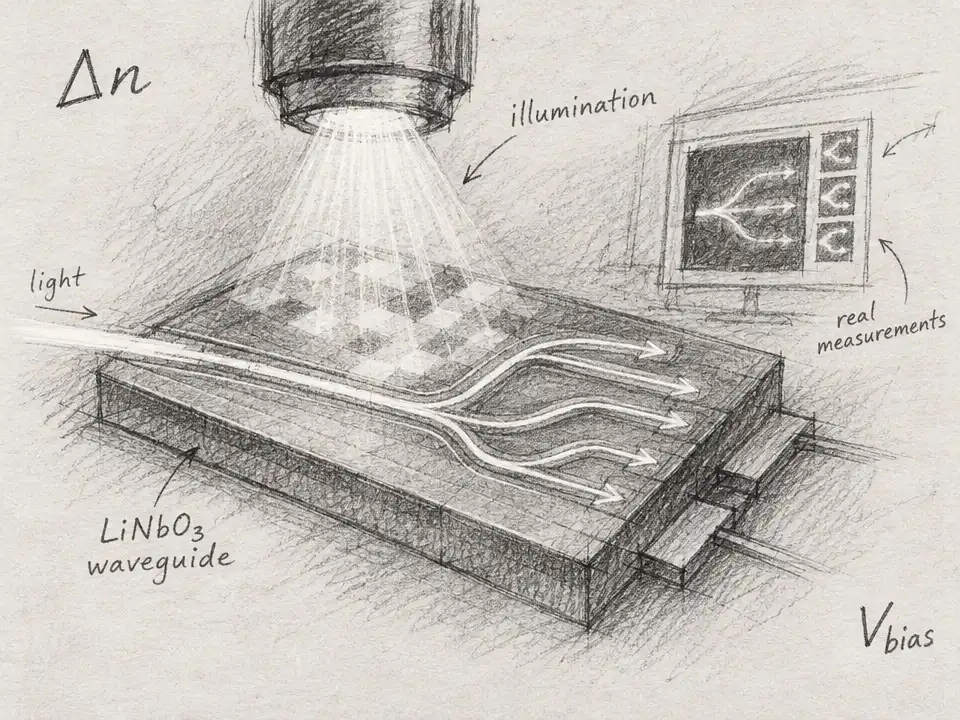
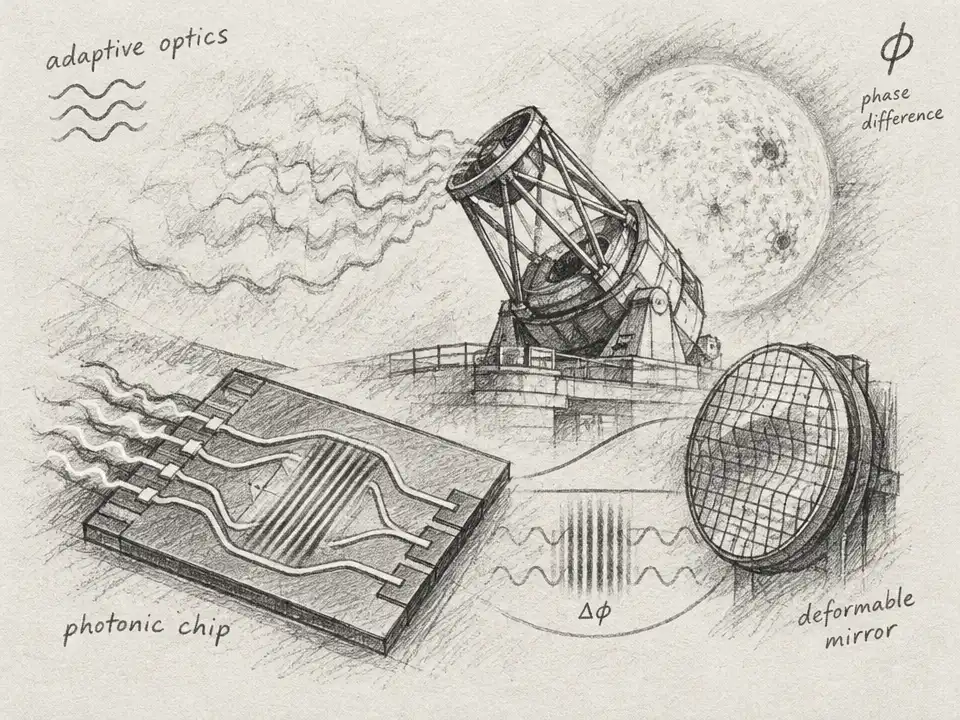
To make the effect observable, the researchers needed fine control over the circuit. Their 12-channel photonic chip contained a reconfigurable mesh of 66 Mach–Zehnder interferometers. These components split and recombine light, allowing the researchers to program how optical amplitudes interfere across the channels. The circuit’s phase resolution was 0.01π, and its settings could be adjusted after fabrication—a crucial advantage when the target resonance is so sensitive to small changes.
The experiment used coherent light at 1550 nm, not a stream of single photons. Researchers measured how the light’s intensity was distributed among the channels as the programmed dynamics unfolded. That distinction matters: this is an optical analog of quantum-model behavior, not a demonstration of a quantum computer or of single particles making the jumps. Its strength is that the chip lets researchers build and inspect a controlled model of the dynamics.
That control also let the team try something beyond a back-and-forth jump. The natural motion is reversible: light travels to a partner site and then comes back. By adaptively reversing the alternating energy mismatch at the right moment, the researchers changed which sites were resonant. The destination became the launch point for another hop, while the reverse route was pushed out of resonance. In this way, a sequence of normally reversible jumps became a directional cascade.
In one protocol, the researchers moved light rightward through a series of three-site hops, with initial transfer fidelity exceeding 0.95. In another, light moved leftward through consecutive single-site hops, with per-stage fidelity exceeding 0.98. They also tested fractional steps of the resonance period, which let the light progress rather than simply return to its starting point after each cycle.
The frontier is a programmable testbed for exploring how resonance, symmetry, and strong driving combine—and perhaps, eventually, for designing controlled routes for light through photonic devices. But these results do not yet show that the approach scales to a large, loss-tolerant device or delivers a practical quantum technology. The demonstrated lattice had 12 channels, and its most distinctive effects depended on carefully calibrated settings. In more complex systems, maintaining that control could become harder.
For now, the chip’s achievement is more specific and more useful: it makes an elusive correction in a familiar model into a tunable transport effect. A tiny shift can decide whether light stays home or takes a long, precise excursion. By learning to set that shift—and flip it at just the right time—researchers gain a new experimental route into the physics of driven systems, along with a clear reminder that the next frontier may hinge on getting the details exactly right.