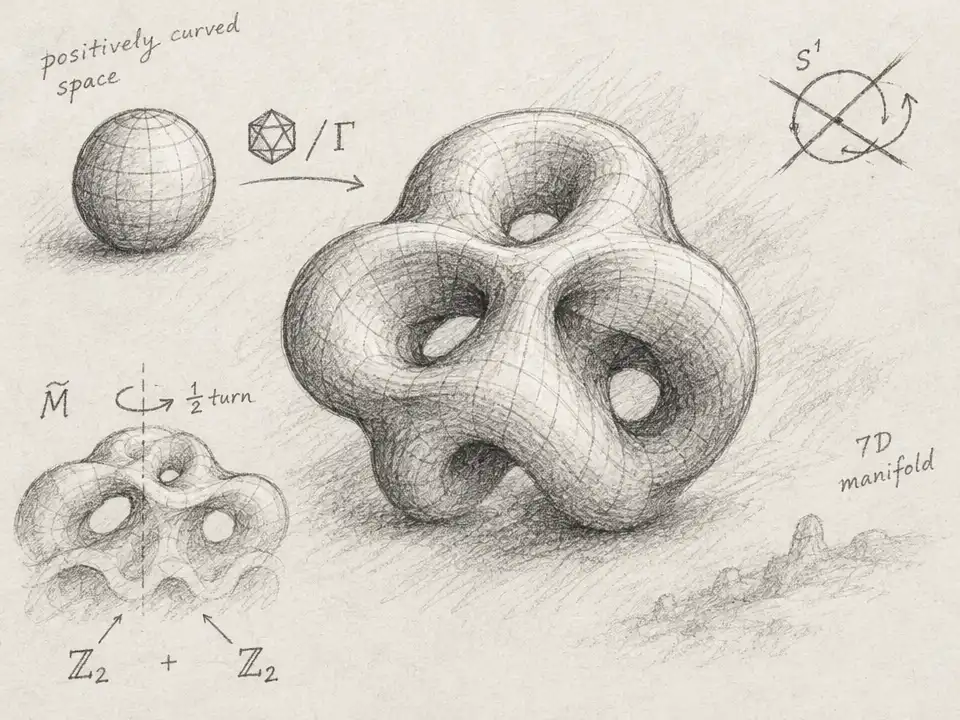
Imagine tracing a tiny triangle across a sphere. Its corners add up to more than they would on a flat sheet: a local sign that the surface curves. Now zoom out. The sphere’s global identity seems settled—it is a sphere. But mathematics has another layer of description, one that asks how smoothly the pieces fit together. At that level, two spaces can be topologically alike and still be different. A new result finds that some of these hidden differences can coexist with curvature that stays positive in every direction.
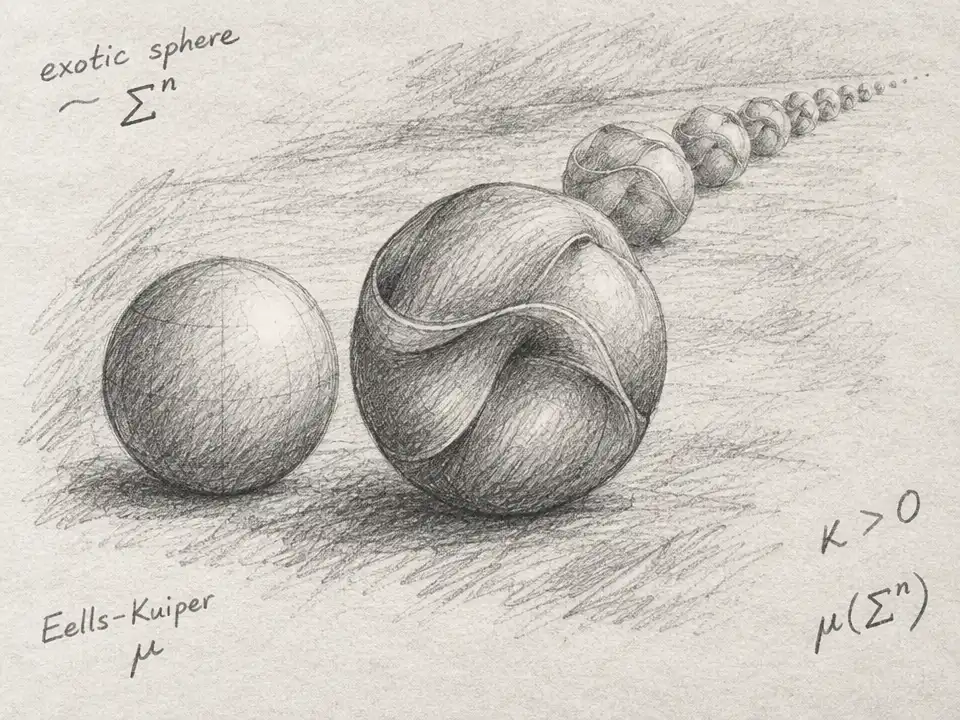
The spaces are called exotic spheres. They are topological spheres: from the broad viewpoint of continuity, each is the same kind of space as an ordinary sphere. But their smooth structures differ. In practical terms, they cannot be smoothly reshaped into the standard sphere, even though no tear or hole distinguishes them as topological spaces. The difference lives not in the outline, but in the fine-grained rules for how coordinates and derivatives fit together.
Finding positive curvature in high dimensions is a stubborn challenge. The condition in this research is stronger than saying a space has positive curvature on average: every two-dimensional direction at every point must have strictly positive sectional curvature. Before this work, the known landscape in dimensions above 24 was strikingly familiar: among closed, simply connected examples, the spaces were diffeomorphic to a short list of highly symmetric models. Exotic spheres seemed like unlikely additions to that map.
In a paper posted on October 22, 2026, mathematician Fernando Galaz-García proves that the map is broader. The result produces exotic spheres with strictly positive sectional curvature in infinitely many dimensions: dimensions that are three more than a multiple of four, starting at 11, apart from dimensions one less than a multiple of 256. That last pattern is not a claim that such spheres do not exist there; it marks a gap in the general proof. Exact computations in the paper fill those gaps below dimension 65,536. In that range, the result covers every dimension in the stated three-more-than-a-multiple-of-four sequence.
The route to the discovery begins with a carefully controlled way of building spheres. Take two disks of the same dimension and join their boundaries, but twist one boundary before attaching it. The twist is not arbitrary: it is designed to respect a symmetry arising from the unit quaternions, a number system that extends the complex numbers. The resulting spaces belong to a family the paper calls star spheres. Their geometry has an important head start: earlier curvature constructions show that every sphere in this family can carry a metric of strictly positive sectional curvature.
That head start changes the question. Instead of inventing a new positively curved metric for each possible exotic sphere, the researcher can ask which members of this already-curved family have a genuinely exotic smooth structure. The family is organized by a twisting map. A numerical feature of that map—the degree of its action on a carefully chosen slice—helps label how the boundary is glued. The challenge is to pick a twist that changes the smooth structure without losing the positive-curvature construction.
To tell whether the structure has changed, the paper turns to a mathematical fingerprint called the Eells–Kuiper invariant. It is calculated using information from a higher-dimensional space that the sphere bounds, including characteristic data describing how that filling bends and is assembled. The standard sphere has a zero fingerprint. If a candidate has a nonzero value, it cannot be smoothly equivalent to the standard sphere: the number certifies that something global has changed, even when the space still looks like a sphere to topology.
The technical bridge between the twist and the fingerprint is partly arithmetic. The invariant separates into a contribution from the chosen twisting map and a rational number that depends on the dimension. Galaz-García identifies twists whose contributions are large enough, in a precise divisibility sense, to prevent the invariant from collapsing to zero. Much of the proof tracks how powers of two divide these quantities. When that accounting shows the result cannot be an integer, the invariant remains nonzero. The exotic structure is established; the curvature comes from the family the sphere was built to inhabit.
The dimensions left out by the general argument have a special arithmetic pattern, and the paper handles a finite stretch of them differently. For dimensions one less than a multiple of 256 and below 65,536, the author checks exact residues in a calculation, then verifies the result with a second, independently written program. That closes the finite range, but it does not extend the general proof to every dimension in this exceptional pattern. The distinction matters: a computational result for a bounded range is not an infinite-family theorem.
What makes the result memorable is the shift in scale. Positive curvature is a local condition, read from the behavior of tiny two-dimensional patches. Exoticness is global, detected by an invariant that remembers how an entire space fits together. The construction links them without confusing them: symmetry supplies a route to curvature, while arithmetic reveals the hidden smooth structure. A sphere can therefore be familiar from far away, positively curved under a close geometric inspection, and still carry a different smooth identity beneath the surface.