Imagine looking down at a plane dotted with points. There are no enormous empty regions, no crowded knots, and no obvious drift toward one side. Zoom out, and the points keep a steady average density. It sounds like the sort of pattern that ought to be a slightly warped version of a square grid.
But one carefully constructed point pattern defeats that expectation. It is spread across a plane, evenly distributed in the large, and built by a compact geometric recipe. Yet no one-to-one assignment can match its points to the points of any lattice while keeping every distance within a fixed distortion limit. The obstruction is nearly invisible at first glance. It lives in a hierarchy of patterns hidden across scales.
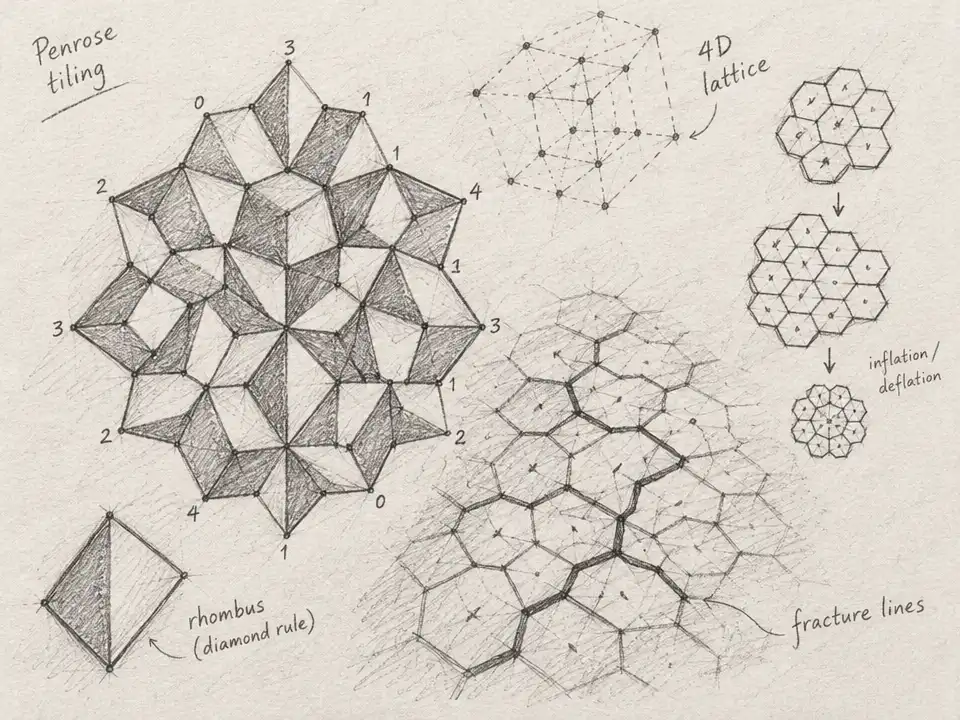
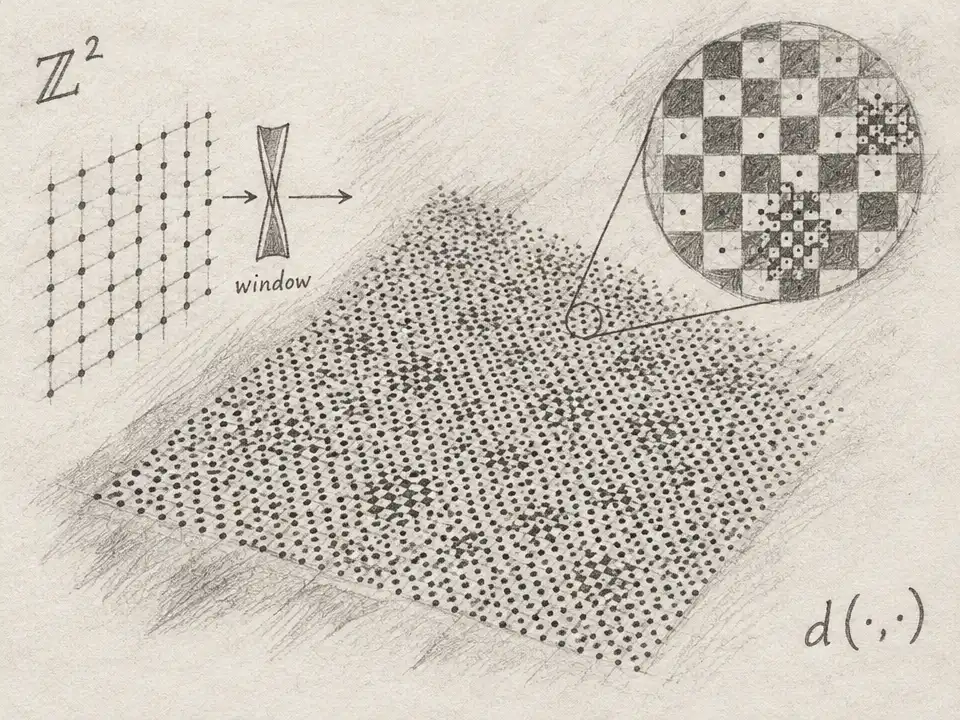
The construction, by mathematician Alan Haynes, begins not in the plane but in three-dimensional space. Picture the familiar integer lattice: points at every whole-number coordinate. Place an irrationally tilted plane through that space. Then keep only lattice points whose positions, measured in the direction perpendicular to the plane, fall inside a chosen “window.” Finally, project the survivors onto the plane.
This cut-and-project recipe can produce orderly arrangements that never repeat exactly. The result in Haynes’s example is a Delone set: its points stay a minimum distance apart, yet no part of the plane is left arbitrarily far from the nearest point. The pattern is neither a regular crystal nor an unstructured scatter. It has enough order to remain evenly spread, but enough hidden complexity to resist being reshaped into a grid.
What does “reshaped” mean here? A match to a lattice must pair each point with a grid point so that distances are distorted by no more than some finite factor. Nearby points cannot be flung arbitrarily far apart, and distant points cannot be squeezed arbitrarily close. That two-way distance control is called bi-Lipschitz equivalence. The theorem says that, for this example, every proposed finite distortion limit fails. It is not merely hard to find a good grid match; no such bounded-distortion match exists.
The surprise is sharpened by a familiar measure of regularity: density. Haynes’s point set has uniform asymptotic density. In sufficiently large squares, wherever the square is placed, the number of points approaches the same constant times the square’s area. The pattern does not encode a large-scale surplus in one region and a deficit in another that would make a grid match impossible by simple counting. Its global bookkeeping comes out even.
The trouble appears when the pattern is inspected at selected scales. For any proposed distortion limit, the proof builds a finite, nested arrangement of rectangles. Inside each rectangle, neighboring squares alternate between slightly more populated and slightly less populated. Then the same kind of contrast is planted again, at a smaller scale, along carefully chosen rows. The next level repeats the process, and another level follows.
Why should a faint checkerboard matter? A distance-controlled map cannot freely turn a persistent difference in point counts into a harmless change of shape. At a sufficiently large scale, the number of points in a region acts like a measure of the area its matched grid region must occupy. If neighboring squares keep demanding different areas, the map has to stretch some short distances more than others.
That is the engine of the contradiction. The paper first proves a geometric result for maps of the plane: when adjacent squares carry a definite area contrast, a map that already stretches one pair of nearby points must stretch some still-closer pair by a larger factor. Repeat this through enough nested levels, and the required stretching grows beyond the original map’s allowed limit. The actual point pattern transfers the same pressure from area differences to differences in point counts.
One finite hierarchy would only rule out maps with a particular bound. The harder task is to hide a hierarchy for every possible finite bound inside one point set. The window does this through infinitely many stages. Each stage contains the pattern needed to defeat one candidate limit; later stages are tucked into increasingly small pieces. Their contrasts become weaker, but each remains strong enough for its own finite argument.
That weakening is essential. If the checkerboard contrast stayed equally strong at arbitrarily large scales, the pattern would reveal a persistent density imbalance. Instead, the local irregularities fade as the scale grows, leaving the overall density uniform. The window itself is compact and is the closure of its interior, but its boundary is countable. A detail that sounds small—a boundary made of scattered points rather than a smooth edge—helps accommodate the endless hierarchy without losing the construction’s regular large-scale behavior.
There is a useful change of perspective here. Uniform density answers a broad question: how many points occupy a large region? A grid match asks a more demanding one: can every pairwise distance be coordinated across all scales? The first question can have a clean, steady answer while the second fails because of patterns too delicate to register in the large-scale average.
Haynes’s example answers an open question about whether cut-and-project sets of this kind must always be equivalent to a lattice under bounded distance distortion. It also separates two ideas that might seem inseparable: a point pattern can fail to match a grid even though its large-scale density is entirely ordinary. The hidden world is not a second population of points or a physical force. It is a nested mathematical architecture—quiet enough to disappear in averages, yet organized enough to defeat every fixed distortion limit.