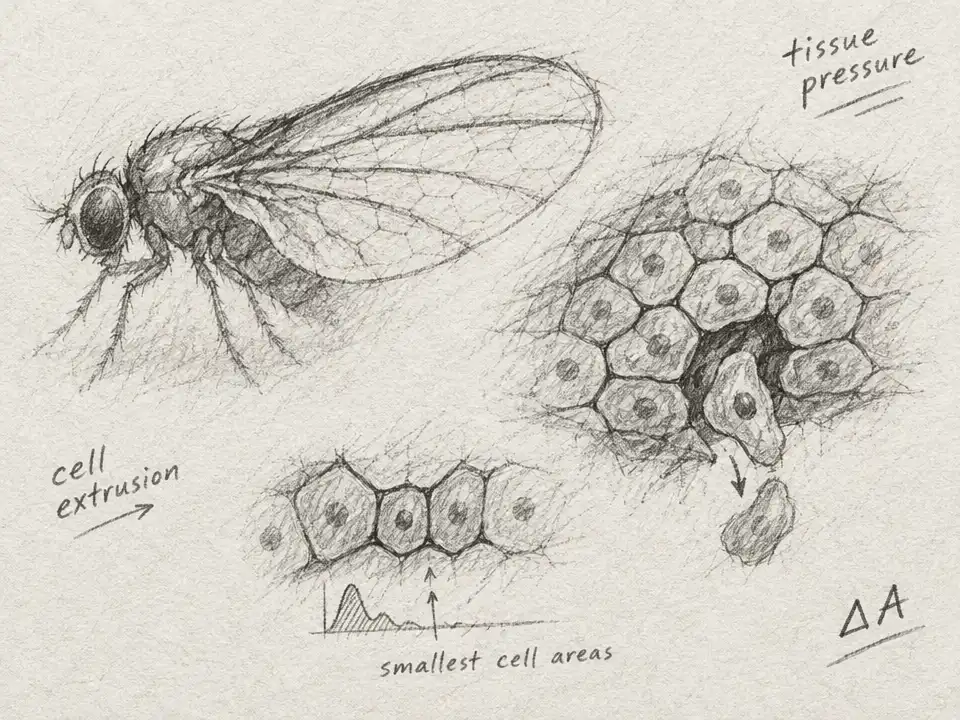
As a fruit-fly wing grows, its cells crowd together. Some divide; others are pushed out of the sheet. The tissue stays whole, but its parts are constantly rearranging. Is it behaving like a fluid, flowing smoothly, or like a solid that gives way in sudden little failures?
A recent study brings the physics of jammed materials—foams, glasses and other solids that deform under stress—to this biological question. Marko Popović and Ali Tahaei propose that pressure can make individual cells in a growing tissue mechanically unstable. When that happens, a cell is squeezed out of the layer, relieving pressure. The researchers then look for a trace of this process in the sizes of cells in a developing fruit-fly wing.
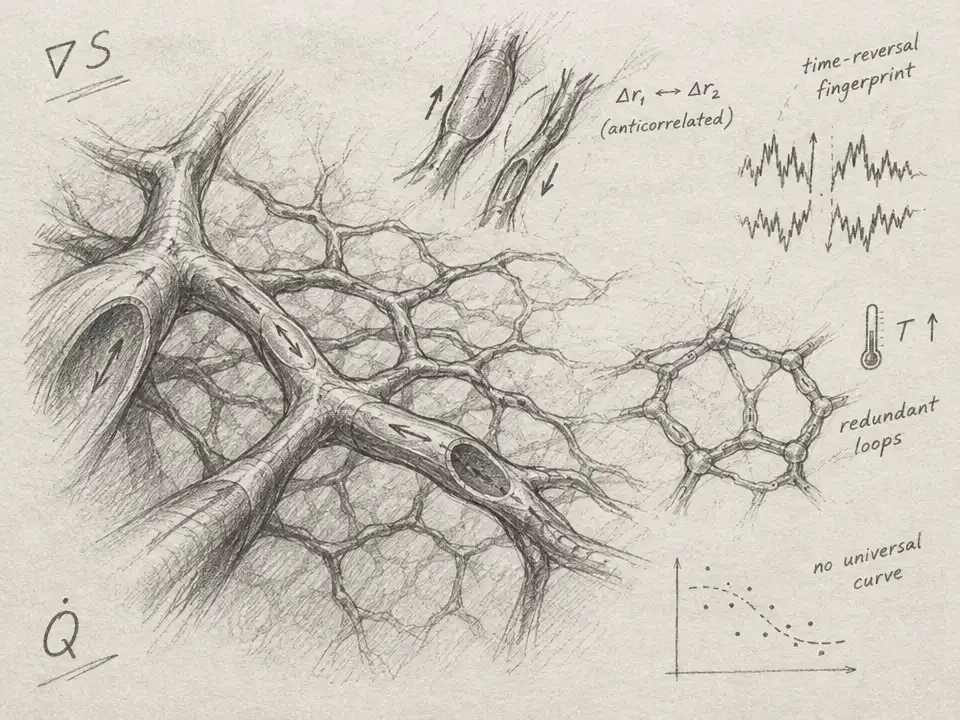
The connection matters because a tissue can look fluid-like when viewed over long stretches of time, even if it does not flow like a liquid moment by moment. Cell divisions and cell loss gradually let the sheet change shape. But between those events, cells press and pull on neighbors, storing and redistributing elastic stress. In the language of materials physics, the tissue can behave like an active solid: a material whose components generate forces and whose localized rearrangements release built-up stress.
In familiar solids, a yield stress marks the point at which a material starts to deform permanently. A growing epithelial sheet faces a related, though not identical, problem. Growth adds cells and builds in-plane pressure. Rearrangements can relax some stress, while cell extrusion can release pressure more directly. In the researchers’ model, an extrusion occurs when pressure pushes a cell past a mechanical threshold: the stable state that holds its area in place disappears, and the cell collapses out of the sheet.
The model also asks what happens across the tissue, not just to one crowded cell. Divisions leave behind mechanical disturbances, while rearrangements and extrusions shift stress in nearby regions. Those disturbances can nudge other cells closer to, or farther from, their own extrusion thresholds. In simulations of slow, incremental growth, pressure rises and falls as cells give way. Eventually, growth and pressure-relieving events balance, producing a steady homeostatic pressure—an analogue of yielding in a stressed solid.
Here the materials-physics idea of a pseudogap becomes useful. Imagine sorting cells by how close each is to the pressure that would make it unstable. In the model’s steady state, very few cells sit right at that brink; the number tapers toward the threshold according to a power law. It is not a literal gap with no cells near failure. It is a statistical pattern in how near-failure states are distributed, shaped by the mechanical kicks that cells give one another.
That pattern offers a way to test the mechanism using images. The team analyzed cell areas from four time-lapse movies of explanted Drosophila melanogaster wing discs. The movies lasted 12–15 h and began 96 h after egg laying. These were previously collected data, not a new experiment in which the researchers directly triggered or watched a cell cross its pressure threshold. Their test instead focused on the smallest cell areas, where the model predicts the clearest imprint of impending extrusion.
The researchers estimated the area threshold separately for each movie. The fitted values fell between 0.4 and 0.6 μm². For the pooled small-area data, the power-law exponent was 2.56 ± 0.12, corresponding in the model to a pseudogap exponent of 0.28 ± 0.06. The observed pattern differs from what the model would expect if the tissue behaved like a simple fluid near the threshold, and from its prediction for pressure fluctuations with Gaussian statistics. It is consistent with a marginally stable solid, disturbed by localized cellular events.
That is suggestive evidence, not a final verdict on why wing cells leave the tissue. The threshold area is inferred by fitting the same distributions the model seeks to explain, and the comparison uses a single dataset of four movies. The study also focuses on the quasistatic limit: growth proceeds slowly enough for the tissue to relax between events. At faster growth rates, the predicted pattern could be cut off at very small distances from the threshold. Nor does the proposed mechanism rule out extrusions driven by other biological signals.
Still, the approach changes what researchers can ask of a tissue image. Instead of relying only on average cell size or average extrusion rate, they can examine the rare, unusually small cells and ask whether their distribution records the material’s approach to failure. The authors suggest that similar signatures might be sought in other growing tissues under confinement, including three-dimensional cell populations, where pressure would need to be relieved through different events. A wing’s geometry may be biological, but the statistics of how it yields could belong to a much wider physics of living matter.