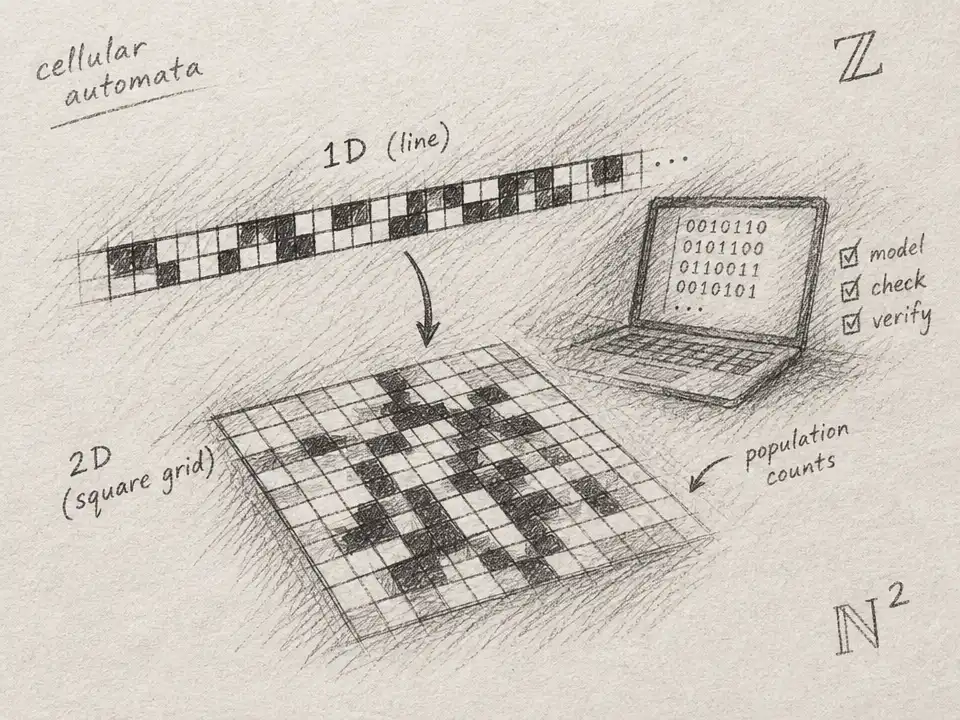
Imagine two mathematical worlds growing from a single spark. In one, cells spread along a line. In the other, they ripple across a square grid. Their local rules are different, their shapes are different, and neither seems to need the other. Yet the population count in the grid can be rebuilt from the population count on the line.
That unexpected bridge emerged from a search through a vast catalog of integer sequences. The study, posted to arXiv on September 26, 2026, asks a question that is easy to overlook: Can a mathematical system help researchers decide which objects are worth comparing in the first place?
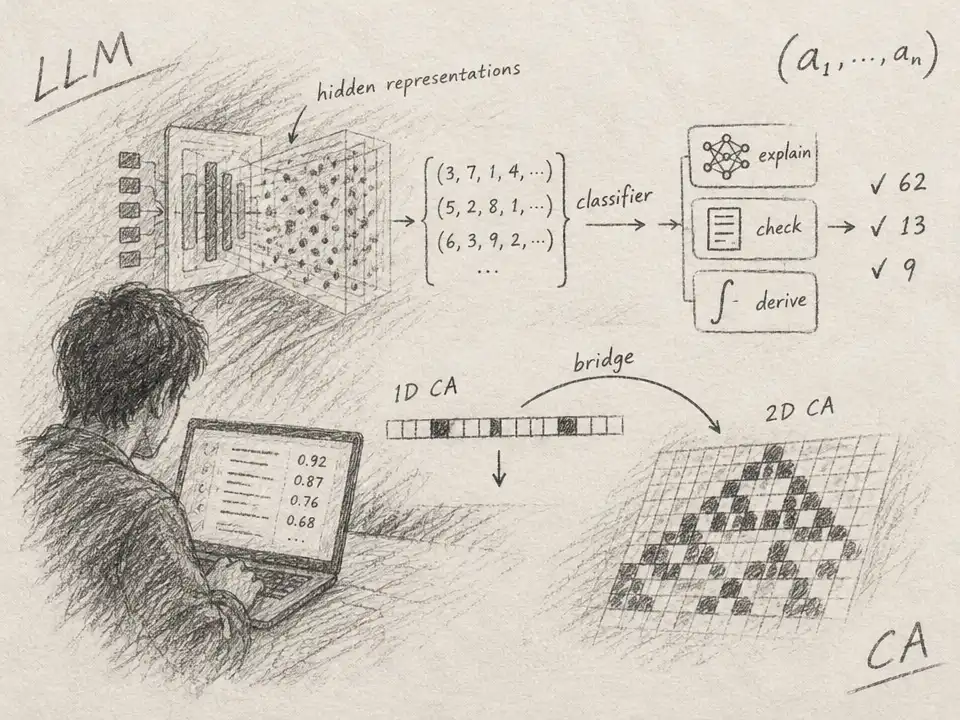
The researchers built LANTERN to search the On-Line Encyclopedia of Integer Sequences, a community-built collection where each entry describes a sequence of numbers and may point to related entries. From the 10,000 most frequently referenced entries, there are 50 million possible pairs. Most pairs are unrelated, and many genuine links are routine. The challenge is not just to spot a numerical resemblance, but to find a connection that says something useful about both objects.
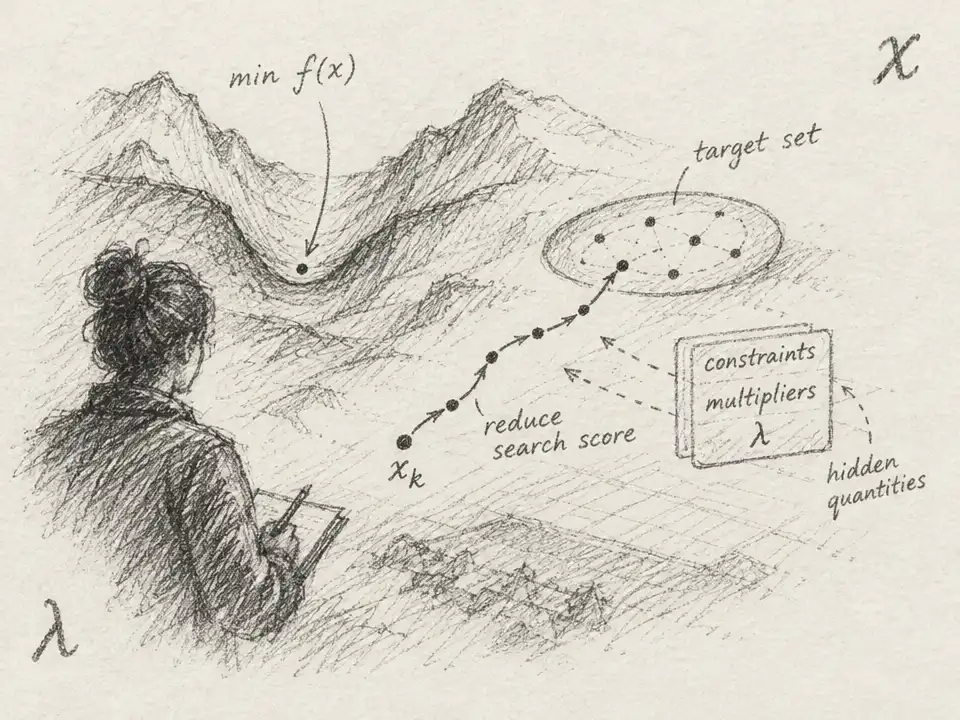
LANTERN uses patterns in a language model’s internal representations to rank pairs that might be related. Think of it as a map that highlights promising routes, not a proof of what lies at the end. A separate process proposes a precise relationship. The researchers then test it against every stored term in the relevant sequences and check the reasoning analytically. A match among listed numbers is only a first checkpoint; it cannot establish that a relationship holds in general.
Across three search configurations, the system produced 62 technically verified relations between entries that had no existing cross-reference. A further screen discarded routine transformations and uninteresting coincidences. Thirteen connections remained, nine of them judged informative or insightful. Four were not found in the encyclopedia or in the researchers’ targeted literature search. That is a careful claim about what they found, not proof that nobody had ever noticed those connections.
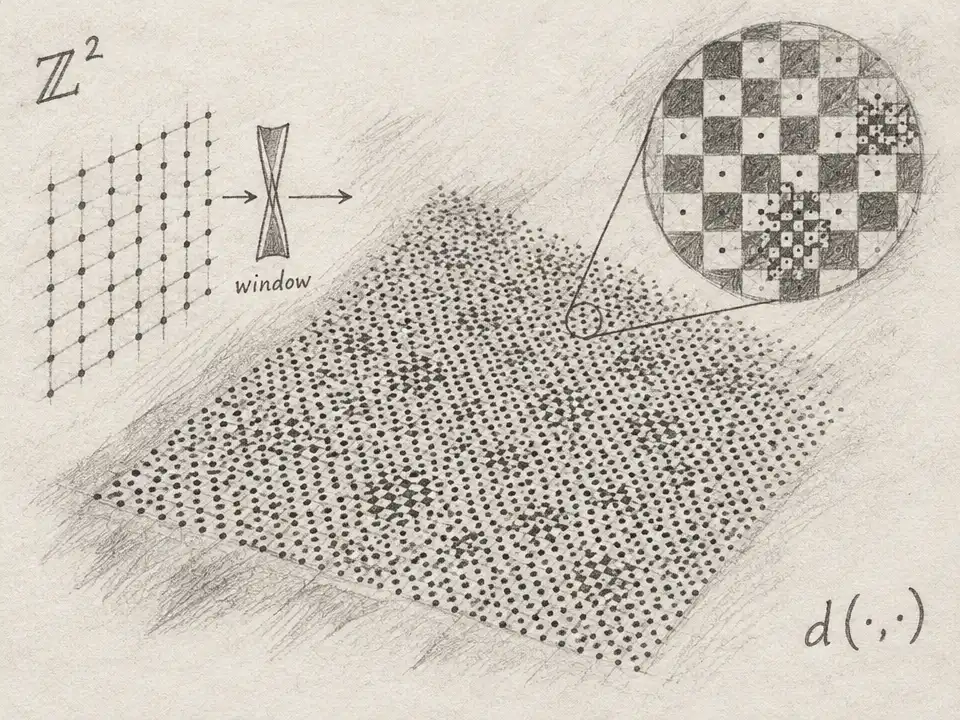
The clearest example begins with two cellular automata: rule-based systems that update cells step by step. Rule 150 lives on a one-dimensional line. At each step, a cell’s new state is determined by the exclusive-or of its own state and those of its two neighbors. The Fredkin replicator lives on a two-dimensional square grid; a cell becomes active when an odd number of its eight neighbors is active.
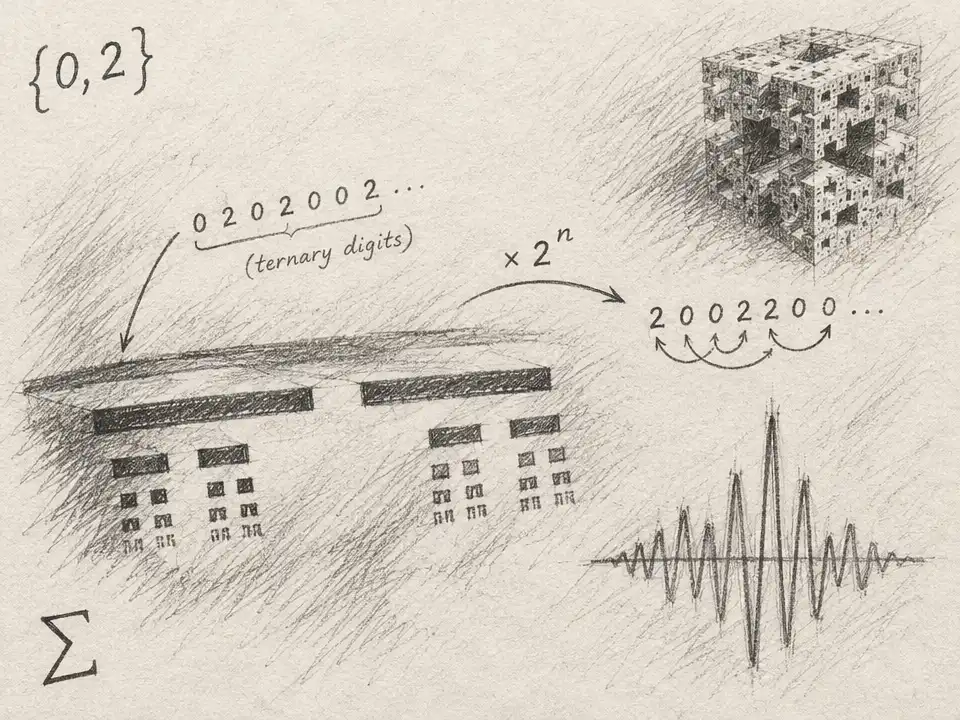
Start either system from one active cell and count the active cells after each step. The resulting lists of numbers look like records of two separate processes. The hidden clue is in the step number itself. Write it in binary, using only zeroes and ones, then group consecutive ones into runs. The count for either automaton breaks into a product of contributions, one for each run. For the grid, each contribution can be calculated from two corresponding contributions in the line system: square the one for a run of length k, then subtract the square for a run two places shorter. The paper gives the boundary convention needed for the shortest runs.
Consider step 13. In binary, it is 1101, which contains runs of lengths two and one. The grid’s contribution for those runs is 24 and 8; multiply them, and the automaton has 192 active cells at that step. The surprising point is not merely that the count can be calculated. It is that a one-dimensional sequence contains enough structure to reconstruct a population count in a different-dimensional system with a different local rule.
The researchers did not claim that the underlying counting laws were new. They were already known separately, and a key identity involving the block counts was recorded elsewhere. What the search surfaced was the interpretation of that identity as a bridge between these two automata—one not recorded in the paired encyclopedia entries or found in the targeted literature search. The discovery is a new connection between familiar pieces, rather than a claim to have invented the pieces themselves.
Several checks make the search more than a hunt for lucky patterns. On later-added encyclopedia links, the researchers compared LANTERN’s rankings with a system using only the words in the sequence definitions. For links with a matched background of similarly themed but unlinked pairs, the text-only system ranked at chance, with a score of 0.51; the representation-based system scored 0.57–0.58. These are ranking scores, not percentages of correct answers, and they indicate a modest signal rather than a perfect detector.
They also tested entries created after the model’s knowledge cutoff. A classifier trained on links between older entries ranked links to new entries nearly as well as it ranked a held-out sample of older ones. That result is consistent with the system picking up mathematical patterns that transfer between definitions, rather than simply recalling the exact encyclopedia pages. It does not show that a model reasons like a mathematician, or that its first suggestions can be trusted without proof.
The paper’s other featured bridge offers a different change of scale: a product of analytic expressions, involving a continued fraction and a theta series, turns out to count special integer partitions. A partition can be drawn as rows of cells; in a 5-core partition, no cell has a hook length divisible by five. The example reinforces the study’s larger point: distant-looking descriptions can conceal the same mathematical structure.
There are limits to the map. The encyclopedia supplies unusually tidy objects: definitions, formulas, initial terms, and a history of cross-references. The search favored frequently mentioned sequences, and the researchers tested only one family of pretrained models. A different mathematical library—or objects without clean definitions and verifiable terms—could be much harder to search.
Still, the scale shift is striking. Instead of asking a machine to solve a particular puzzle, the researchers asked it to help choose which puzzles deserve attention. Among millions of pairs, a small number opened onto exact, checkable routes between mathematical worlds. The proof remains the essential part. But before a proof can begin, someone has to see that two distant objects might belong in the same story.