A radar has four chances to find a target somewhere around a ring. Should its beam be razor-thin, so each look is precise, or broad enough to sweep up much of the scene at once? In a computer model, neither extreme wins. The best beam is broad enough to leave useful clues, but not so broad that it blurs them together. The twist: its next move depends on what the last look found.
The researchers built a deliberately small puzzle: a target could occupy any of 16 cells, and a phased-array radar could make four noisy measurements. A narrow beam covered fewer cells; a wide one covered more. Each look returned a yes-or-no detection, with a 0.9 chance of detecting a target inside the beam and a 0.05 false-alarm chance outside it. This was a modeled search, not a field test. Its simplicity let the researchers calculate the best measurement strategy exactly.
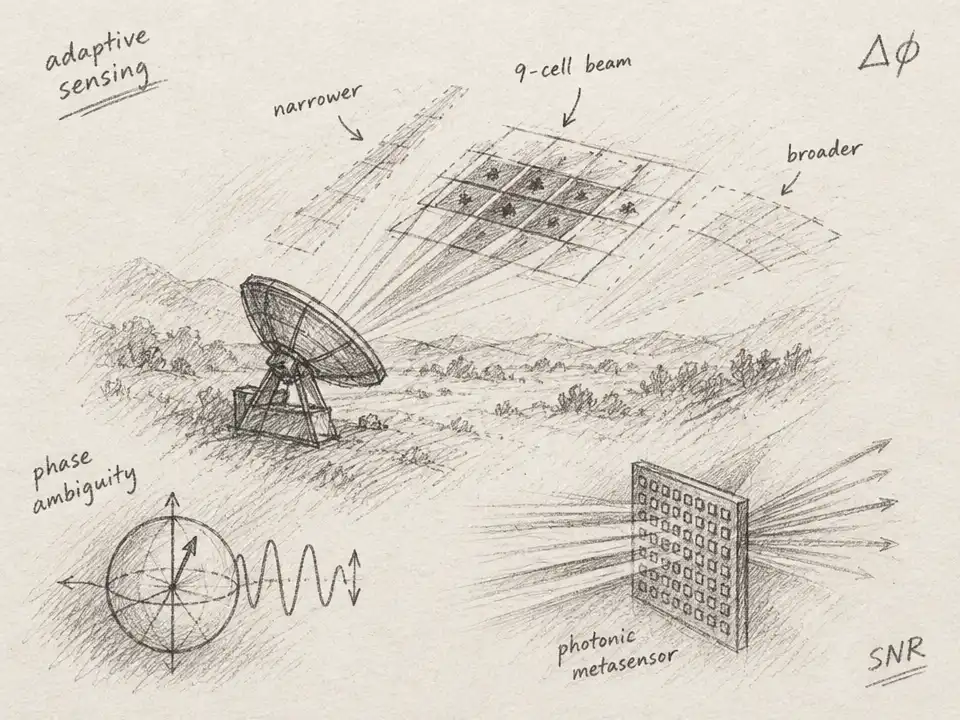
There are two ways to play. A fixed schedule chooses all four pointing directions in advance. An adaptive one makes a measurement, updates its estimate of where the target might be, then chooses the next direction in light of that result. Think of the difference between following a list of questions prepared before a conversation and choosing each question after hearing the answer.
The surprising result was that a beam covering nine of the 16 cells gave the adaptive search its highest average information score: 1.704 nats. A narrower beam might seem better because it points more precisely. But early in the search, precision can mean looking at the wrong sliver of the ring. A wider beam might seem safer because it covers more ground. But if it catches too much at once, a detection says less about exactly where the target is.
With the nine-cell beam, each answer can reshape the next search. In one illustrated sequence, the model points first at cell 1, then cell 14, and gets no detection either time. Those misses narrow the possibilities. It then points at cell 12 and cell 4, and detections help localize the target at cell 8. The point is not that every search follows this exact route. It is that the best route can only be chosen after the earlier clues arrive.
Then comes a tempting false lead. The researchers also examined a score based on how much better a search could be if the target’s location were already known. That score favors extreme beam widths: an all-knowing searcher can exploit a very narrow or very broad beam especially well. But a real sensor does not know the answer in advance. Choosing the beam from that score alone would sacrifice 2.75 times the attainable adaptive value in this model. The apparent best design belongs to a clairvoyant, not to the sensor that must actually do the searching.
That mismatch points to the paper’s larger question: should hardware be designed for the first measurement, or for the whole sequence of decisions that follows? The team’s proposed answer is to design the sensor’s physical structure and its measurement policy together. Their method repeatedly asks two questions: given this hardware, what should the sensor measure next; and given that strategy, what hardware would make the whole sequence more informative?
A second modeled puzzle involves a superconducting quantum circuit used to estimate magnetic flux. The circuit’s response oscillates with the flux, like a repeating pattern on a ruler. A long measurement delay can distinguish nearby values very finely, but the repeating pattern can make several different flux values look alike. That is a kind of aliasing: a sharp reading can still leave the sensor unsure which repeating interval it has landed in.
The modeled adaptive strategy starts with a short delay to narrow down which interval is plausible, then uses longer delays to measure more precisely within it. The fixed comparison commits to long delays from the beginning and can remain stuck with several plausible answers. Here, too, a sensor gains by using an early measurement to decide what kind of later measurement will be useful. The result is a computational comparison, not a newly performed experiment on a quantum device.
The researchers also carried the idea into a simulated photonic sensor: a two-by-two array of waveguide scatterers whose shape is described by 90,000 design pixels. The modeled device has eight output ports and aims to detect small changes in refractive index across four cells. After each round, its strategy chooses new input-light phases based on which part of the estimate remains most uncertain. That turns the physical geometry into more than a passive receiver: the pattern of the structure helps determine which information the sensor can preserve.
But this is where the puzzle gets harder. The radar and quantum examples use exact planning over a small number of measurements. That calculation becomes unwieldy as the number of possible measurement histories grows. For the photonic example, the researchers therefore used a faster approximation: a filter that represents uncertainty in a simplified way and a policy that chooses the next probe using an information score. Such a filter can struggle when the possibilities split into several distinct peaks. The large photonic design is a simulation, not a fabricated sensor.
The study also treats the unknowns as static. Real targets move; sensor conditions drift. And an optimal strategy for one assumed range of possibilities may not be robust if the real world falls outside it. The work does not settle those problems. Instead, it exposes a design question that conventional sensor engineering can overlook: what should the hardware make possible after the first reading?
The answer may be a sensor that does not chase the sharpest first look. It may be one built to keep good choices available—so a noisy detection, a missed target, or an ambiguous signal can guide the next measurement rather than end the search.