An approaching object can announce itself before it is easy to identify. Its image steadily swells across your field of view: a ball rushing toward your face, a car closing in on the road ahead. For a locust, that expansion is more than motion. It is a warning cue—and a compact visual circuit in the insect’s brain helps distinguish it from movement that is less urgent.
Researchers have now built that biological idea into a computer vision model designed to notice looming objects in video. The crossover is between insect neuroscience and machine perception: instead of asking a system first to recognize every object, the researchers give it a specialized job—detect visual patterns consistent with something drawing near.
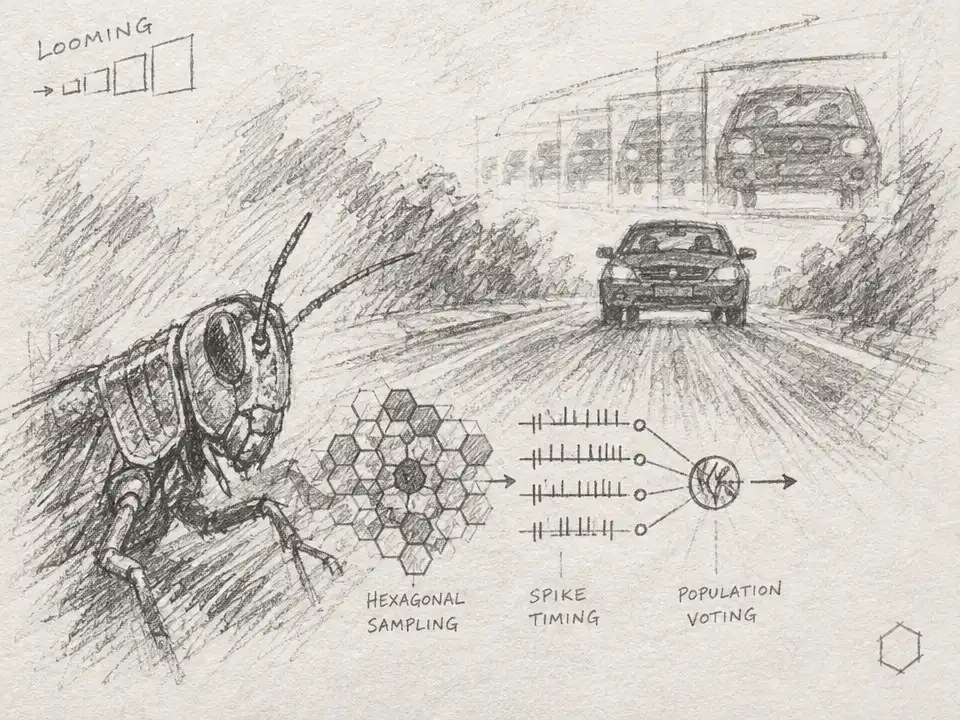
The model takes inspiration from a locust neuron called the lobula giant movement detector, or LGMD. The neuron responds strongly to an object whose image expands as it approaches, while helping the locust distinguish that looming pattern from motion across its visual field. A simple version of the challenge appears in the researchers’ tests: an expanding dark shape should trigger a response; a dark shape sliding sideways should not.
That distinction matters because motion alone is a noisy clue. A moving tree line, a passing vehicle or a camera jolt can all shift pixels. A vision system that treats every change as danger would be exhausting—and not very useful. The locust-inspired model instead combines several stages that echo features of biological vision, then tests whether they help it focus on expansion.
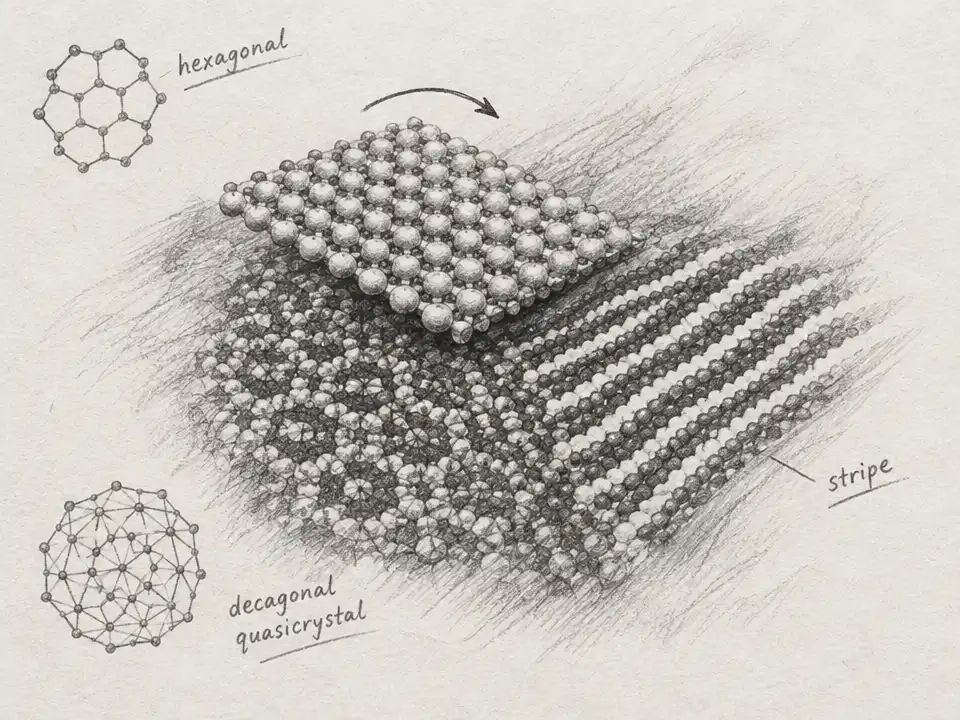
First, it samples the image on a hexagonal grid, borrowing the arrangement of light-sensitive units, called ommatidia, in a compound eye. This is a software representation, not a camera made of insect-like lenses. The grid offers a more even set of directions for tracking local changes than a conventional square layout. The model then separates increases and decreases in brightness into two channels, roughly corresponding to signals about light turning on and off.
Next comes a push and pull. Excitatory signals build when parts of the image change in a way associated with an approaching object. Inhibitory signals damp responses to motion that spreads across the scene or stays localized. A population-voting step combines activity from neighboring patches, so one noisy patch is less likely to decide the outcome by itself. Finally, a leaky integrate-and-fire unit accumulates the combined signal over time. If that signal reaches a threshold, the model produces a spike-like output.
The “leaky” part is important: evidence can build, but it also fades. This gives the system a simple way to combine changes across video frames rather than reacting to each one in isolation. In the researchers’ controlled tests, the model responded to an expanding square while remaining largely quiet for a bar moving sideways. It also responded selectively to approaching balls in laboratory video sequences, including at different speeds.
The more demanding check used 194 real-world dashcam clips: 42 labeled as collision cases and 152 as non-collision cases. The model identified 35 of the 42 collision clips, for a reported recall of 83.33%. But it also raised alarms on 39 non-collision clips. Its reported precision was 47.30%, its accuracy 76.29%, and its F1-score 60.35%.
That split is the story’s essential tension. Missing a genuine collision cue can be serious, so catching most of the collision clips is encouraging. But 39 false alarms—slightly more than the 35 correctly identified collision clips—show why sensitivity alone cannot make a system dependable. Complex motion in the background and camera-induced disturbances contributed to the errors, the researchers report. A detector that warns too often risks being ignored.
Nor did the study put the model in a moving car or show that it could safely steer one away from danger. The results come from simulations, laboratory sequences and recorded dashcam video. The authors describe the approach as computationally efficient, but the paper does not establish that it is ready for real-time vehicle use. Its current performance is better read as evidence that a biologically inspired design can pick up looming cues—not as a road-ready safety record.
Still, the idea offers a useful alternative to building every visual system around general-purpose recognition. A locust does not need to name an approaching object to react to its growing image. For a machine, that narrow skill could eventually complement more elaborate vision: one system identifies what is on the road, while another watches for the particular geometry of a collision course. The insect’s lesson is not that one circuit can solve driving. It is that sometimes a focused alarm, built around the shape of danger, may catch what a broader view misses.