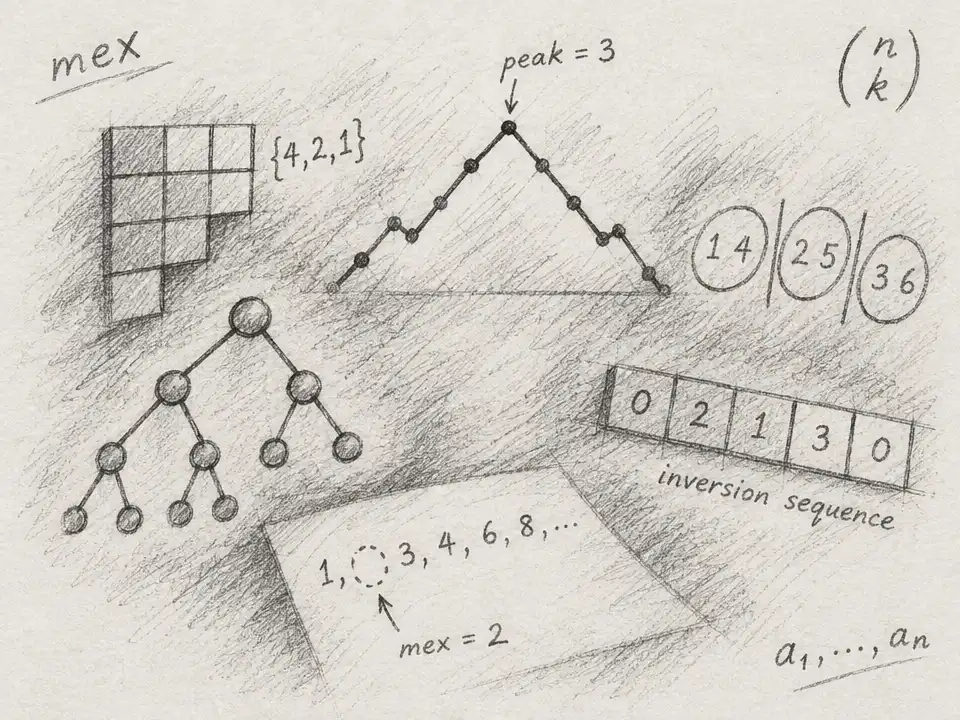
Take the number five. You can build it from five ones, from three and two, or from four and one. Now impose a rule: use only odd parts. Or use no part more than once. The permitted piles look different, but each rule produces exactly three ways to make five. That small coincidence is part of Euler’s famous partition identity. The deeper surprise is that a pile of parts can be redrawn as a staircase—and that the staircase’s edge can carry enough information to turn an infinite counting claim into something a finite mathematical certificate can verify.
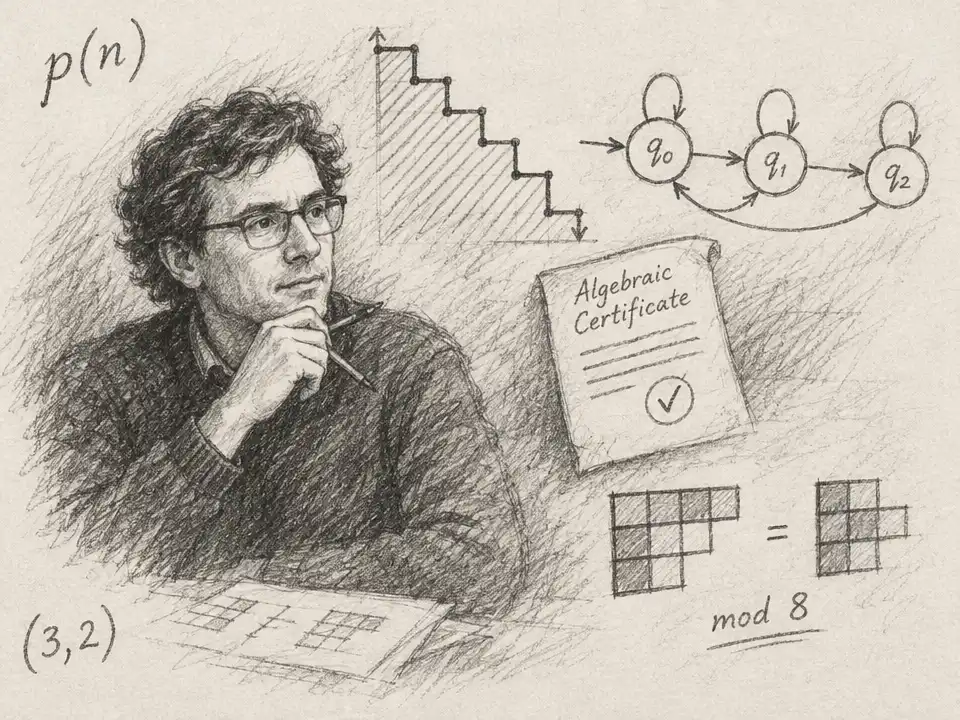
A partition is a way of breaking a whole number into positive parts, with order ignored: three and two is the same partition as two and three. Draw each part as a row of boxes, with longer rows above shorter ones, and the rows form a stepped shape. Laurent Bartholdi’s paper, “Automatic partition identities,” shifts attention from the boxes to the shape’s boundary. Trace the edge using two kinds of step: one moving right, the other moving up. Each partition now becomes a path—a string of steps that can be read and analyzed.
This change of viewpoint is more than a clever picture. The path remembers the partition’s size in its geometry: the way right-steps and up-steps cross encodes how many boxes the shape contains. So counting partitions becomes a problem of counting certain paths. If the rule says parts must be odd, or must not repeat, it translates into a rule about which step sequences are allowed. Instead of inspecting a growing pile one part at a time, mathematicians can ask what patterns a path may contain.
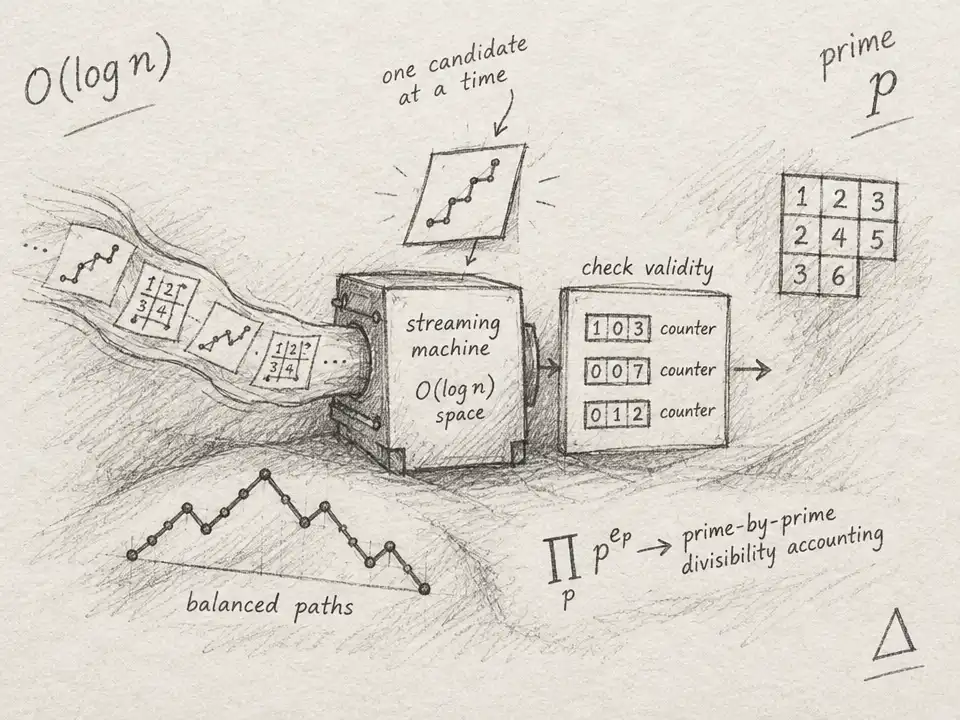
That is where finite-state machines enter. Imagine a small inspector walking along the boundary, carrying only a short note about what it has seen: perhaps the current height, or whether a nearby part has already appeared. At each step it updates the note and decides whether the path remains acceptable. For the kinds of local restrictions studied in the paper, the note can be drawn from a finite set of possibilities. The machine may process paths of unbounded length, but it does not need an unbounded memory to check them.
The resulting machine can represent an entire family of partitions, not just one example. A second machine can represent another family, defined by a different rule. The hard question is whether the two families contain the same number of partitions of every size. Checking the first hundred numbers may suggest an identity; it cannot establish that the pattern continues forever. Bartholdi’s method aims for something stronger: a finite certificate whose exact algebraic checks establish the equality across the whole infinite sequence.
The certificate works a little like a carefully arranged cancellation. The difference between the two path-counting systems is written as two streams of shifted terms. When the contributions are added, neighboring pieces cancel in a telescoping pattern, leaving no net difference. But the infinite streams must genuinely settle down; a formal cancellation is not enough if the terms keep contributing at the scale being counted. The paper supplies finite equations and checks that certify this convergence. In its area-based bookkeeping, contributions from paths with increasingly large area become less relevant to any fixed low-order count.
There is an important limit to the promise. The procedure does not guarantee that every true partition identity will yield a certificate that its searches can find. A false identity, however, eventually reveals a mismatch in the method’s successive checks. For a true identity, the proof still needs a completed certificate establishing the necessary convergence. In other words, the machinery is not a magic button for every conjecture: it is a route from a finite description of the rules to a proof that can be checked exactly when the route succeeds.
Bartholdi puts the framework to work on a more elaborate puzzle involving colored partitions. Here a part can come in different colors, and the rules constrain how many colored parts may occur at neighboring sizes. The main result proves a three-row, level-two case of a conjecture by Primc. It says that, for each total size, the number of partitions obeying those local color-and-neighbor restrictions equals the number obeying a very different rule: their parts must belong to specified residue classes modulo eight.
These are not two descriptions that obviously match item by item. One rule looks at the neighborhood of a part and limits combinations there; the other sorts allowed part sizes by their remainders after division by eight. The result equates the counts, not each individual partition with a uniquely corresponding partner. For one boundary condition, the paper’s residue list allows parts in classes two, three, five, and six, with one color for each, and class four with two colors. The same exact count emerges from the local restrictions in the colored, three-row setup.
To bridge the two worlds, the proof compresses the local rules into a small machine with four states. A hidden relation lets that system split into two simpler systems connected to the classical Göllnitz–Gordon identities. The author then uses finite telescoping certificates to verify the needed relationships; established product identities complete the count. The key is not a direct march through every possible partition. It is recognizing that a complicated set of paths has a compact internal structure, one that can be reduced to familiar pieces.
The same boundary-path viewpoint also handles well-known identities, including Euler’s, and extends to other restrictions that can be recognized with finite memory. That suggests a broader lesson about infinity: a claim may range over numbers of every size, yet its proof can sometimes be controlled by a small machine and a finite package of exact checks. The staircase edge was present in each partition all along. The change is seeing it not as decoration around the boxes, but as a hidden language—and finding the rules that let that language speak for an infinite world.