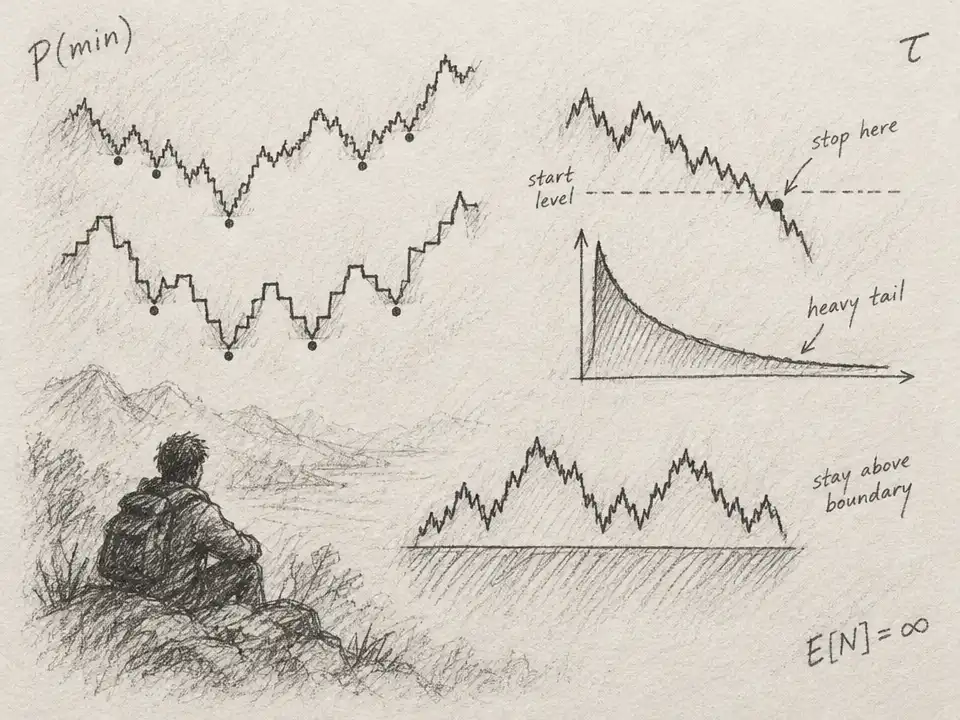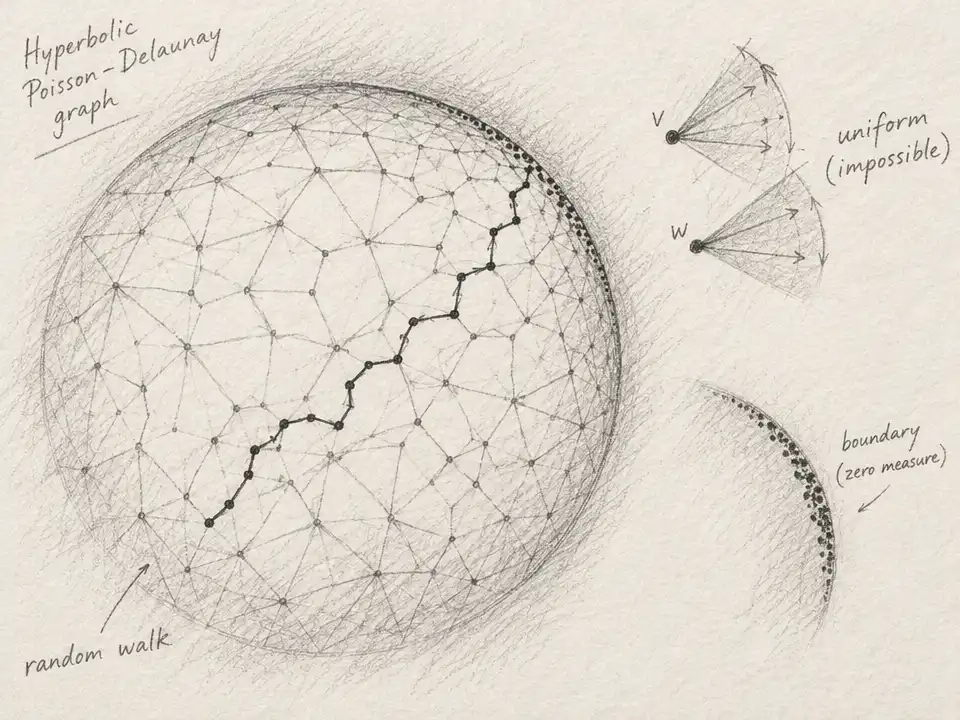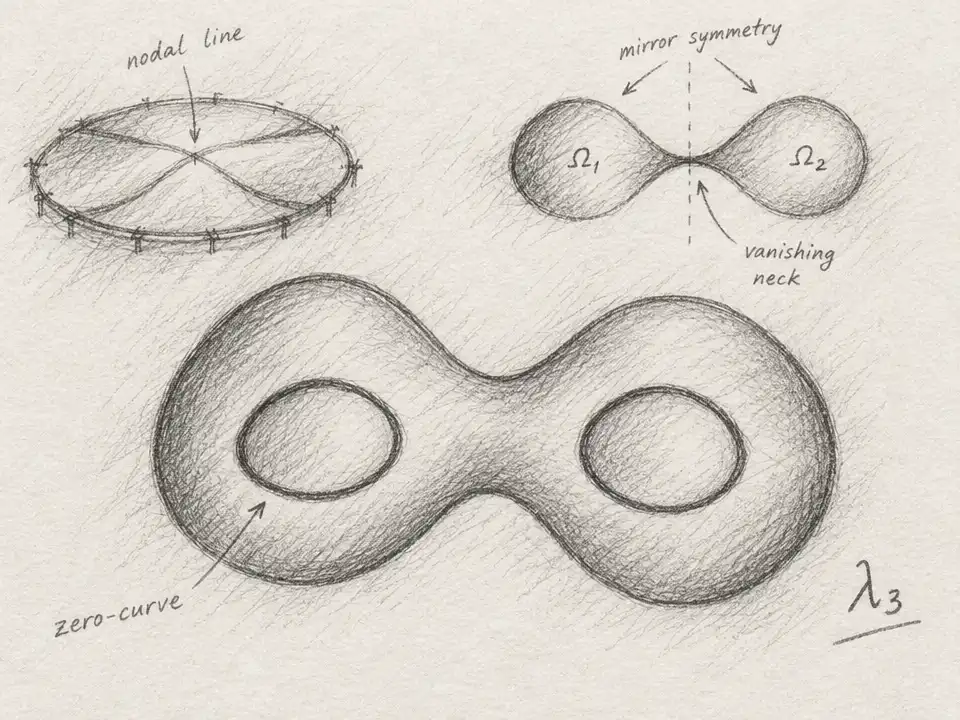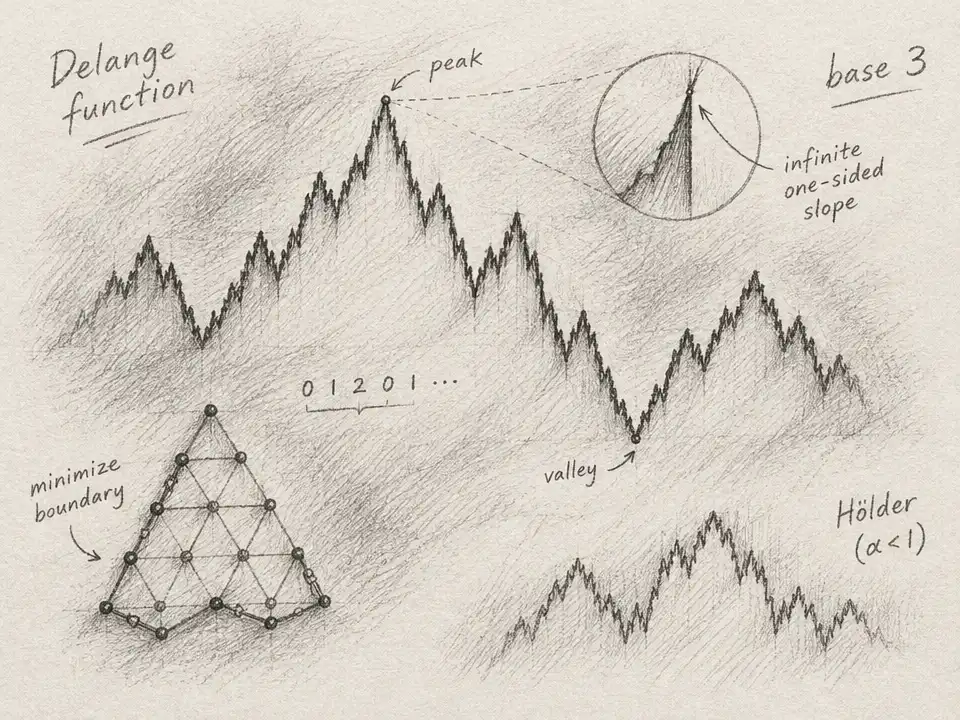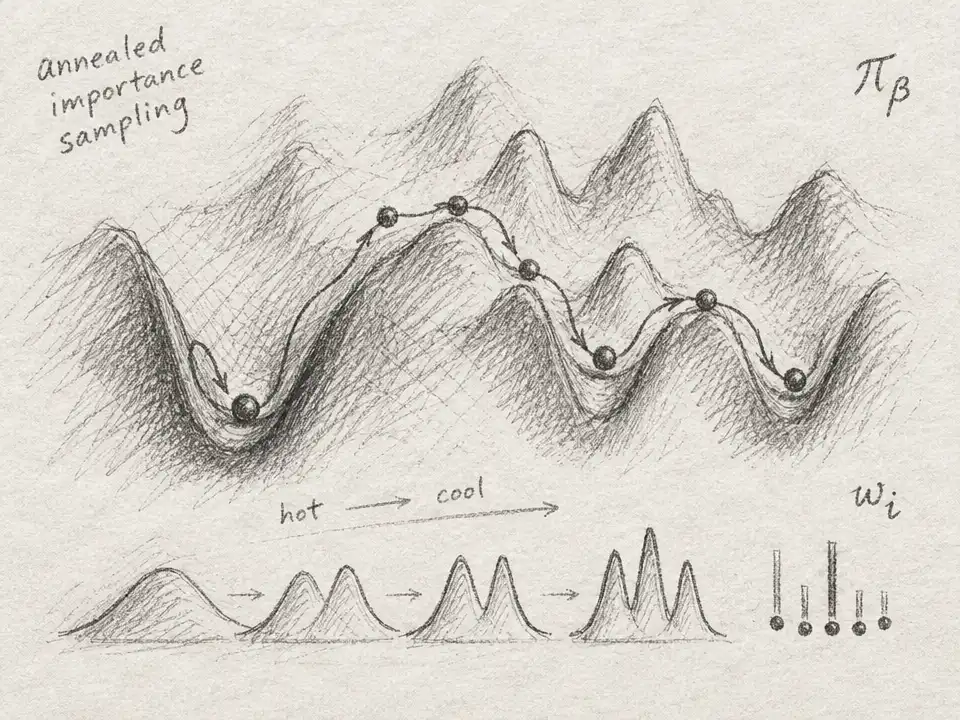
Picture a landscape full of valleys. A probability sampler wanders through it, trying to map where the important regions lie. At a comfortable temperature, random jolts can carry it over ridges and into neighboring valleys. Turn the temperature down, and the sampler settles into the low ground—but a ridge that once seemed crossable can become a wall. It may spend an age in one valley, unaware that another matters just as much.
This is more than a picturesque nuisance. In Bayesian statistics, an energy landscape can encode competing explanations of data. In statistical physics, it can describe configurations a system might occupy. In both settings, missing a whole valley means misrepresenting the possibilities. A standard strategy called Langevin sampling follows the landscape’s slope while adding random motion. It is useful, but at low temperatures, crossing high barriers can take exponentially longer as the temperature falls.
Seungjae Son’s new mathematical analysis explores a way around the bottleneck: don’t ask a sampler to leap a tall ridge while the world is cold. Let it travel through a sequence of temperatures instead. Start warmer, where random motion helps it explore; then lower the temperature in measured steps until it reaches the distribution of interest. The idea, known as annealed importance sampling, turns a single daunting crossing into a gradual journey.
There is a catch. Warming a landscape changes the probabilities the sampler is meant to represent. Son’s method keeps track of that shift with weights. At each temperature, the algorithm lets a point move according to Langevin dynamics, then adjusts its weight to account for the change in the target distribution. Repeat the process across the temperature schedule, and the final collection of points—unequally weighted—can represent the colder distribution even though the route there passed through warmer ones.
The striking result is not a new computer demonstration, but a proof that this strategy can work under a broad set of mathematical conditions. Earlier analyses handled compact spaces, where the sampler cannot wander off to infinity. Son extends the argument to ordinary unbounded space: the landscape can stretch outward without a boundary, provided it rises sufficiently far from its wells and meets other regularity conditions. The analysis also covers any finite number of wells, not just a pair, and allows varied saddle shapes between them.
For targets that meet those assumptions, the paper proves that a weighted collection of sampler outputs can approximate the desired distribution. In broad scaling terms, the computational cost grows like the inverse square of the target temperature and the inverse square of the desired accuracy, up to logarithmic factors. The exponents in this bound do not worsen with the number of dimensions. That is a meaningful theoretical contrast with ordinary low-temperature Langevin sampling, whose mixing time can grow exponentially because of energy barriers.
But “dimension-independent exponents” is not the same as “equally easy in every dimension.” The theorem’s constants can still depend on the landscape and the dimension, and the guarantee describes a mathematical algorithm, not a tested software package running on a real data problem. The bound is a map of what can be achieved under the proof’s conditions, not a promise that every difficult sampling job will become fast.
Those conditions are the price of the result. The wells must be sufficiently regular, with no degenerate critical points, and the energy must grow in a controlled way at infinity. Most importantly, the relevant wells cannot become vanishingly unimportant relative to one another over the temperature range used. Equal-depth wells satisfy the paper’s mass-balance condition; for unequal depths, the guarantee cannot simply be pushed to arbitrarily low temperatures, because the shallower well’s probability can dwindle toward zero. A rare but meaningful possibility is exactly what a sampler must not casually erase.
The proof’s hardest terrain is mathematical rather than computational. On an unbounded landscape, the functions that describe how the sampler relaxes need not stay bounded, and the spectrum of its evolution operator is not automatically as tidy as it is on a compact space. Son combines estimates that control behavior far from the wells with local arguments near critical points. For multiple wells, the proof also needs a carefully designed perturbation near saddle regions to control the relevant functions there.
That gives the result a clear frontier. It shows that annealing can, in principle, overcome the exponential slowdown of direct low-temperature sampling without restricting the world to a finite box. The next challenge is to learn how much of the theoretical route survives when landscapes are irregular, wells have sharply different probabilities, or computations use practical time steps rather than idealized continuous motion. Until then, the result is not a universal escape hatch. It is a proof that, under the right conditions, a sampler need not face every mountain at its steepest.