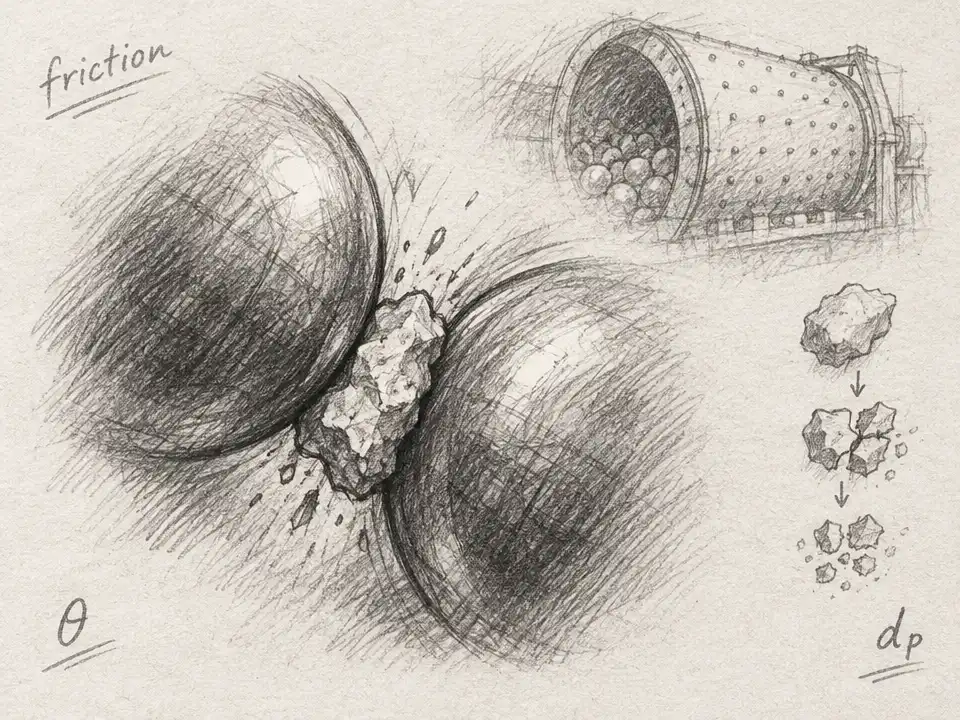
Inside a ball mill, steel spheres tumble together with rock, ore, or other material, turning large pieces into fine powder. The goal sounds straightforward: make the collisions harder, and more particles should break. But a grain caught between two moving balls has another possible fate. It can slip out of the way before the impact really squeezes it.
A recent study puts that escape route at the center of the problem. The researchers simulated a tiny scene from a mill: a brittle limestone particle touching one steel ball as a second ball rushes toward it. They varied the incoming ball’s speed, the angles of approach, the relative sizes of the balls and particle, and the friction between their surfaces. This was a computer study, not a trial inside a working mill—but it let the team separate collision geometries that are difficult to control one by one in industrial equipment.
The first surprise is that a collision has to pass two different tests before it can break anything. First, the smaller particle must be caught between the balls rather than pushed out of the gap. Then it must be squeezed hard enough to fracture. Speed matters to the second test. For the first, the geometry and surface friction can matter more: if the grain escapes, a harder blow does not rescue that collision.
Picture the approaching ball meeting the limestone grain off-center. The surfaces press on the grain from different directions. Their normal forces tend to shove it sideways; friction at the contacts resists that motion. If the collision angles fall outside the trapping range, the grain squirts free. It may feel some compression on the way out, but the simulations show that it is unlikely to fracture. In that case, more impact speed cannot turn a glancing escape into a sustained squeeze.
That distinction changes what “more friction” means. In the model, friction mainly widens the range of angles that can hold a grain in place. Once a particle is trapped, friction has much less influence on the peak compressive stress it experiences. For the study’s example of steel balls and limestone, the researchers used a friction coefficient of about 0.47, then explored values from 0 to 1. At zero friction, a grain was ejected for any nonzero impact angle in the head-on setup they examined. At friction coefficients of 0.75 or higher, it was not ejected—though at sufficiently oblique angles, the incoming ball could miss it altogether.
The researchers’ maps make the boundary visible. With a ball-to-particle size ratio of 4 and friction of 0.47, a head-on collision could trap the grain; at the same settings, the trapping boundary lay around 50.3 degrees. Beyond about 73.7 degrees, the incoming ball no longer contacted the particle. Between those limits, it could hit and still knock the grain free. These angles apply to that modeled setup, not every collision in every mill, but they show why a mill’s effectiveness cannot be judged from impact speed alone.
Only after trapping does speed become the more direct lever. For a head-on collision in the example setup, two different fracture criteria placed the threshold at about 2.5 meters per second using the stress-based criterion, and about 2.2 meters per second for a 63% fracture probability using the statistical criterion. Those figures are model predictions, not measured operating thresholds for a real mill. The two methods estimate failure differently, but both draw the same broad picture: a well-aimed, sufficiently fast impact can break a trapped particle.
Then comes another twist. Smaller particles were harder to trap across a wide range of collision angles, because the geometry left a narrower window for contact. Yet when a smaller particle did become trapped, the stress concentrated more strongly in it, making it easier to fracture in the model. So grinding finer material is a balancing act: the grains may be more vulnerable once caught, but harder to catch in the first place.
To estimate breakage, the authors used two approaches. One compares the particle’s average compressive stress with a material-dependent failure threshold. The other draws on Weibull statistics, which account for the fact that larger brittle pieces tend to contain more or larger flaws—the weak spots where cracks can start. The criteria gave similar overall patterns, though their predicted thresholds shifted with particle size. The statistical model also makes clear that fracture is not simply a matter of pushing until a grain is crushed: compression creates internal tension, which can open cracks and split the material.
The practical implication is not simply to turn the mill faster or roughen every surface. The simulations point instead to a sequence: make productive collisions more likely to be near head-on, keep enough friction to hold particles in the gap, and match ball sizes to the particles being ground. The authors suggest that mill rotation, liners, and lifters could influence collision angles; surface condition or, in wet milling, slurry additives could affect friction. These are design directions suggested by a simplified model, not a demonstrated recipe for improving an operating plant.
That caveat matters. The study follows three spheres in a controlled geometry, with one grinding ball fixed. A real mill contains many balls and particles in motion, with a broad range of sizes and collisions. The researchers say that connecting their collision maps to a realistic mill—and to the distribution of impacts inside it—is a next step. Still, the small model exposes a useful blind spot in the intuition that harder hits automatically mean more grinding. Before a collision can break a grain, it has to keep hold of it.