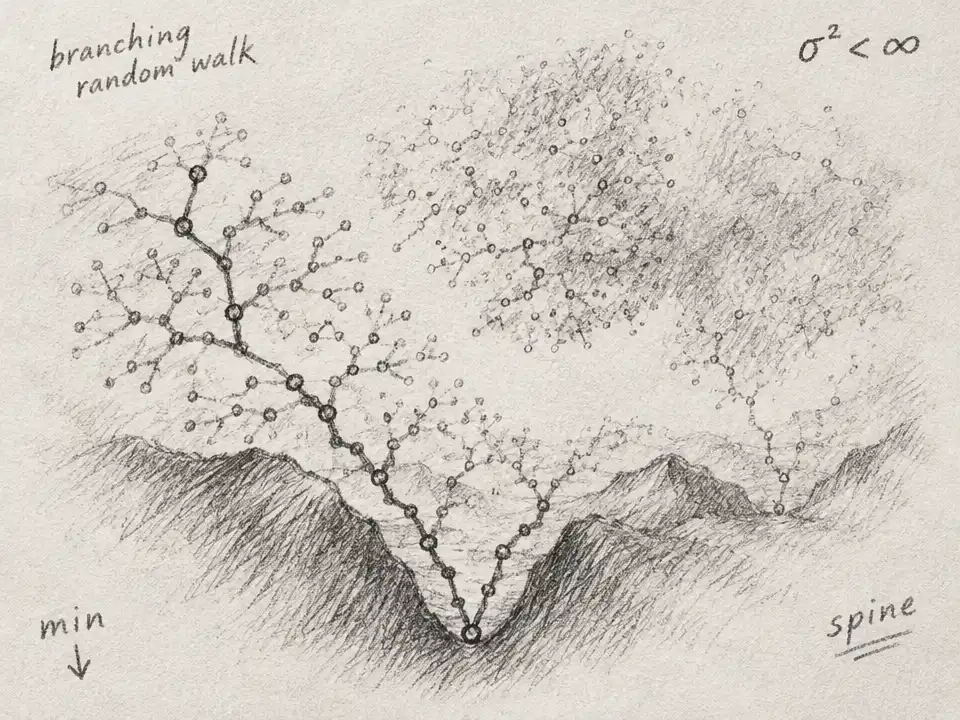
Imagine looking down a branching family tree, one generation at a time. Each branch carries a traveler whose position changes with every step. The farther down the tree you look, the more travelers compete to be the leftmost. Surely one special path, however long it lasts, should eventually lose that contest.
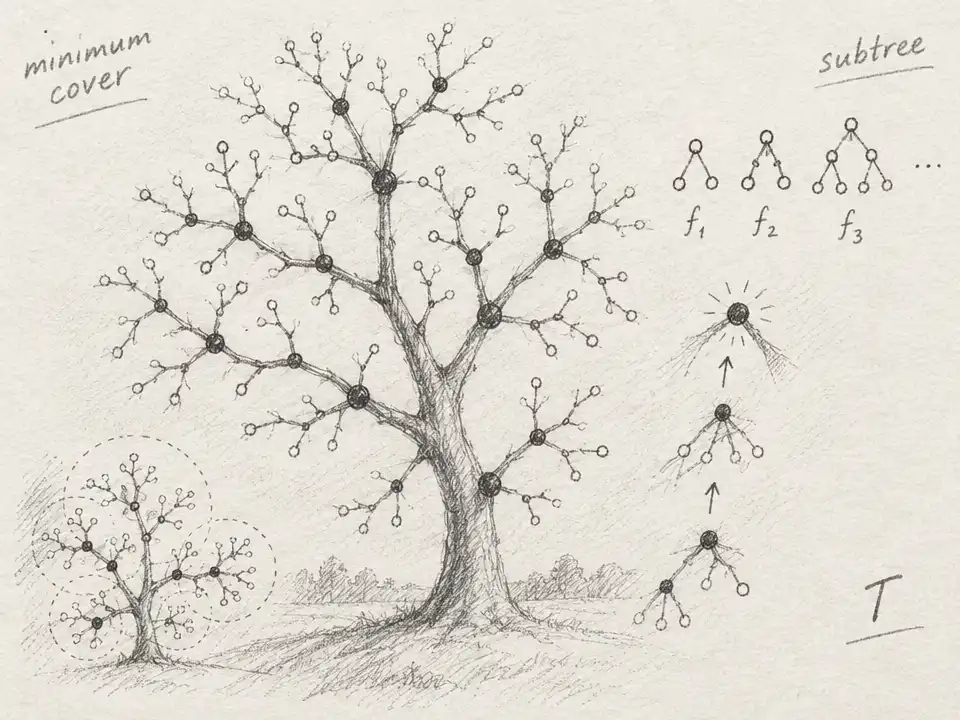
A recent mathematical study asks what happens in a carefully constructed version of this forest. The starting population follows a critical branching rule: each individual has one child on average, but the number varies. In the ordinary model, the population eventually dies out almost surely. The researchers instead use a size-biased version, which guarantees an endlessly continuing ancestral line called the spine. Other children of spine members start ordinary branching populations.
Each family member also receives a position. Every step adds an independent random displacement, which might be positive or negative. At each generation, the question is whether the spine’s traveler is at the smallest position in the entire population. The competition is spatial, not genealogical: being on the immortal family line does not automatically make someone the leftmost.
The surprising answer is that, when the variation in offspring number is positive and finite, the spine keeps returning to the minimum—infinitely often. Even more unexpectedly, the result does not require the step sizes to average out, or even to have a finite mean or variance. The spatial rules can be extraordinarily wild. What matters for the main recurrence result is the reproduction process.
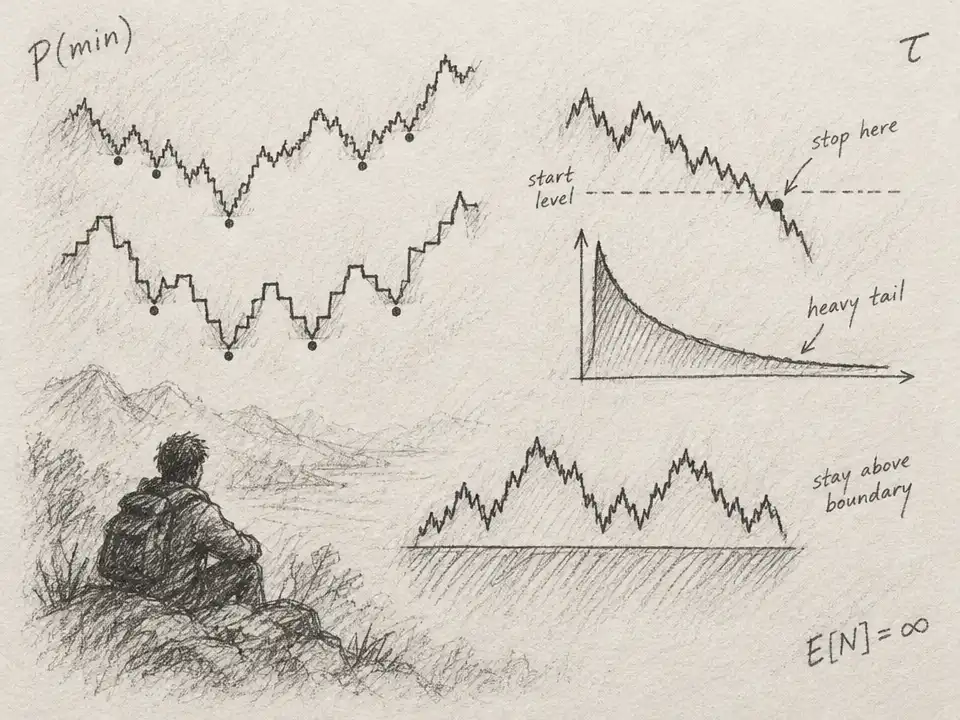
The first clue is a cancellation hidden in the size-biased construction. At a given generation, the spine is equally likely to be any one of the living particles once the family tree is known. But the size-biased model also gives greater weight to trees with more living particles. When asking whether the spine is a chosen minimum—using a fixed rule to break ties—the chance of selecting that one particle is the reciprocal of the population size. The two effects cancel. The probability that the spine is the chosen minimum at generation n is exactly the ordinary population’s chance of surviving to generation n.
For a critical branching process with finite positive offspring variance, that survival chance falls approximately like two divided by the offspring variance times n. Add those chances across generations and the total grows like a logarithm. The paper proves that this is more than a statement about averages: almost surely, the number of chosen-minimum visits grows like the logarithm of N raised to a power tending to one, where N is the number of generations examined. In probability, the count has the scale of the logarithm of N.
That distinction matters. Visits at different generations are dependent, so an expected count alone cannot establish what happens along a typical infinite tree. The proof exploits the spine’s repeating structure: after an earlier visit, its future descendants form a fresh branching process. This gives bounds on how often visits cluster. The authors also handle ties, where several particles share the lowest position. For any nonconstant displacement law, the spine’s chance of being among the tied minima stays within a fixed factor of the ordinary survival probability. Requiring the spine to be the unique minimum still gives the same broad recurrence and frequency conclusions.
The result has a pleasing symmetry. Reverse every step’s direction, and a minimum becomes a maximum. So the spine also occupies the top position in infinitely many generations. That does not mean it reaches the top and bottom at the same time. Nor does the paper show that the actual count divided by the logarithm settles to one precise constant. The authors leave the sharp frequency and the limiting distribution of the count open.
Then the story changes when offspring numbers have infinite variance. The paper studies a specific family of heavy-tailed reproduction rules. In that family, the ordinary population’s survival chance decays like a power of n with exponent greater than one. Those chances add to a finite total. The authors show that, for any nonconstant step-size law, the spine is at the spatial minimum in only finitely many generations almost surely.
So a small change in how a family reproduces can flip the outcome: endless returns in the finite-variance setting, but only finitely many in the paper’s infinite-variance example. This is not a classification of every possible infinite-variance branching process; the authors leave that broader question open. Still, the contrast changes how the original puzzle looks. The immortal path’s recurring victories are not driven by unusually favorable steps. They emerge from the arithmetic of survival—how likely an ordinary critical family is to still have someone alive at each distant generation.