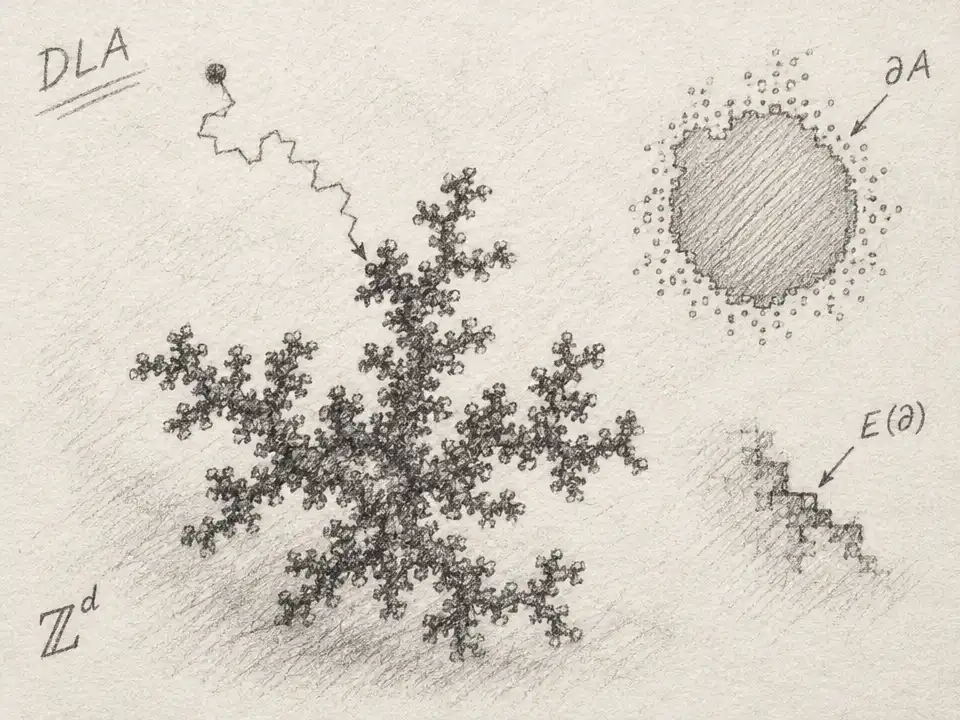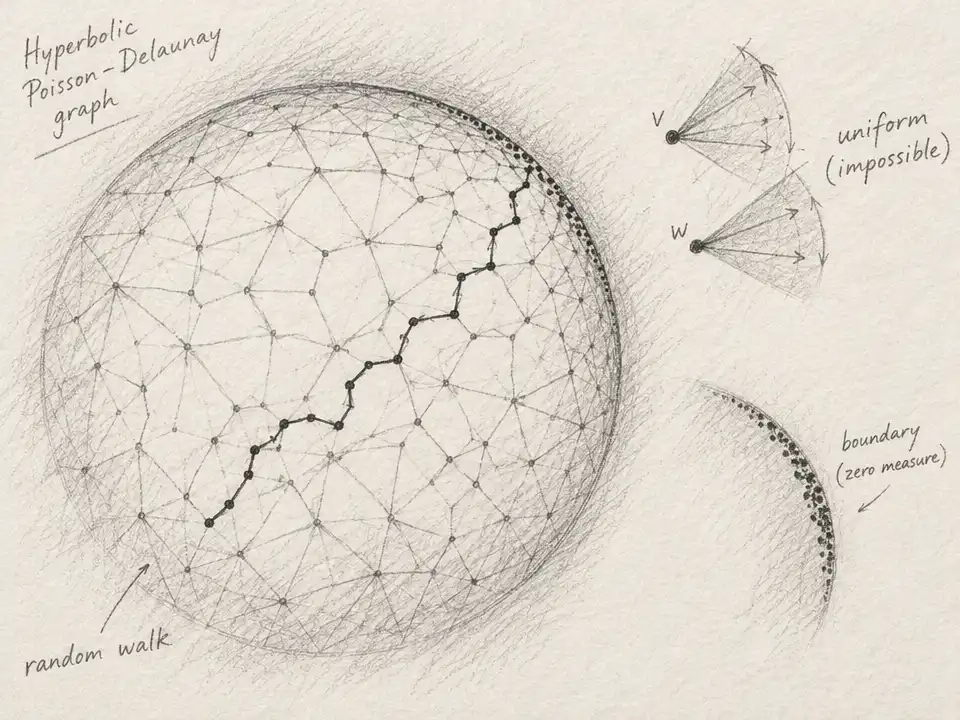
Here is a mathematical scene with an odd twist. Scatter points at random through a negatively curved space, connect nearby points according to the shapes of their Voronoi cells, then let a walker choose a neighboring point at random over and over. The space stretches away toward a boundary at infinity. The walk eventually reaches that boundary—but, in almost every fixed random landscape, its possible destinations are confined to a set with zero surface measure.
Now change the question. Don’t freeze one landscape: average the walk’s endpoint distribution over all the random landscapes. Rotational symmetry says the average is perfectly uniform around the boundary. How can nearly every individual distribution be squeezed into a zero-measure set, while their average spreads evenly everywhere? The difference between those two statements is the puzzle at the heart of a new result by mathematician Kohki Sakamoto.
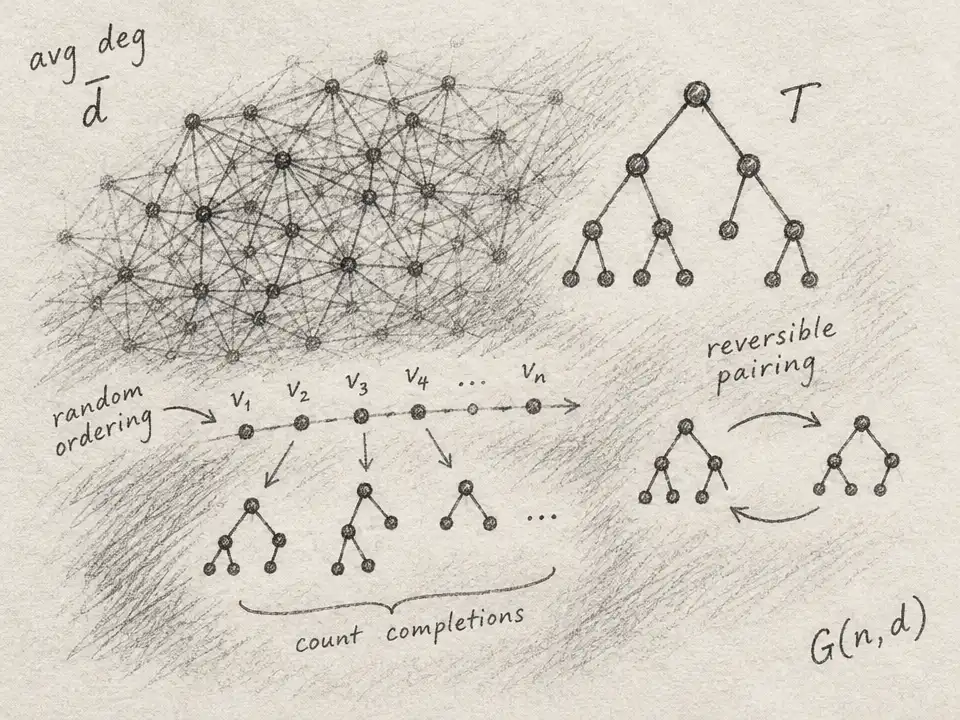
The construction begins with a Poisson point process: in any region, the number of points is random, with more expected in larger regions, and disjoint regions fluctuate independently. Each point gets a Voronoi cell containing the locations closer to it than to any other point. Join two points when their cells share a face. The resulting Delaunay graph turns the curved space into a random network. A simple random walk moves along its edges, choosing each available neighbor with equal probability.
Earlier work had shown that this walk makes steady progress outward: its distance from its starting point grows roughly in proportion to time. In hyperbolic space, paths that keep moving outward settle toward points on the boundary at infinity. For a fixed network, the harmonic measure is the probability distribution of that final destination. It does not describe one path, but the statistical pattern formed by many possible walks through the same frozen network.
The first clue is that symmetry of the whole random construction does not mean symmetry of each realization. Averaging across landscapes erases their individual quirks, leaving a uniform distribution. But that average alone cannot tell us whether a typical landscape produces a smooth distribution, a concentrated one, or a mixture. Sakamoto’s proof first narrows the possibilities: an ergodic argument forces an all-or-nothing choice. Almost surely, the endpoint distribution is either absolutely continuous with respect to surface measure, or singular—concentrated on a set of surface measure zero.
That still leaves two rival explanations. Could a typical network send walkers toward the boundary in a sufficiently even way to produce a smooth distribution? To rule this out, the proof looks not just at destinations, but at pairs of destinations. A boundary measure called the Naïm current keeps track of how paths through the network link two points at infinity. It also connects those paired paths to the energy of functions that assign boundary values to locations in the network. In this setting, energy measures how much those values vary across connected points.
Assume, for a moment, that the smooth option is true. The ergodic structure then imposes a striking rigidity: the boundary current must match a fixed geometric pattern, apart from which pairs of destinations it includes. And Poisson randomness supplies a way to test that rigidity. A typical configuration stays typical after almost any finite insertion of new points. The researchers exploit that freedom to add a carefully arranged cluster near one existing site, changing a small part of the network while leaving distant connections alone.
The cluster is designed around the site’s neighbors. For each neighbor, three new points create three two-edge routes from the original site to that neighbor. This local construction has a global consequence for energy: the insertion can only increase the relevant energy, and the increase vanishes only if the harmonic values at the original site and all its neighbors are equal. In plain language, if the assumed smooth boundary pattern survives this carefully chosen change, the walk’s boundary predictions must become identical when it starts from neighboring sites.
That conclusion spreads through the connected network. Under the smoothness assumption, every starting site would have the same distribution of destinations. But the construction is also compatible with the symmetries of hyperbolic space. Averaging those identical, symmetry-respecting distributions would require a probability distribution on the boundary that is unchanged by every hyperbolic isometry. No such invariant probability distribution exists. The smooth option therefore leads to a contradiction.
For the hyperbolic plane, the proof can compare the energy of smooth boundary data directly. In higher dimensions, that energy may be infinite, so the argument instead compares finite, reduced energy calculations on selected sets of vertices. The technical route changes, but the contradiction remains: local insertions would force a kind of uniformity the geometry cannot support. The result applies in every dimension at least two and at every positive intensity of the Poisson process.
So the answer to the opening puzzle is not that symmetry secretly makes each landscape uniform. It is that the uniformity appears only after averaging over landscapes. In almost every frozen network, the endpoint law is singular: it assigns all its probability to a boundary set that occupies no surface area. The theorem does not claim that this set is a single direction, or specify its detailed shape. It proves the surprising contrast itself. A random walk can look evenly spread when the world keeps changing, yet hide on a measure-zero set when you hold one world still.