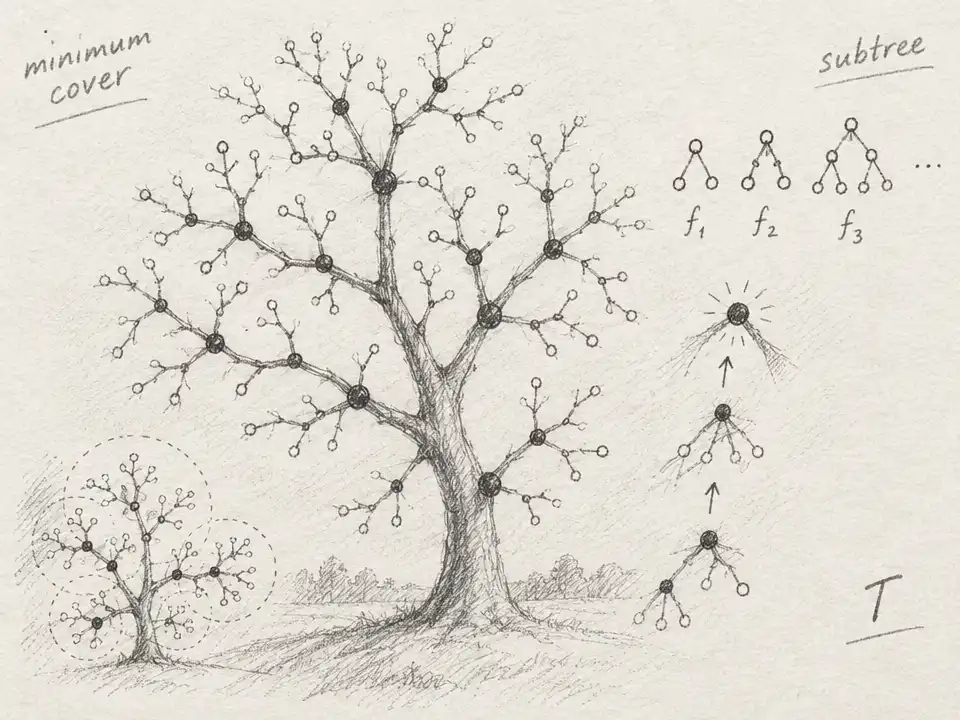
Imagine a sprawling tree with thousands—or millions—of vertices. You want to place as few watch stations as possible so every vertex lies within a fixed number of steps of one. The best arrangement seems like a problem for the whole tree: move one station, and the right choice elsewhere might change. Yet a new mathematical approach shows that, for many large random trees, the fraction of stations required can be read from the small rooted subtrees that appear again and again.
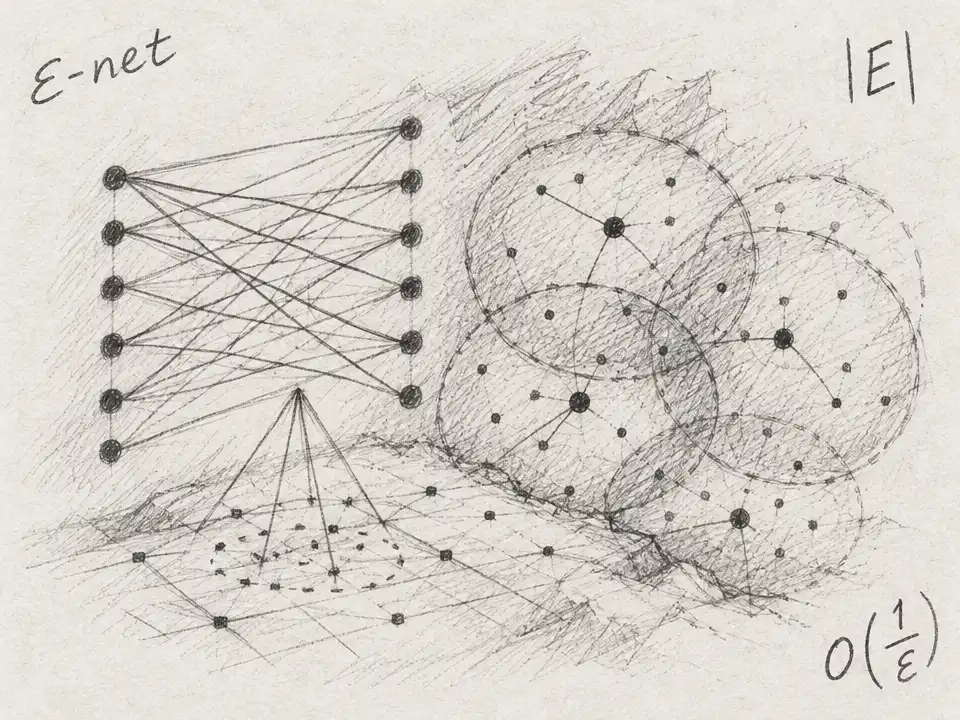
The same result reaches a second kind of arrangement. Instead of covering every vertex, choose a set of vertices spaced far enough apart that no two are too close. This is a packing problem. On trees, a classic identity connects the size of a minimum cover of radius r with the size of a largest packing whose centers are separated by more than twice that distance. The new work uses this connection to bring both questions into one local framework.
The obstacle is that an optimum is usually global. A station near one branch may cover part of another; a locally sensible choice could force extra stations later. And a tree can have many different minimum covers, each with centers in different places. Simply inspecting a small neighborhood around every vertex does not, by itself, tell you which vertices belong to an optimal solution.
The researchers’ way through is to define one particular minimum cover—a canonical one—by growing it upward from the ends of the branches. Start with every vertex uncovered. When an uncovered vertex lies at least r steps from the root, select a suitable ancestor: one whose still-uncovered descendants reach exactly r steps away. That selected vertex becomes a center, and everything within distance r of it is removed from the uncovered set. Repeat until the remaining uncovered vertices are close enough to the root, then add the root if needed.
It is a little like placing lamps while walking in from the tips of a branching cave. Each lamp is positioned high enough to illuminate the deepest remaining pocket below it, but not so high that a lower position would have worked just as well. The order of choices might seem arbitrary, but the authors prove that this procedure always produces a minimum cover and that its final set of centers is unique, regardless of which valid choice is made at an intermediate step.
The crucial property is even more surprising: whether a vertex is selected in the procedure can be determined from the rooted subtree hanging below it. The rest of the giant tree does not affect that vertex’s status in the canonical construction. In technical language, the selection rule is local in the tree’s fringe structure—the collection of subtrees rooted at its vertices.
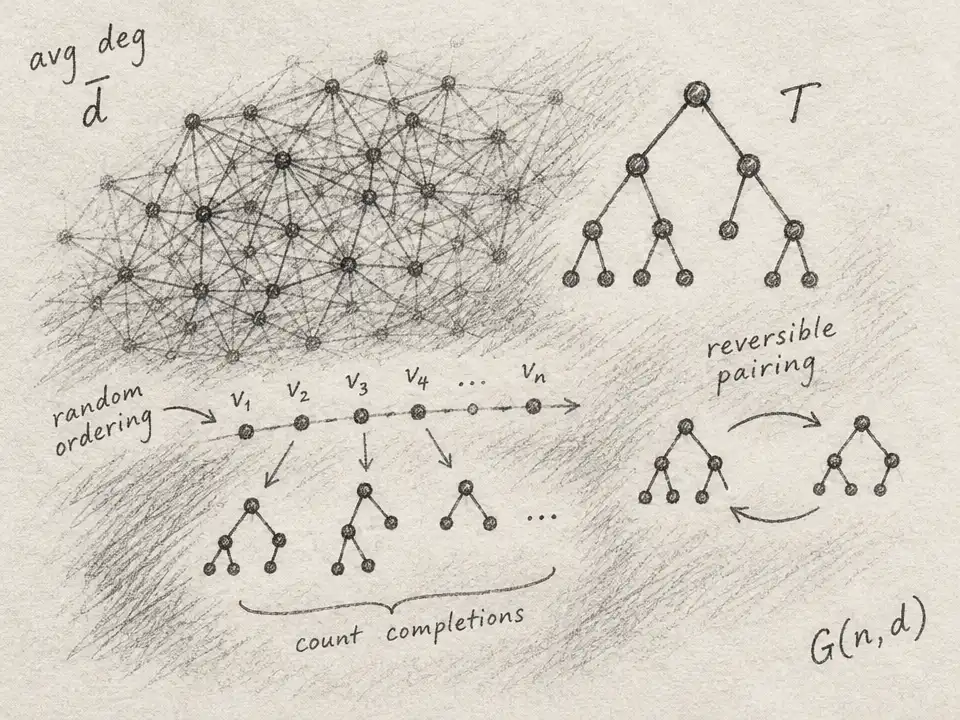
That turns an enormous optimization into a counting problem. If, in a sequence of larger and larger trees, the share of vertices carrying each finite rooted-subtree shape settles toward a limiting distribution, then the share selected as cover centers settles too. The limiting density is the probability that the root of a randomly sampled fringe subtree would be selected by the canonical rule. Since the total number of centers is just the sum of those local selection indicators, stable frequencies of local shapes yield a stable fraction of centers.
The researchers prove that this conclusion holds whenever the trees’ fringe distributions converge in the required sense. It is not a claim that every tree can be solved by inspecting only small pieces, or that every random tree has the same density. Rather, once a tree model has a known limiting distribution of rooted subtrees, the theorem translates that local information into the asymptotic fraction of centers needed for a minimum cover. The packing result follows through the covering–packing identity for trees.
The range of examples makes the framework feel less like a trick for one specially designed tree and more like a reusable measuring tool. It applies to models including uniform ordered trees, uniform binary trees, random recursive trees, simply generated trees, preferential-attachment trees, and the minimum spanning tree of a complete graph. For a uniform spanning tree of a complete graph, for instance, the relevant local limit is an unconditioned branching tree with a Poisson-one offspring distribution. The paper’s theorem then says that the large-tree covering density is determined by applying the canonical rule to that limiting local model. For the minimum spanning tree example, the fringe convergence is in distribution, so the resulting conclusion is convergence in expectation rather than the stronger convergence in probability.
For certain branching-tree models, the authors also show how to compute the limiting constant through a recursive calculation. A tree can be assembled by joining smaller rooted trees beneath a new root; the method tracks how the partial covering behaves as those pieces merge. That gives a practical route from the distribution of the number of children at each vertex to the predicted covering density, without having to optimize over a huge tree directly.
The broader lesson is that “global” does not always mean “unknowable from local structure.” On a tree, the branches give the problem a direction: a carefully chosen minimum cover can be built so each vertex’s role is settled by the descendants below it. Once that hidden local rule is exposed, the behavior of enormous random trees can be understood by asking a much smaller question: what kinds of rooted subtrees does a typical vertex see?