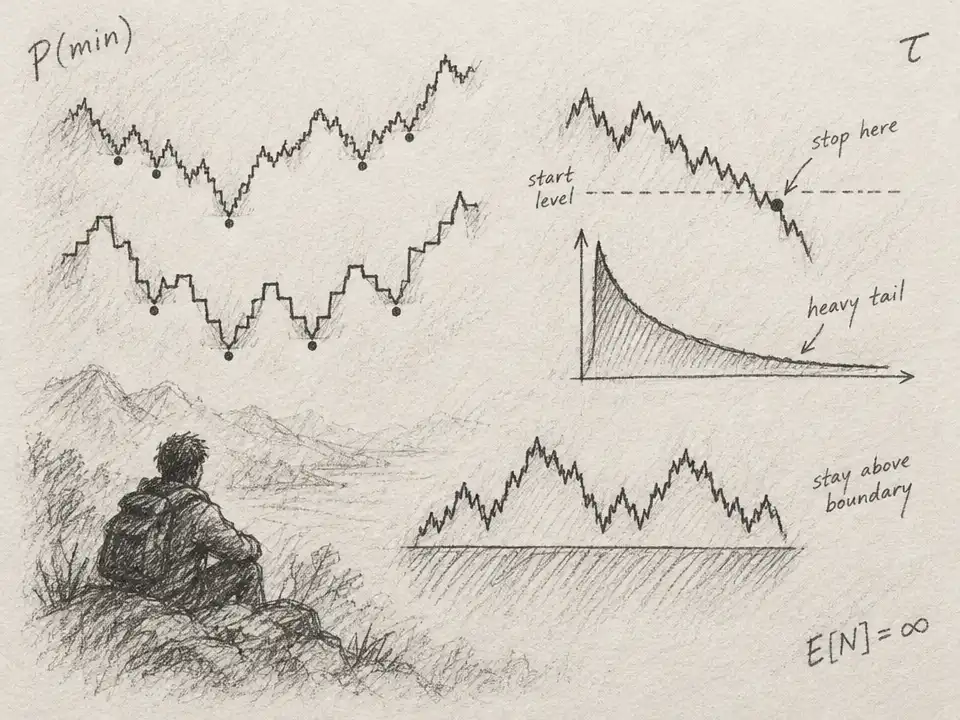
Imagine two explorers drawing a jagged landscape, one taking cautious little steps and the other occasionally leaping across a canyon. Their maps look nothing alike. Yet when researchers count the valleys in those paths, a surprising thing can happen: the odds of finding a particular number of minima are exactly the same.
The key is to ask what counts as a valley. In a step-by-step path, a point is a local minimum when the walk descends into it and then climbs away. The height of each jump seems as if it ought to matter. A leap could plunge the path far below its previous level; a short hop could barely change it. But in a freely wandering path with symmetric jumps, the basic count of valleys depends on something simpler: whether each step went up or down.
That observation helps explain a result for random landscapes generated by ordinary random walks and by Lévy flights. A Lévy flight can make rare, exceptionally long jumps, unlike a walk whose step lengths have a finite variance. The two paths can have dramatically different shapes. Still, for the question “How many local minima are there after a fixed number of steps?” the full probability distribution is identical across these different symmetric step-length rules.
For a path with a fixed number of steps, the researchers find that the typical number of minima is about one for every four steps. The spread around that typical count becomes more predictable as the path grows: for long walks, the distribution approaches a bell curve. This is not because the landscapes have become smooth or their jumps have become alike. Rather, each valley is created by a downward step followed by an upward one, so the pattern of signs carries the relevant information.
But the apparent simplicity has a catch. What if the path does not stop after a preset number of steps? What if it continues until it crosses its starting level for the first time?
That stopping rule changes the question. The walk is now selected by its own history: it must stay on one side of the starting level until its first return across it. The researchers found that the number of valleys in this first-passage landscape has a very different distribution. Large counts are much less rare than a bell curve would suggest. The probability falls with a power-law tail, proportional to the number of minima raised to minus three-halves. That tail is so broad that the average number of minima, taken over all such paths, diverges.
This does not mean a single path contains infinitely many valleys. Each path has a finite count. The divergence arises because unusually long excursions occur often enough to pull the mathematical average upward without limit. A few extraordinary walks matter disproportionately.
To uncover why, the researchers changed what they watched. Instead of tracking every step, they connected the successive valleys and treated their heights as a second, auxiliary random walk. It is a clever shift in viewpoint: a complicated landscape becomes a simpler walk through the sequence of its minima. In the first-passage setting, asking whether the original path accumulates many valleys becomes equivalent to asking whether this auxiliary walk survives on one side of zero for many steps.
That survival question has a remarkable property. For symmetric, continuous jump rules, its probability does not depend on the detailed distribution of jump sizes. The same mathematical structure therefore links paths built from ordinary finite-variance steps to paths capable of Lévy-like leaps. The landscape remembers the boundary condition—where the walk is allowed to go and when it must stop—but, within the stated assumptions, it forgets much of the microscopic recipe for its jumps.
A follow-up study pushed the idea further. It examined three versions of the problem: an unconstrained walk, a walk required to stay nonnegative for a fixed number of steps, and a walk that stays positive until its first crossing back below zero. The rules produce different distributions of minima. Yet each distribution remains universal with respect to the symmetric jump-length distribution. The same auxiliary-walk mapping supplies a common framework for deriving all three.
That comparison makes the real lesson sharper. Universality does not mean every detail is irrelevant. Change the jump-size distribution within the allowed symmetric class, and these counts stay put. Change the stopping or survival rule, and the distribution changes. The boundaries and the way a path is sampled can matter more than the distances it travels.
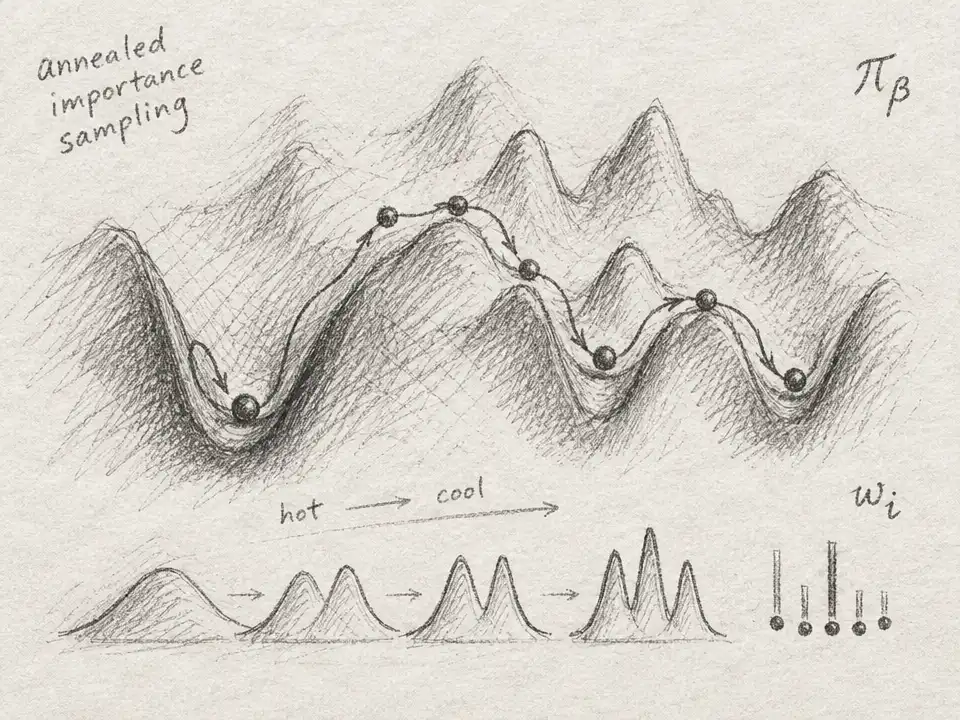
Why care about counting valleys in an abstract path? Random landscapes are used to represent settings where systems face many possible configurations and may become trapped in local low points. In that picture, valleys stand for potential resting places, and the number and arrangement of them help describe how complicated the landscape is. The studies do not claim that every real material, biological system, or optimization problem follows this exact model. They offer something more focused: an exact result for a clean, one-dimensional setting, and a method that may help researchers identify which features of a more complex problem truly control its statistics.
The journey from one valley to the next reveals a subtle bargain. Randomness can make the terrain wildly uneven, but certain counts remain strikingly robust. Then a single change—letting the walk decide when it ends—can replace a familiar bell curve with a distribution dominated by rare, sprawling excursions. The steps make the landscape. The rules for stopping decide what its valleys mean.