Imagine shaping two waves so each would normally spread out and settle down. Now let them travel together through a nonlinear medium. A new mathematical study finds that their interaction can reverse the forecast: the pair may sharpen toward a dramatic peak, even though neither wave would do so alone. The clue comes from a kind of mathematical early warning borrowed from the language of fluid motion.
The waves in the study are not ocean swells. They are modeled as slowly changing envelopes, a framework used for light in nonlinear optical materials and for other systems, including two-component Bose-Einstein condensates. Each wave affects its own evolution, but it also feels the intensity of the other. The fields are coupled: what happens to one can alter the path of the other.
The researchers start each field with a simple shape: a rounded, parabolic profile that fades to zero at its edges. They also give it a quadratic phase, a pattern called a chirp. In practical terms, the chirp sets how the wave’s local frequency changes from place to place. It is one of the knobs that can be adjusted in an experiment, making it a natural candidate for controlling what happens next.
To follow the evolution, the team translates the wave equations into a fluid-like description. The wave’s intensity becomes a density, while changes in its phase become a velocity. In this picture, the waves behave somewhat like interacting streams of fluid. That shift in viewpoint brings a familiar problem into focus: a smooth flow can steepen until neighboring parts move at sharply different speeds.
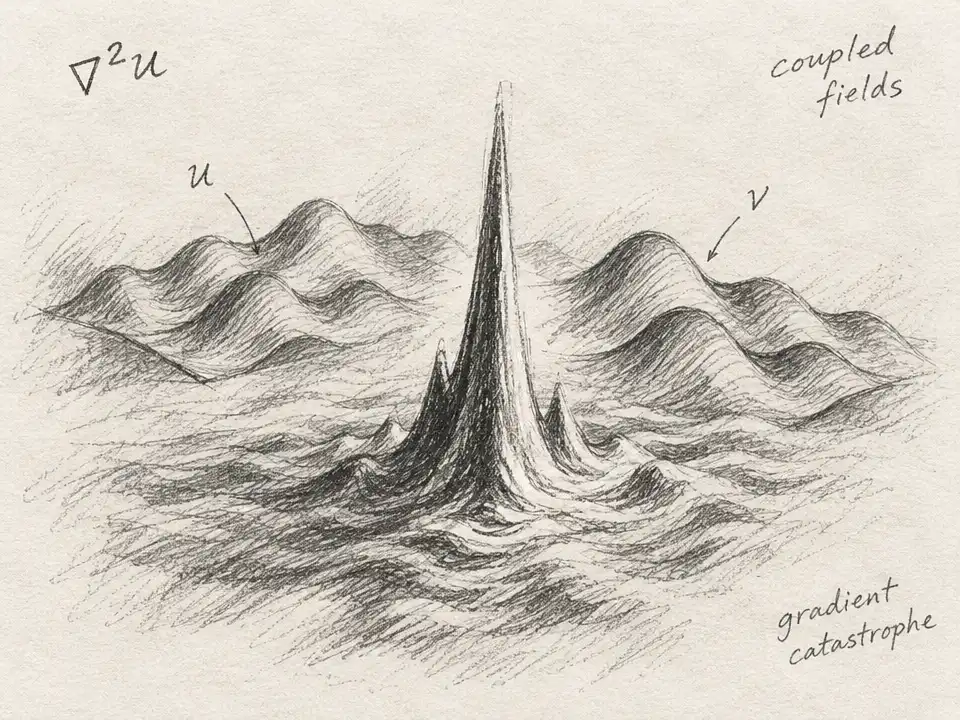
In the fluid model, that steepening can reach a gradient catastrophe: the slope becomes unbounded, and the smooth description breaks down. It is not a claim that the physical wave’s height literally becomes infinite. Instead, it marks the point at which the simplified, dispersion-free model can no longer follow the developing shape. In many wave systems, what happens around that breakdown is precisely the interesting part.
The mathematical shortcut is to ask whether the initial parabolas keep their basic shape as they evolve. In the dispersion-free model, they do: their heights, widths, and curvatures change, but the profile stays parabolic. That self-similarity reduces a complicated problem about waves across space and time to a smaller set of equations tracking those changing features. The authors use this reduced model to derive conditions for whether the profiles relax or reach a catastrophe, and when the catastrophe occurs.
Then comes the unexpected twist. Because each field’s intensity contributes to the other’s evolution, coupling can change the outcome. The researchers find cases where each field, considered by itself, would relax, yet the two together develop a catastrophe. With matching initial supports—the regions where the two profiles exist—the coupled catastrophe affects both fields. In their analysis, when a catastrophe occurs, coupling brings it earlier than it would arrive in either field on its own.
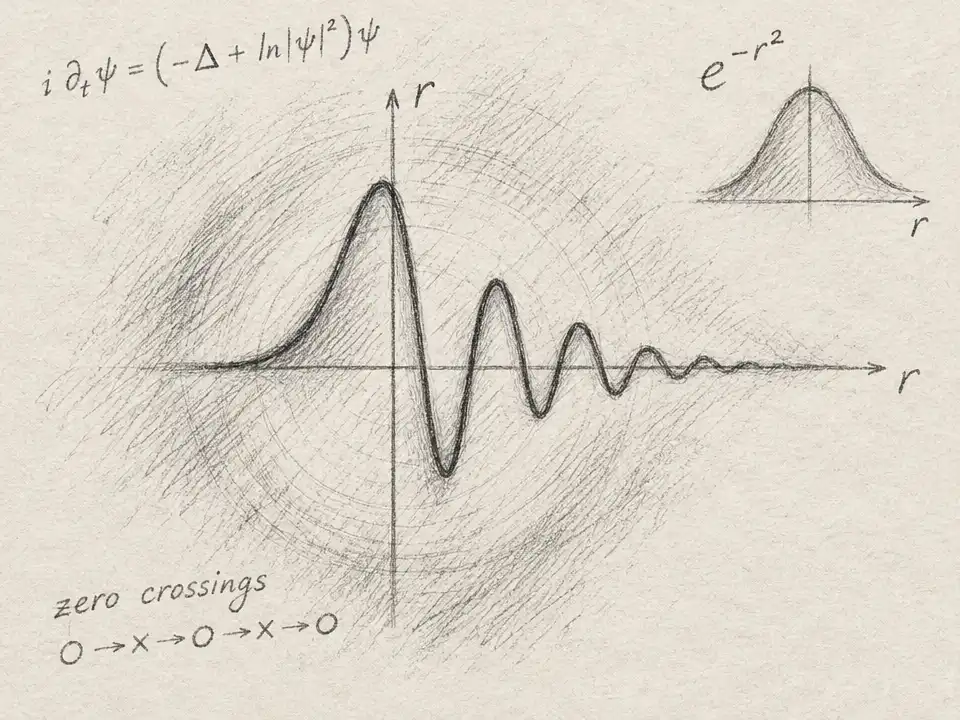
That warning sign becomes useful when the researchers restore dispersion, the effect left out of the fluid-like approximation. Dispersion matters: rather than allowing the sharp mathematical break to continue unchecked, it reshapes the wave near the predicted catastrophe. In numerical simulations of the full wave equations, the researchers see intense, localized peaks emerge near the time forecast by the simpler model. Their shapes resemble a well-known idealized wave structure called a Peregrine soliton, with neighboring dips around the central peak. The team describes these features as rogue-wave-like.
This is the crossover at the heart of the work: a mathematical tool for tracking steepening in fluid-like equations helps predict the timing of extreme structures in coupled waves. Rather than begin by resolving every fine detail of a dispersive wave, the researchers first identify where the simpler model is headed. In the cases they simulate, the time of its gradient catastrophe is a reliable guide to when the full wave develops its peak.
The result is not a universal recipe for making rogue waves. The comparison with the full dispersive system is numerical, and it concerns a restricted setup: parabolic initial profiles, matching supports, and weak dispersion. The reduced construction is an exact dispersion-free solution when the initial supports and chirps match; with different chirps, it is expected to describe the neighborhood of the profiles’ maxima, rather than every point in the wave. The authors also point to possible relevance for optical and condensate experiments, but they do not report having performed those experiments.
Even with those limits, the study offers a useful way to think about control. The onset of a dramatic wave structure may be written into the initial phase and shared intensity before the peak appears. And in a coupled system, the crucial actor may not be either wave alone, but the interaction that makes one field’s fate part of the other’s.
That is why the fluid analogy matters. A gradient catastrophe is not the rogue wave itself; it is a sign that the smooth, large-scale motion is about to hand the story over to finer wave physics. Here, that sign appears to carry across the boundary between two fields of study—and may help researchers know when to look for a peak.