Imagine a wave spreading across an endless, empty plane. With nothing to interrupt it, the wave can travel outward, carrying energy with it. Now add a landscape so faint that its overall strength can be made arbitrarily small. You might expect the wave to keep behaving much the same. A new mathematical construction shows how wrong that intuition can be.
In an October 2026 arXiv preprint, mathematicians Simon Becker and Mengxuan Yang build a smooth, nonnegative potential that changes the very kind of energy states available to a wave. The key is not a towering wall or a single deep pit. It is a hidden architecture of rings, each placed far beyond the last, whose subtle patterns work together across distance.
The result challenges a conjecture about the Schrödinger equation, the mathematical framework used to describe quantum waves. In free space, a particle can have any energy in a continuous range, and its wave can spread outward. Mathematicians call that traveling part of the spectrum absolutely continuous. Barry Simon conjectured that, in two or more dimensions, a sufficiently well-behaved, decaying potential would preserve such traveling states at almost every positive energy.
Becker and Yang construct a counterexample. Their potential can be made arbitrarily small not only in peak height but also in weighted measures of its total size. Those measures penalize potential far from the origin, and the result still holds with an additional distance weight whose exponent can be any value below one-third. Yet the operator has no continuous spectral component at positive energies.
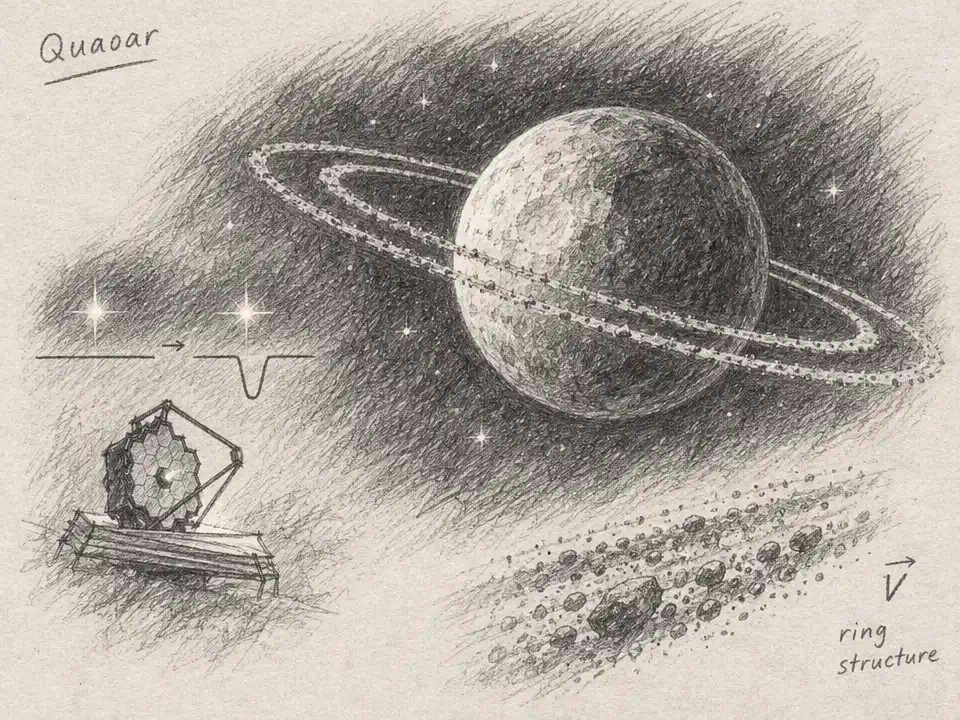
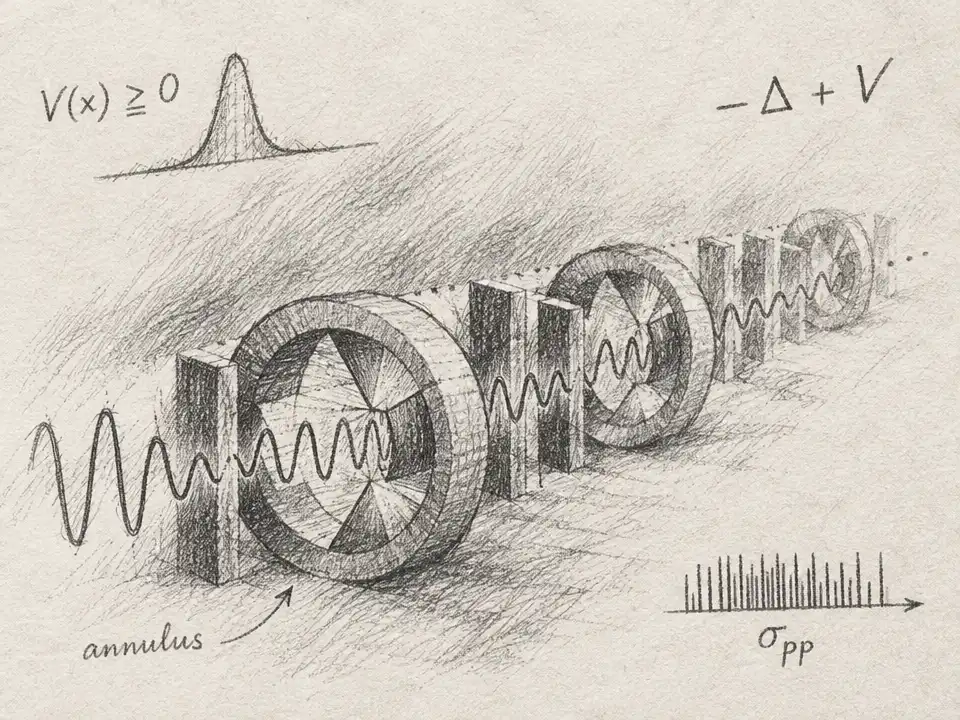
To see how the landscape works, zoom out. The authors place potential in widely separated annuli: thin bands centered on the origin, with enormous empty stretches between them. Inside each band, two patterns cooperate. One is an angular lens, arranged to funnel certain wave components into narrow directions. The other is a periodic barrier, patterned to reflect waves in selected energy ranges.
The word lens is more than decoration. A wave arriving at an annulus is not simply met by a uniform circular wall. The angular pattern reshapes how its components move, concentrating them along paths that encounter the reflecting parts of the band. The periodic structure, meanwhile, is tuned so that its gaps block waves over chosen ranges of energy. Together, the patterns make the annulus behave less like a simple obstacle and more like a carefully set trap.
One ring could not do the whole job. A barrier designed for a limited energy range cannot automatically account for every higher energy. So the construction keeps going: farther rings are designed to handle broader ranges, and the ranges grow as the rings recede. From nearby, the landscape may look almost empty. At the scale of the whole construction, its rings form a sequence of increasingly comprehensive barriers.
The proof does not follow a wave through this infinite maze one collision at a time. Instead, the researchers show that, at each scale, waves driven by a source inside a region can be approximated by solutions that vanish outside a larger region. The error can be made extremely small, apart from narrow exceptional sets of energies. By coordinating these approximations across the rings, they establish the mathematical conditions needed to show that the spectrum is pure point.
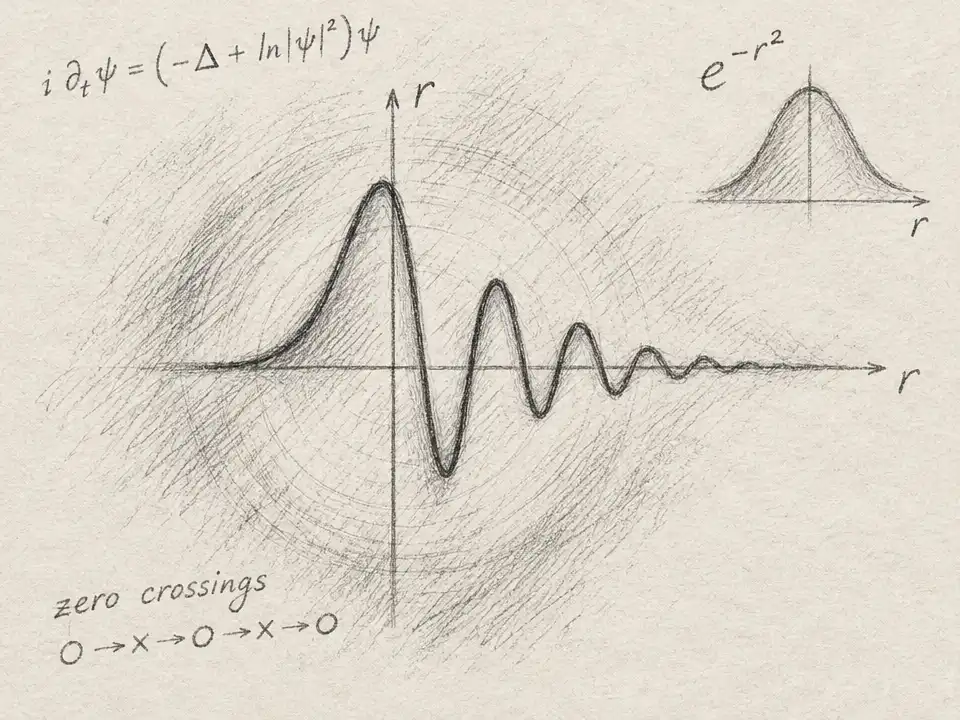
That phrase describes the character of the states, not which energy values are available. Pure-point spectrum means the system has a complete set of square-integrable eigenfunctions: wave patterns that stay localized rather than spreading out as traveling states. A further twist is that the positive eigenvalues are dense in the entire positive energy range. There are no energy gaps; instead, bound states crowd together throughout a range that, for a free particle, would support a continuum of traveling waves.
This is possible even though the potential is nonnegative. There are no attractive wells pulling the particle into a conventional local trap. The localization comes from the coordinated placement and patterning of barriers on many scales. The authors first establish the construction in two and three dimensions, then combine these cases to extend the result to every dimension at least two. A final rescaling makes the potential's peak height and weighted measures of its size arbitrarily small without changing the spectral behavior.
There is an important boundary to the claim: this is a mathematical counterexample, not an experimental report about a material or device. Its lesson is about what general theory can safely promise. A small, distant potential may seem too weak to matter, but a carefully organized one can overturn the expected relationship between decay and traveling states. The rings are nearly invisible from any single viewpoint. Their effect appears only when the whole landscape comes into focus.