Imagine a cloud of points being rearranged to match a new destination pattern. There is a best way to move them: choose the assignment that keeps the total travel as small as possible. Now nudge the destinations. How much must the mathematical instructions for that rearrangement change?
For years, one familiar tool seemed like a natural guide. The Poincaré inequality says, roughly, that a function’s fluctuations are controlled by how sharply it varies. It is a powerful way to understand probability distributions. But Cyril Letrouit and Tudor Manole’s new work on optimal transport reveals a subtler answer: under the right conditions, the transport instructions obey an even stronger stability law. And ordinary Poincaré control, by itself, does not guarantee that law.
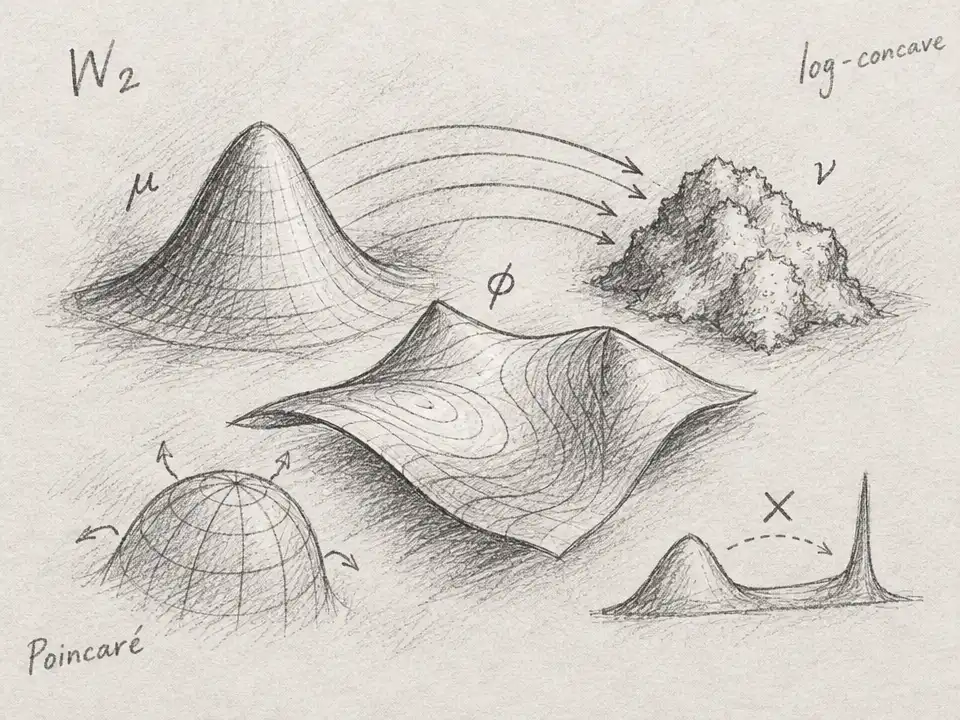
The setup begins with a fixed source distribution and two possible destination distributions. Each optimal rearrangement can be described by a convex potential: picture a landscape whose slope at each point gives the direction that point should travel. The authors ask whether the difference between two such landscapes can be bounded by how far apart the destination distributions are, measured using the Wasserstein distance—the least possible average travel needed to transform one distribution into the other.
The surprising part is what makes this comparison work. If the source distribution has a firm minimum of curvature everywhere—a property called uniform log-concavity—then the variance between the two transport potentials is controlled by the squared Wasserstein distance between their destinations. The bound depends only on the source’s curvature floor, not on whether the destinations have smooth densities or tidy shapes.
That is stronger than an ordinary Poincaré inequality. A simple point-by-point comparison of the two landscapes’ slopes would give a bound involving their average squared difference. But Wasserstein distance allows the points to be matched up again in whatever way makes travel cheapest. That freedom can only reduce the cost. So controlling fluctuations of the potentials by this optimized, potentially smaller cost is a more demanding statement—and the researchers prove it nonetheless.
The proof follows the changing destination through a mathematical landscape of its own. The equation governing optimal transport, known as the Monge–Ampère equation, describes how a convex potential reshapes one distribution into another. The authors study how that equation changes when the target shifts, then establish an estimate that prevents the potential from changing too wildly. A generalized version of the Bochner–Reilly identity—a tool that connects curvature, derivatives, and boundary geometry—supplies the crucial control.
For a standard Gaussian source, the result reaches a precise balance: the best stability constant matches the familiar Poincaré constant. The authors also recover a useful comparison in Gaussian geometry. For centered Gaussian destinations, the squared transport distance between them lies between one-half and all of the squared Frobenius distance between the square roots of their covariance matrices. This comparison was already known by other methods; here it appears as a consequence of the new stability framework.
Then comes the twist. Maybe any log-concave source—a distribution with a density shaped by a convex potential—should have this stronger stability property. Log-concave distributions already satisfy an ordinary Poincaré inequality. Yet the paper constructs examples showing the stronger conclusion can fail completely.
In every dimension at least two, the authors consider a distribution whose density is proportional to the exponential of minus the square root of one plus the squared distance from the origin. It is log-concave, but its curvature grows weaker in certain directions far from the center. To expose the weakness, they build test functions in thin annular regions far out in the distribution’s tail. Each region is only one unit thick in the radial direction, but stretches roughly the square root of its distance from the center in another direction. Across that long stretch, the density changes very little. A function can therefore keep substantial variation while changing only gently in the chosen direction.
Those carefully placed functions defeat the directional control that the stronger transport inequality would require. The result is stark: the source can have finite Poincaré control and still have no finite universal constant for the transport-stability bound. Log-concavity alone is not enough. The distinction is not a technical footnote; it marks the gap between controlling how a function varies locally and controlling how an optimal global rearrangement responds when its destination changes.
The authors do find a route beyond uniformly curved sources. If a log-concave source is confined to a convex region that fits inside a ball of radius R, they prove a stability bound with a constant no larger than four times the square of that radius. For bounded target regions, they also derive a one-third-power stability estimate for the transport maps themselves. These results are weaker than the clean curvature-based bound, but they show how the geometry and size of the source can replace a uniform curvature guarantee.
The paper’s unexpected lesson is that probability distributions have more than one kind of stability. A distribution may keep ordinary fluctuations under control while still allowing its optimal transport landscape to react too sharply to changes in destination. Strong curvature closes that gap; mere log-concavity does not. In the mathematics of moving clouds, how the source is shaped can matter as much as how far the destinations move.