Fix a cell, and its clock stops. The messenger RNA molecules inside it no longer travel through the nucleus, but their positions remain: a scattered map of where each molecule ended up. Could that still image reveal something about the motion that came before it?
That question matters because many ways of locating RNA molecules require cells to be fixed or otherwise cannot follow each molecule for long. Techniques such as single-molecule fluorescence imaging can record where RNA sits, but not the route it took to get there. The cell’s interior is not uniform terrain, either. Chromatin, nuclear speckles and other structures may make movement easier in some places than others. A map of RNA positions could therefore hold clues to hidden differences in how molecules travel.
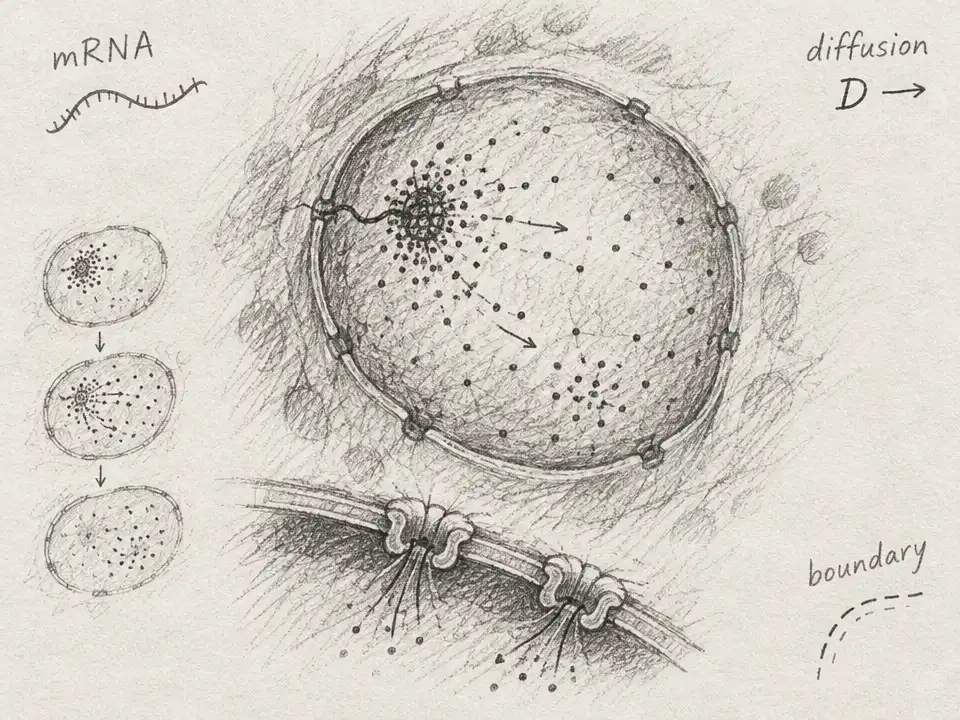
A recent study brings tools from physics and applied mathematics to this biological detective problem. The researchers model RNA as being produced, diffusing through space, and eventually degraded. At a steady state, the balance of those processes shapes the density of RNA across the nucleus. The researchers then ask whether that density—and the individual molecule positions sampled from it—can reveal the processes that made it.
The bridge between fields is an inverse problem. In a forward calculation, scientists start with rules for motion and production, then predict what a pattern of molecules should look like. Here, the direction runs backward: start with the pattern and try to infer the rules. Physics-informed methods help by requiring candidate explanations to obey a governing transport model, rather than fitting the observed positions with no regard for how molecules move.
But a convincing fit is not the same as a unique explanation. A model can return an answer even when the image does not contain enough information to distinguish it from alternatives. The paper’s central finding is a warning against treating every inferred map of molecular mobility as a discovery. Sometimes different combinations of production and transport can leave exactly the same spatial pattern.
Imagine RNA molecules bunching up in one region. Perhaps they move slowly there, so they accumulate. Or perhaps the cell produces more RNA there. If production is spread smoothly through space, the study shows mathematically that changes in the production pattern can be balanced by changes in the diffusion pattern, leaving the same steady-state distribution. No clever fitting procedure can choose between those explanations from that snapshot alone. The ambiguity is in the information available, not simply in the algorithm.
A sharply localized source can change the picture. RNA production begins at a gene’s transcription site, which the researchers represent as a point source. In their model, that localized origin creates a distinct signature in the spatial profile. If the surrounding medium is assumed to vary smoothly at the source, the source’s signature cannot simply be reassigned to a sudden change in mobility. Under specified boundary conditions and other model assumptions, that can make the source and diffusion pattern identifiable: in principle, only one admissible set of them produces the observed profile.
The boundary matters because molecules may leave the nucleus, remain trapped, or encounter something in between. A perfectly absorbing boundary and a reflecting one impose different constraints on the inferred motion. If the boundary is only partly permeable and its permeability is unknown, the researchers show that a single source and one snapshot may still leave multiple explanations. In plain language, an apparent change in movement inside the nucleus might instead be explained by how easily molecules escape at its edge.
There is another subtle choice: what, physically, does it mean for a particle to diffuse through a region where the diffusion rate changes? The researchers compare different conventions used to describe that stochastic motion, including Itô and Fickian diffusion. Those choices change the mathematical link between a molecule’s position pattern and the underlying mobility. The snapshot does not tell researchers which convention is right; that assumption must come from knowledge of the physical system or from additional measurements.
The paper also points toward ways to get more evidence without following every molecule continuously. Multiple transcription sites with a shared production rate can add constraints. So can observing a precursor RNA and a downstream product, or collecting two steady-state patterns under different conditions. Each adds another clue that competing explanations must satisfy. These are mathematical proposals and results under particular assumptions, not demonstrations that the method has already extracted a complete transport map from living cells.
To test whether the inference could work in practice, the researchers generated synthetic snapshots: simulated molecule positions drawn from models with known diffusion patterns. They compared three physics-informed approaches across 100 trials per method. In one set of tests, snapshots contained an average of about 48 molecules. The methods could estimate the source strength reliably, but the reconstructed diffusion pattern was imprecise, capturing only coarse features near the source. With about 190 molecules per snapshot, recovery improved; a finite-volume solver tracked the test pattern most accurately, while the neural-network approaches tended to smooth away some detail.
Even in the more favorable tests, the shape of the diffusion pattern was generally easier to recover than its absolute scale. Fine-grained variations were also harder to reconstruct than broader ones. That distinction matters: locating regions where RNA movement may be relatively faster or slower could be useful even before a method can pin down an exact diffusion rate. But the paper’s tests are simulations, and successful reconstruction there does not establish that a real fixed-cell image will reveal the same detail.
A fixed cell cannot show its past as a video would. What it can offer is a set of traces, and physics can help work out which stories those traces allow. This study’s most useful contribution may be drawing that boundary clearly: a snapshot can, under the right conditions, carry information about molecular motion—but it can also conceal several different histories behind the same pattern.