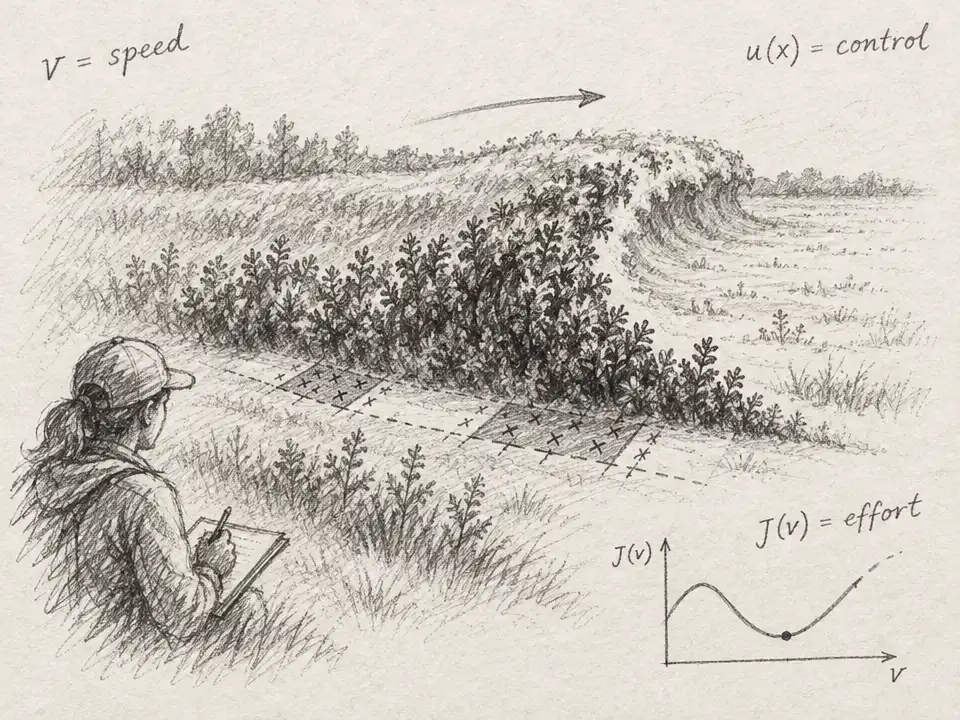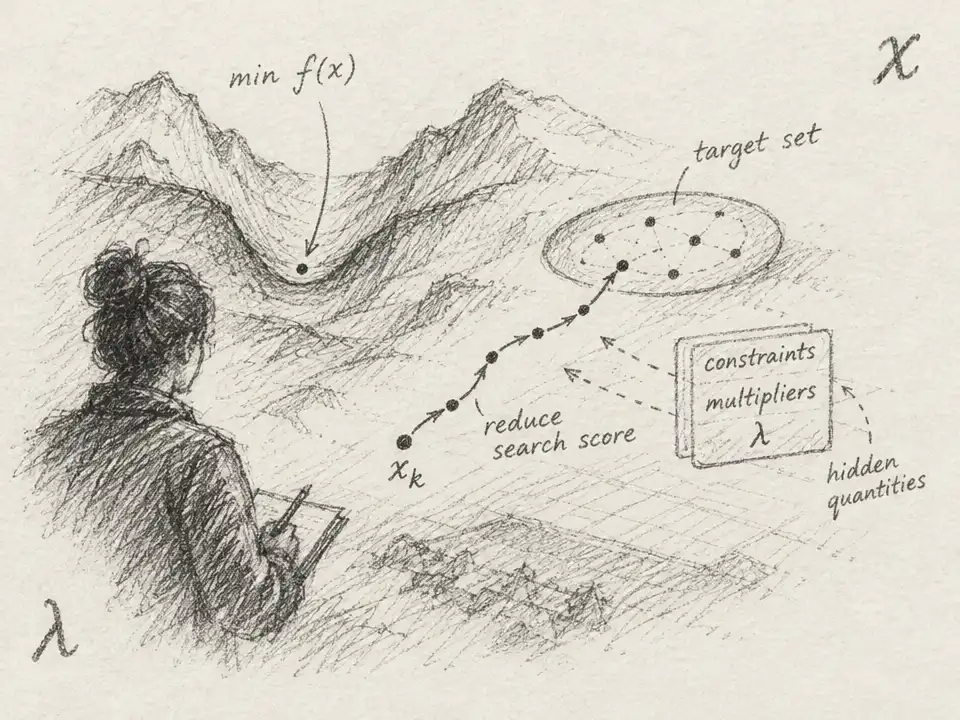
Imagine searching for the best design among millions of possibilities: the lightest bridge, the most efficient schedule, the lowest-cost route. Optimization turns that search into mathematics. The usual picture is a landscape, with an algorithm stepping downhill toward a low point. But what if the search is better understood as a control problem—with a system to steer, a destination to reach, and rules for choosing each move?
That is the surprising crossover in a 2026 paper by mathematician and control theorist I. M. Ross. It brings tools from optimal control theory, which studies how to guide a changing system toward a goal, into the world of optimization algorithms. The paper proposes a framework for understanding how familiar algorithms can arise from a deeper set of mathematical dynamics. It is not a claim that computers obey a newly discovered physical law. The word physics here describes a mathematical structure for how the search evolves.
The bridge begins with two different ways of describing an endpoint. In optimization, a candidate answer is often judged by conditions involving the objective, the constraints, and quantities called multipliers. These conditions, known as Karush-Kuhn-Tucker conditions, can help identify a point where further improvement is locally blocked. They are important clues, but they do not automatically prove that a point is the best possible answer in every case.
In control theory, a system moves through time under the influence of chosen inputs. Optimal control asks which inputs guide it toward a desired final state while meeting certain requirements. Ross's key move is to connect the endpoint conditions from control theory with the conditions that mark a candidate solution in optimization. If the two sets of conditions can be made to match, then steering a mathematical system to its endpoint becomes a way to describe a search for an optimum.
To make that connection, the framework tracks more than the current guess at an answer. Its extended state also carries information about the objective, the constraints, and their multipliers, along with a quantity related to how sharply the combined objective-and-constraint picture changes. Think of the original search as a small marker moving across a map, while the expanded state keeps a running instrument panel: not just where the marker is, but what the landscape and its boundaries are telling it.
Under the paper's assumptions—including that the problem's data functions are smooth enough to have second derivatives—Ross shows that these hidden states follow a shared set of dynamical equations. The equations give a control-style description of how a candidate, its constraints, and its other mathematical bookkeeping can evolve together. That is the theoretical heart of the work: a common framework that can describe a range of constrained and unconstrained optimization problems.
But a continuous trajectory is not the only way to search. Computers typically make discrete updates: calculate, take a step, calculate again. The paper therefore develops an inverse-optimal approach that works directly with controlled jumps. Start with a search Lyapunov function—a score that is positive away from the target conditions and reaches zero at them. In control theory, Lyapunov functions help show that a system is moving toward a stable state. Here, a step is chosen to reduce the search score.
The rhythm is simple to picture. Take a step, check whether the score has fallen, then choose another step that keeps it falling. In the paper's framework, if each controlled jump decreases the chosen score in the required way, the sequence approaches points that meet the specified optimality conditions, within a tolerance. The method does not need to simulate a physical object, or even produce a continuous motion first. The trajectory is a way to derive and analyze the discrete search, not necessarily a path that a computer must literally follow.
One illustration links this way of thinking to sequential quadratic programming, a family of methods that repeatedly solve simpler, locally approximated optimization problems. Under a particular choice of search score and geometric metric, the framework can interpret an SQP method as an inverse-optimal algorithm. The distinction matters: Ross says this example is an after-the-fact interpretation, not that he set out to invent SQP from the control equations. The same general recipe can lead to different algorithms, depending on the score and the allowed control moves.
That flexibility is part of the appeal—and part of the challenge. The framework is more like a method for generating and analyzing algorithms than a single replacement for every optimizer. Choosing the score and allowable steps shapes what the resulting method does. The equations provide a common starting point, but researchers still have to study the consequences of each choice and establish when it is useful.
The limits are just as important as the promise. This is a theoretical paper: its case rests on mathematical derivations and illustrative examples, not a set of performance trials showing that the approach beats existing software on real-world problems. Its main result assumes smooth problem data, while extending the theory to nonsmooth functions remains an open challenge. And reaching conditions that are necessary for a local optimum is not the same as proving that a solution is the global best, especially in a problem with many valleys and peaks.
Still, the crossover offers a fresh question for algorithm designers. Instead of asking only, “What step should the search take next?”, they can ask, “What hidden system would make those steps natural, and what score would prove they are heading somewhere useful?” Control theory supplies a language for steering; optimization supplies the destination. Connecting them may reveal not one universal route to the answer, but a more systematic way to build and understand the many routes that algorithms take.