A proof about symmetric polynomials has an unlikely starting point: a line of customers circling through a ring of service stations. Yet a recent paper shows that this queueing network can settle a mathematical question first posed in 1959—and reveal why a seemingly reasonable shortcut fails along the way.
The puzzle concerns a family of polynomials built from a list of nonnegative numbers. To make one of degree k, form every possible product of k entries and add them up, allowing an entry to be used repeatedly. For a list containing two numbers, the degree-two polynomial includes the square of each number and their product. These sums are called complete homogeneous symmetric polynomials.
In 1959, mathematician J. B. McLeod proved a striking inequality for one member of this family and asked whether it extended to a broader set of ratios. The new work by Suvrit Sra answers yes: the result holds in every input dimension, for every nonnegative starting degree and every positive number of steps. In plain terms, a particular measurement made from these polynomial sums obeys a strong rule: combine two input lists coordinate by coordinate, and the measurement on the combined list is no greater than the sum of the separate measurements.
That rule is called subadditivity. It follows from a related property, convexity, which says that the function bends upward in a precise way as its inputs change. The result closes the general case of McLeod’s conjecture. But the most unexpected part is how the proof gets there.
At first, the natural move seems to be algebra. The key ratio compares the polynomial of one degree with the polynomial just below it. Sra tried to show directly that each ratio is convex by calculating its curvature. The approach worked for degrees up to four, but the resulting expressions offered no clear path for higher degrees. The problem was not simply that the arithmetic got longer. The calculation stopped revealing why the desired inequality should hold.
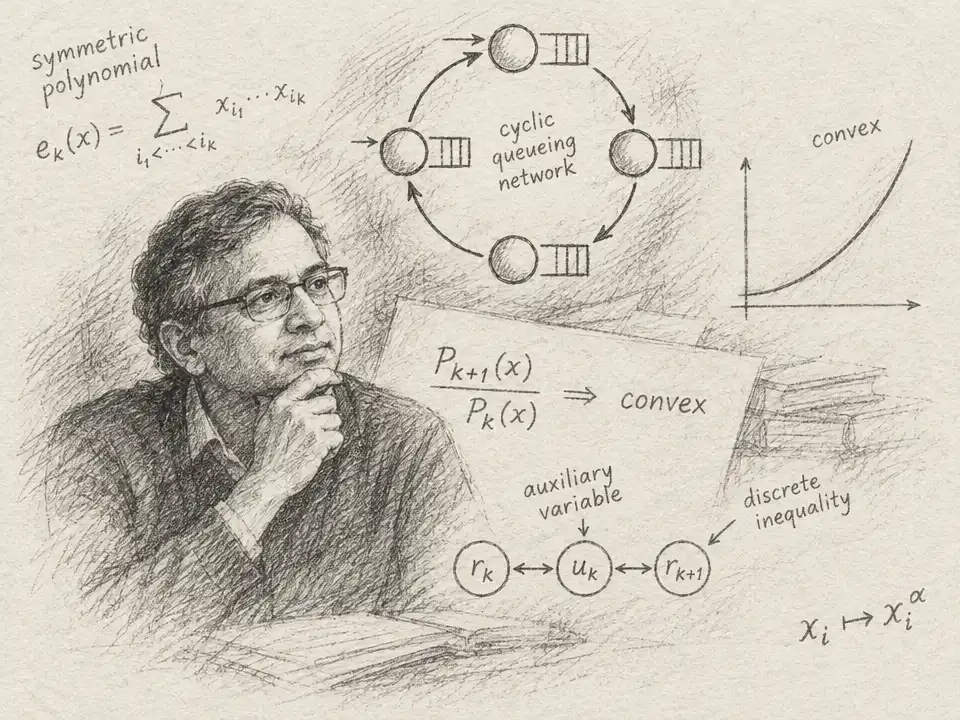
Then the ratios acquired a second meaning. Picture n single-server stations arranged in a circle, with k customers circulating through them. Each station serves one customer at a time, and the input number assigned to that station sets its average service time. The customers never leave the system; they keep moving from station to station.
Here is the mathematical coincidence that makes the queue useful. The polynomial sum is also the normalizing factor for the network’s long-run distribution of customers among stations. In other words, each possible allocation of the circulating customers gets a weight built from the stations’ service means, and adding all those weights produces the same polynomial. From that distribution, the long-run service-completion rate at each station is given by the ratio of the polynomial one degree lower to the polynomial for the current customer count. Flip that ratio over, and it becomes the average time per completion.
Now the ratio is no longer just a quotient of abstract sums. It is the time the network takes, on average, to complete another service. And completion times have a useful built-in structure. A service begins only when both the server and the customer are ready, so its start depends on whichever becomes available later. The next completion time is therefore built by adding a service time to the later of two earlier times.
To compare networks with different average service times, Sra couples them: imagine the same underlying random service draws in each network, scaled by the station’s chosen mean. For any fixed set of those draws, service durations vary linearly with the means. Adding times and taking the later of two options preserve convexity, so every individual completion time is convex in the input list. As the network runs longer, its average time per completion converges to the polynomial ratio. The convexity of the finite completion times passes to that long-run limit.
That proves the first important step. It does not yet prove McLeod’s inequality. The target function combines several consecutive ratios by taking their geometric mean. And geometric means do not automatically preserve convexity. Each ratio might bend upward on its own, while differences in how sharply they bend—or how quickly their slopes change—could make the combined function bend the wrong way.
The paper’s fix is a clever bit of mathematical stagecraft called tensorization. Add an auxiliary input to the polynomial, initially set to zero, and see how the ratio responds. That extra coordinate links neighboring degrees: a tiny change in it makes information from one degree show up in the next. But one auxiliary coordinate does not provide quite the right control. So the proof splits its influence equally among more and more auxiliary coordinates.
As the number of these little coordinates grows, their combined first-order influence stays intact while a key second-order contribution is halved. That change exposes a useful pattern: the queue’s throughput—the rate of service completions—has concavity as the number of circulating customers changes. More importantly, the split-coordinate calculation ties the curvature of each ratio to the difference between the slopes of neighboring ratios. Instead of treating the ratios as unrelated pieces, the proof makes them constrain one another.
A discrete version of the Poincaré inequality supplies the final link. It bounds how much a sequence of values can vary by measuring the differences between neighbors. Here, it shows that the ratios’ individual curvature is large enough to control the spread in their slopes. The downward pressure that threatened the geometric mean is matched by an upward curvature budget. The combined function is convex after all, and the conjecture follows.
The paper also extends the result to certain coordinatewise power transformations: powers at least one preserve the inequality, with a corresponding adjustment to the root. The larger lesson is a satisfying one for mathematics: when a direct calculation hits a wall, an object’s second interpretation may reveal the structure the algebra was hiding. In this case, a polynomial’s coefficients were also a map of where customers wait—and the queue supplied the missing proof.