Imagine two ways to judge how well a mathematical repair works. In the first, you adjust an unknown matrix and count how many independent errors remain. In the second, you place the problem inside a larger matrix system, allow a much broader transformation, and count the leftover errors there. For years, mathematicians suspected those two best-case counts must match. A small example has now shown that they need not.
The surprise is unusually crisp: one approach cannot get below rank two, while the other reaches rank one. The result, proved by Shuo Shi, Juan Zhang, and Yun Zhang, gives a counterexample to a conjecture proposed by Michael Lin and Hans Wimmer in 2011. It works over every field, and the authors show that, over the complex numbers, the example is as small as a counterexample can be.
Here, “rank” is a way of counting independent directions in a matrix’s output. It does not measure the size of an error in the everyday sense. Rank one means all the remaining output lies along a single independent direction; rank two means at least two directions are needed. The conjecture asked whether two different optimization problems always end at the same rank.
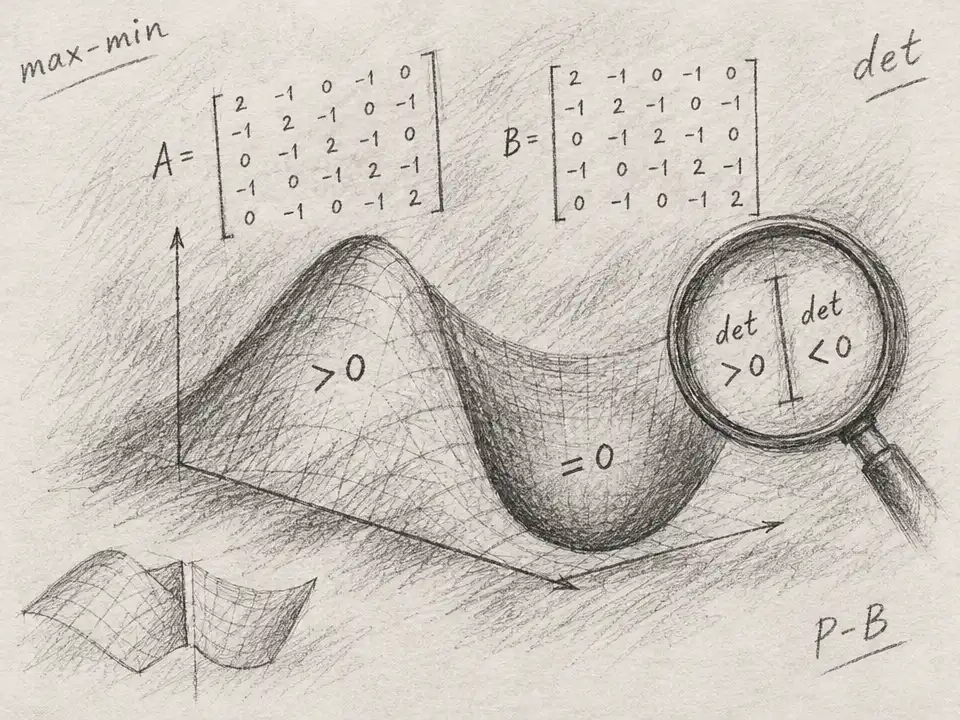
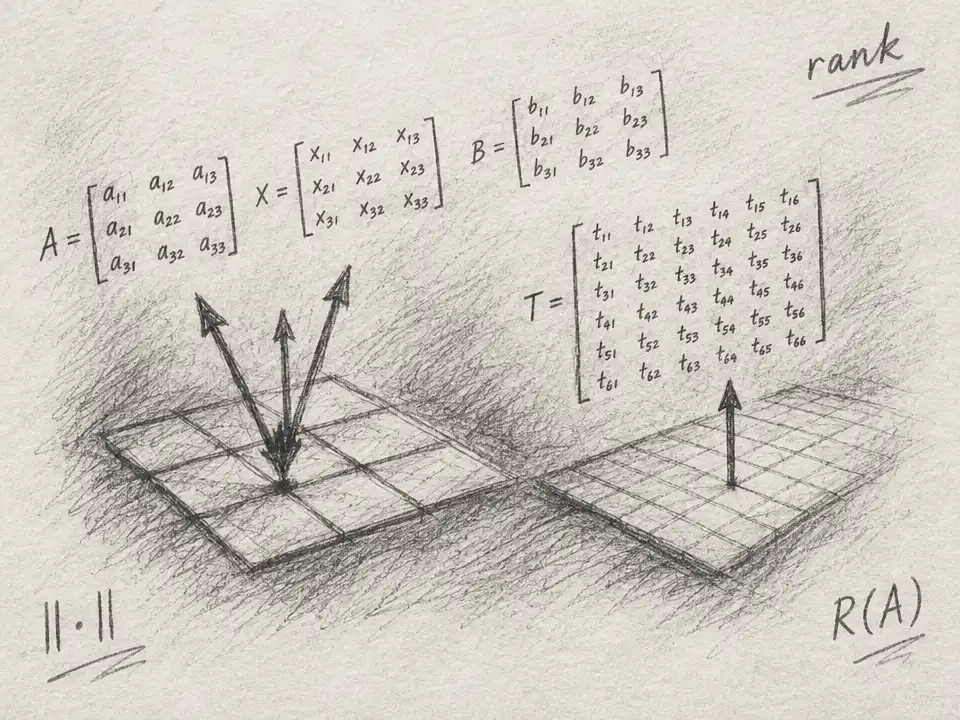
The first problem begins with a familiar kind of matrix equation, called a Sylvester equation. Two square matrices, A and B, act on an unknown matrix, X. The question is whether X can be chosen to make their difference match a prescribed matrix, C. If exact agreement is impossible, one can still choose X to make the leftover matrix as low-rank as possible.
The second problem repackages the same ingredients into larger, block-structured matrices. Instead of choosing X, it allows an invertible transformation of the whole combined system. That freedom matters: the transformation can mix directions across the blocks, rather than merely adjusting the unknown matrix in the original equation.
There was a strong reason to think the two viewpoints might still agree. Roth’s similarity theorem establishes that they agree on the most basic question: whether an exact solution exists. If the first equation can be solved perfectly, the larger system can also be matched perfectly, and vice versa. Lin and Wimmer’s conjecture proposed a bold extension: even when perfection is impossible, both approaches should leave the same minimum rank of error.
The new counterexample keeps the setup compact. The two square matrices are identical three-by-three matrices. Each has just one eigenvalue, zero, arranged in a particular pattern: one pair of directions forms a short chain, while a third direction stands apart. The prescribed matrix C marks two separate directions. These details put the example outside spectral conditions known to make the conjecture work.
Now try every possible choice of X. The researchers show that the residual can never collapse to one direction. Their proof follows the columns of that residual. The third column is guaranteed to be nonzero. If the whole residual had rank one, every other column would have to line up with it. That forces the first column to vanish. But the resulting constraint makes the second column carry a nonzero component in a direction the third column does not have. The columns cannot all lie on one line after all.
So rank two is unavoidable. It is also attainable: choose X to be the zero matrix, and the leftover has rank two. The first optimization problem therefore bottoms out exactly at rank two—not because the researchers failed to find a cleverer X, but because the structure rules one out.
On the larger-system side, the authors exhibit a particular invertible six-by-six transformation. It makes the discrepancy have rank one. The discrepancy cannot have rank zero: that would mean the two larger systems match exactly, which Roth’s theorem says would produce an exact solution to the original equation. The column argument has already ruled that out. So the second minimum is exactly one.
That is the break in the conjecture: two for the direct repair, one for the broader transformation. The larger system has found a way to combine or redirect the mismatch that the original adjustment cannot reproduce. The point is not that one measure is wrong. The two procedures allow different kinds of moves, and matching on exact solvability did not force them to match when some error remains.
The size of the example adds another twist. Over the complex numbers, the authors prove the equality does hold whenever either of the two matrix sizes is less than three. In smaller dimensions, the eigenvalue structure is too restricted for this particular failure: the known conditions guaranteeing equality apply. At three-by-three, a common eigenvalue can have the just-right combination of a repeated direction and a nontrivial chain. The counterexample sits at that boundary.
This is not a claim that the conjectured equality fails for every matrix pair, nor that the broader transformation always wins. Earlier work established broad classes where the two minima do agree. The new result identifies a genuine gap in the general claim and leaves a sharper question behind: precisely when can the freedom to mix the larger system reduce the rank below what any direct adjustment can achieve?
In a six-by-six construction, one extra degree of freedom in how the system is viewed erases an entire independent error direction. The matrices are small enough to inspect, but the lesson reaches beyond this one example: two mathematical problems can agree perfectly about whether a solution exists and still disagree about how close they can get when no exact solution is available.