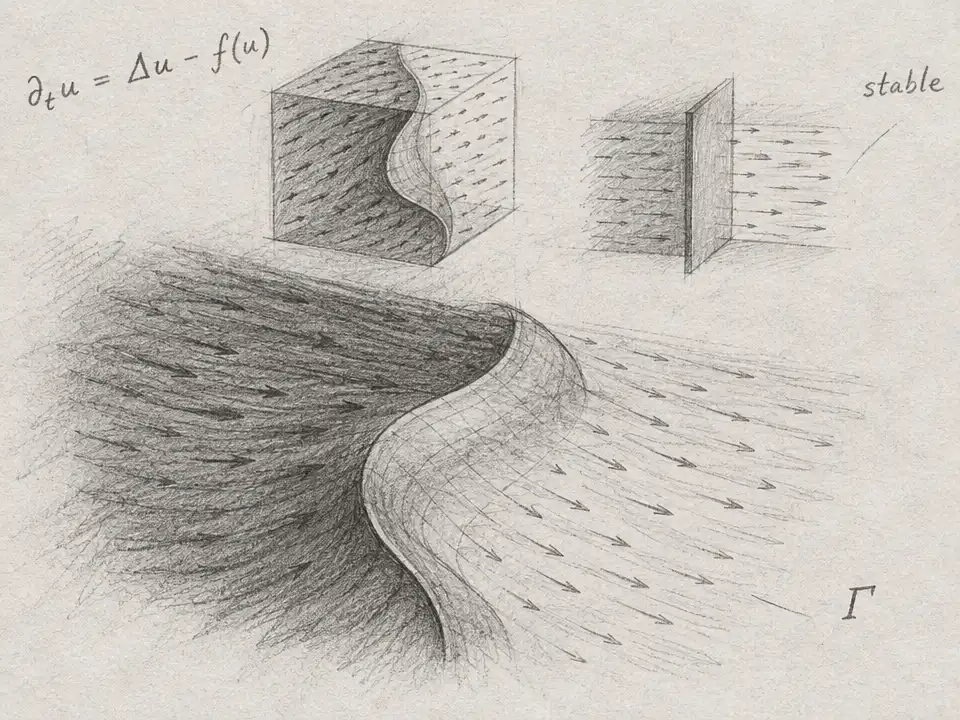
A graph can look tame from a distance and still hide a restless surface. Imagine a sheet rising above a flat floor: it never shoots upward in a cliff, and its slope stays bounded. Yet the direction of that slope might change so erratically that no clear tangent plane settles at some points. Mathematicians call the first condition Lipschitz continuity. It limits how sharply a graph can rise, but by itself it does not guarantee that the graph’s shape changes smoothly.
A paper posted to arXiv on October 1, 2026, by Jonas Hirsch, Connor Mooney, and Riccardo Tione shows how much more a geometric equation can reveal. They study graphs over a two-dimensional region whose bending is tied to a prescribed forcing field. If that field is integrable to a power greater than two, the authors prove that every Lipschitz solution has substantially better regularity throughout the interior of the region—even when the graph rises into any number of extra dimensions.
“Better regularity” has a precise meaning here. The graph has locally integrable second derivatives, and its first derivatives vary continuously in a controlled, Hölder-like way. The precise continuity improves as the forcing becomes more integrable: its exponent is one minus two divided by the power in the assumption. This does not mean that the graph becomes infinitely smooth. It does mean that its tangent plane cannot keep making abrupt or endlessly fine changes while satisfying the equation.
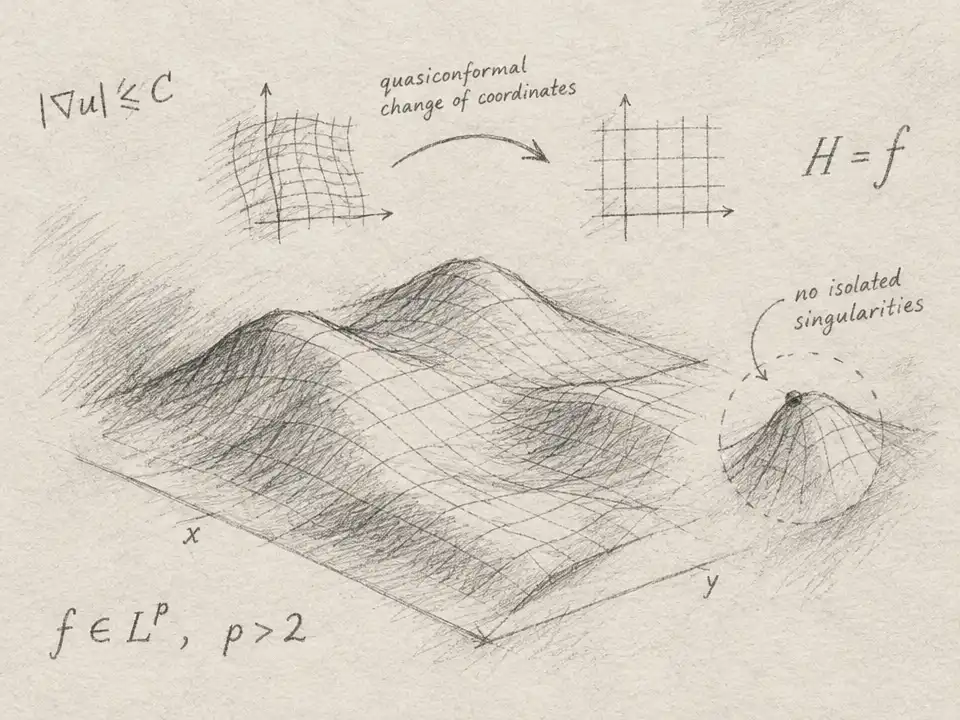
The surprising part is the route to that conclusion. Instead of inspecting the graph on the original flat floor, the researchers change the coordinates of the floor itself. This is not a trick that makes the graph flat. It is more like replacing a distorted map grid with one whose local stretching is carefully balanced, so that the graph’s hidden geometric structure becomes easier to see.
Why should changing the floor help? A graph carries its own notion of distance along the base: moving the same amount in two directions can correspond to different stretches along the sheet. That induced geometry is encoded by a metric. In two dimensions, the researchers can choose special coordinates that make this metric conformal to the ordinary flat one: locally, lengths are rescaled, but angles are preserved. The coordinate map may distort shapes, but it does so in a controlled way; mathematicians call such a map quasiconformal.
In the new coordinates, the original graph can be viewed as two linked objects: a relabeled base and a new height map. The height map satisfies an auxiliary elliptic equation. When the forcing vanishes, this transformed map is harmonic, a particularly well-behaved kind of mathematical field. With forcing present, it is no longer harmonic, but the equation still gives the team a foothold. The challenge is that the height map and the coordinate map can each be irregular. The breakthrough comes from studying them together.
The paper identifies a conformal balance between those two maps. In plain terms, the way one map stretches in one direction is tightly linked to how the other stretches. A quantity that captures the uneven, shear-like part of their stretching cancels between them. That relationship gives the researchers a way to compare the maps’ changes at nearby points and control how wildly their derivatives can fluctuate.
Then comes a careful bootstrapping process. The initial information is not enough to guarantee smooth tangents. But the balance between the maps yields a little more control over their derivatives. That extra control feeds back into the elliptic equation, which yields still more. Repeating the step pushes the derivatives beyond a key integrability threshold. Once they cross it, standard mathematical tools turn that improved control into continuous, locally Hölder-varying tangents.
There is still a trap to clear. During the argument, the coordinate map might seem capable of having isolated points where its derivative vanishes. Around such a point, the map could appear to branch, much as a many-to-one map folds several nearby locations together. The authors examine what the equations would force near any hypothetical bad point. The map would have to behave locally as if it wrapped around with a branching pattern. But a quasiconformal coordinate map is one-to-one and cannot branch that way. The suspect points disappear, leaving no hidden exceptions to the regularity result.
The threshold matters. The authors point out that when the forcing is only square-integrable, a bounded-slope graph can still have a slope that refuses to settle at a point. So the condition that the forcing be integrable to a power greater than two is not just a convenient technical detail: the paper’s conclusion cannot be extended indiscriminately below that threshold.
The result also depends on the plane. The graph’s base is two-dimensional, while the number of directions in which it can rise is unrestricted. The authors’ method exploits special features of two-dimensional coordinates; their paper leaves the corresponding question for three or more base dimensions as a direction for future investigation.
What emerges is a change of perspective with real mathematical force. A graph that looks rough in its original coordinates can contain a better-organized geometry underneath. By finding the right grid, then proving that its possible hidden defects cannot actually occur, the researchers show that the equation rules out a whole class of invisible irregularities. The surface was not smooth because it looked simple. Its smoothness was waiting in the coordinates that revealed how its pieces fit together.