There is a pleasing promise at the heart of fixed-point mathematics: keep applying a rule, and eventually you may land on a point the rule leaves unchanged. But that promise can hide a computational snag. Knowing that an answer exists—or that repeated steps will eventually approach it—is not the same as finding it quickly.
In a paper posted October 31, 2026, mathematicians Xi Chen, Yuhao Li, and Mihalis Yannakakis uncover a geometric property that helps bridge that gap. The surprise is subtle: a map used to choose promising places to look does not merely change smoothly. It never stretches distances, when distance is measured by the largest difference in any coordinate. That extra restraint lets the researchers replace a costly search with a more structured algorithm.
Fixed points turn up in problems far beyond puzzles about repeatedly applying a rule. They help describe the values of games, economic models, and other systems whose outcomes depend on their own evolving state. A classic result proved by Stefan Banach in 1922 says that a contraction—a rule that brings points closer together by a consistent amount—has one unique fixed point. Repeatedly applying the rule will converge to it.
The trouble is speed. If the rule barely pulls points together, the simple repeated-step method may need an enormous number of steps to reach the desired accuracy. Researchers therefore look for algorithms that can find a good answer using relatively few calls to the rule. Imagine the rule as a sealed oracle: give it a point, and it returns the point that results from applying the rule. A call may be costly, so fewer calls are valuable.
But call counts tell only part of the story. A previous algorithm could make a number of oracle calls that grows roughly with the problem’s dimension and the logarithm of the requested precision. Yet deciding where to make those calls could require brute force—up to a cost that grows like inverse precision raised to the dimension. In a high-dimensional problem, even a seemingly modest demand for accuracy could make the computation balloon.
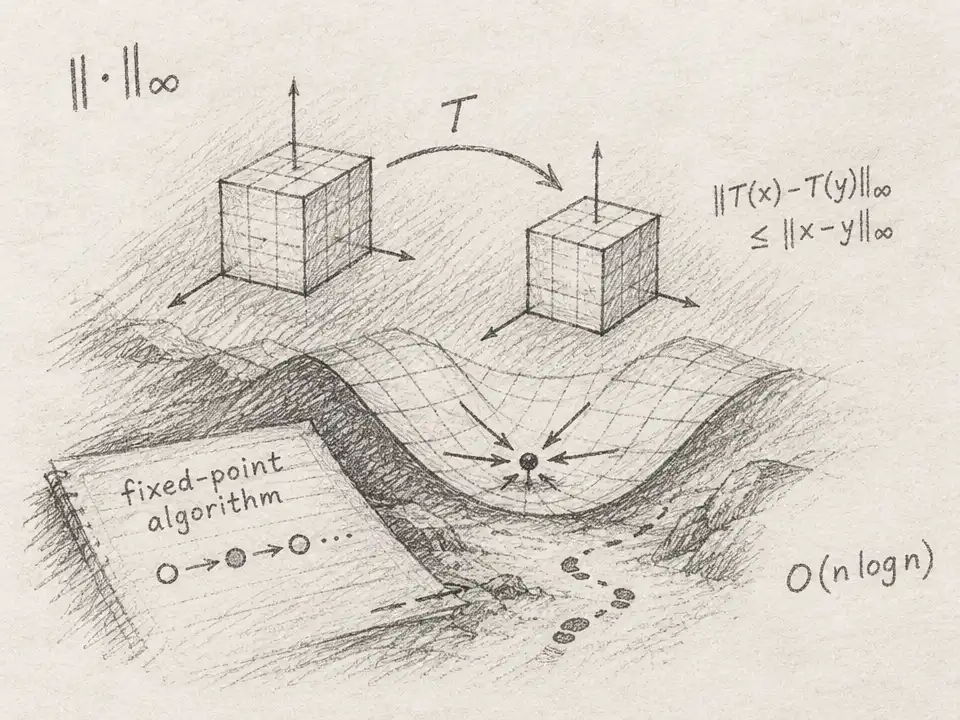
The new work tackles that hidden expense by treating the search as a problem in geometry. Picture a cloud of all the points that could still be the fixed point, inside a many-dimensional cube. Each unsuccessful query can rule out part of that cloud. The researchers’ earlier method relies on choosing a well-balanced query: a point positioned so that certain geometric cuts through it leave at least half of the remaining candidate volume on either side. If the answer shows that the query is not close enough to a fixed point, the algorithm can discard a substantial region of possibilities.
This is a powerful way to narrow a search—but only if the algorithm can actually find such a balanced point. Earlier work had established that a particular map has a fixed point that supplies one. The map was known to be continuous, which is enough for a mathematical existence argument. But existence does not automatically give a fast route to the answer. The practical question was whether an algorithm could locate an approximate fixed point of that map without resorting to an expensive search.
Here comes the unexpected turn. Chen, Li, and Yannakakis show that the map has a stronger property: it is nonexpansive. If two inputs differ by a certain maximum amount in any coordinate, their outputs cannot differ by more than that. The map does not pull every pair closer, as a contraction does; it may preserve distances. But it cannot make a small separation grow.
That distinction matters because mathematicians already had a recursive method for locating approximate fixed points of nonexpansive maps. The authors can therefore use that older tool to find the balanced query points their search needs. Their proof of nonexpansiveness is geometric: it tracks how volumes on opposite sides of a point change as the point moves through the cube. Those changes fit together tightly enough to show that the map never stretches distance in the relevant measure.
The result is an algorithm that keeps the low oracle-call count while making the work between calls more controlled. For contraction problems, the paper bounds the total computation by a quantity whose base depends on the dimension and on logarithms of inverse accuracy and inverse contraction gap, with an exponent that grows with dimension. That is a major improvement over a brute-force dependence on inverse precision raised to the dimension. It is not, however, a polynomial-time solution for every high-dimensional problem: the computation can still grow exponentially with dimension.
That limitation is worth keeping in view. The paper does not make every fixed-point problem easy, nor does a small number of queries guarantee a small total runtime. Instead, it exposes a particular mismatch between asking a black box for information and doing the geometry needed to choose the next question. A property that looked useful only for proving that a balanced point existed turns out to be strong enough to help compute one.
The broader lesson is a familiar but fruitful one in mathematics: a hidden regularity can change the algorithmic picture. Continuity said the search had a destination. Nonexpansiveness supplied a route to it. In a field where proofs of existence can sit far from practical methods, that extra geometric fact is the difference between knowing where the answer must be and having a systematic way to go looking.