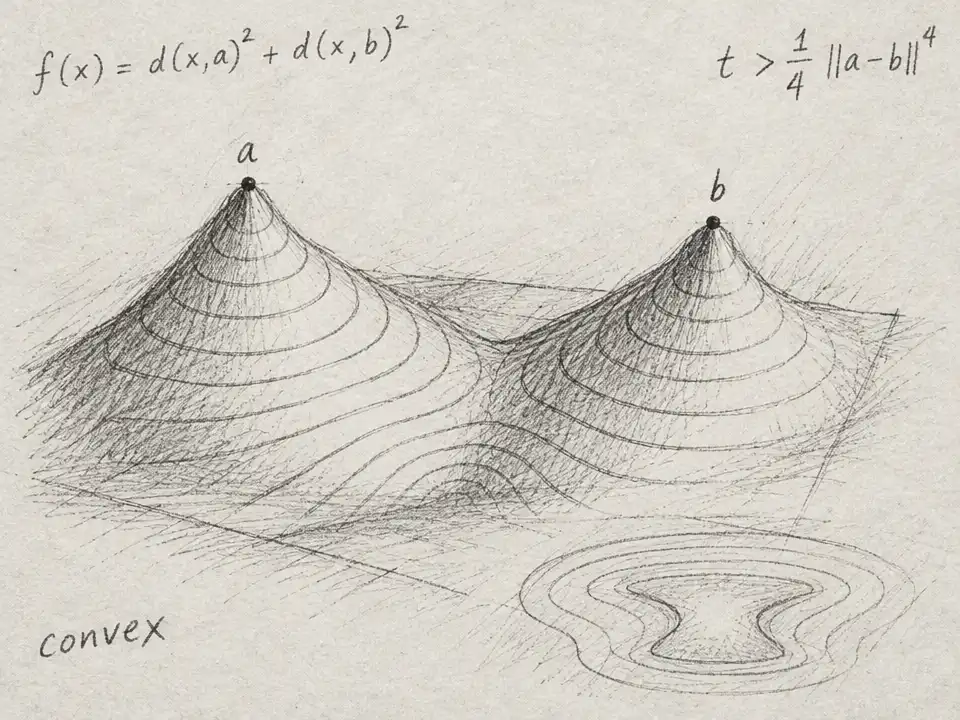
Put two points on an empty plane. Now imagine that every other location gets a score: measure its distance from the first point, measure its distance from the second, square both measurements, then multiply them. The score is zero at either anchor. Far away, it climbs. In between, it forms a landscape whose contour lines can pinch and curve in surprising ways.
This simple construction has a name in geometry: a product of squared distances. In two dimensions, its contours are related to Cassini ovals, the looping shapes traced by points whose distances from two fixed foci have a constant product. But the question behind a new mathematical result is less about drawing the loops than finding a boundary: how large must a sublevel region grow before it is guaranteed to be convex?
Convexity has a wonderfully concrete test. Pick any two places inside a region and draw a straight line between them. If the whole line stays inside, the region is convex. A round disk passes. A crescent fails. In optimization, that difference matters: convex regions are often easier to analyze and search than regions with inward dents, where a route between two feasible points may leave the feasible set.
The two-anchor landscape makes the challenge visible at once. At score zero, the sublevel set contains just the two anchors. The straight segment between them includes points with positive scores, so the set is not convex. As the allowed score rises, the region spreads outward. Yet intuition alone cannot tell us the exact level beyond which every inward bend is gone.
Tudor Micu, Cornel Pintea, and George C. Turcaş have now calculated a sharp boundary for two anchors in every Euclidean dimension of at least two. Let the distance between the anchors be called the separation. Their theorem says that for any score above one quarter of the separation raised to the fourth power, the sublevel region is convex. For every score below that value, it is not convex.
That is a precise geometric promise, but the fine print matters: the paper does not claim that the region at the boundary value itself is convex. The result pins down the sharp infimum—the dividing value that cannot be lowered—while leaving the endpoint unsettled. The distinction is small in a formula and large in a proof: a threshold can be exact without settling what happens at equality.
How do two points reveal such a boundary? The researchers look not only at the score but at the landscape’s curvature, captured mathematically by its Hessian. Where that curvature is positive in every direction, the landscape bends upward locally. The authors establish a useful principle: if every point at or above a chosen score lies in this upward-bending zone, then the sublevel region below that score must be convex. A straight segment trying to escape would have to pass through an impossible local maximum.
For two anchors, symmetry makes the curvature map tractable. The line joining the anchors supplies one special direction; directions perpendicular to it expose the geometry around the midpoint. Below the threshold, the authors can find a matched pair of points inside the sublevel region whose midpoint lies outside. It is the convexity test turned into a construction: two permitted endpoints, one forbidden point between them. Above the threshold, the upward-curving zone surrounds every sufficiently high score, and the escape route disappears.
The result reaches beyond a flat tabletop. Its two-anchor threshold works in any dimension at least two, because there is always a direction perpendicular to the line between the points. And the paper establishes a broader fact for any finite collection of anchors: far enough out, the leading, rapidly growing part of the distance product dominates the smaller terms that encode the anchors’ arrangement. The curvature therefore becomes positive outside a bounded region, and sufficiently high sublevel sets are compact and convex.
That broader theorem is a map, not yet a set of directions. With more than two anchors, the researchers do not give a general formula for the sharp convexity threshold. Their paper shows that the relevant obstruction is confined to a bounded area, so a maximum score there exists. But finding it for a particular constellation becomes a polynomial optimization problem, even in the plane. Special arrangements might yield clean answers; the general case remains open.
Here is the possibility—and its price. A distance-product objective can look awkward near its anchors, yet its far-reaching regions have reliable shape. For problems whose feasible sets are defined by such sublevel scores, a certified convexity threshold could help distinguish the tangled inner geometry from the simpler outer geometry. But this paper does not provide an applied algorithm or show that a particular engineering task becomes easier. The first obstacle is more basic: for several anchors, researchers still need a way to calculate the threshold instead of merely proving that one exists.
There is a quiet satisfaction in the two-point answer. A pair of locations, a multiplication of distances, and a rule scaling with the fourth power of their separation: together they turn a vague question about a shape’s changing outline into a sharp mathematical boundary. The frontier now lies where symmetry runs out—among three or more anchors, where the landscape remembers the whole configuration and the clean formula disappears.