Picture a collection of short binary messages: strings of zeros and ones, each the same length. Now impose a peculiar rule: every pair must differ in exactly the same number of positions. Two strings might disagree in three places, for example, but no pair is allowed to disagree in two or four. How large can the collection grow before that rule becomes impossible?
The question sounds like a puzzle about arranging symbols. A June 2026 paper by Scott Duke Kominers takes a different route: it translates the strings into points in space. That shift lets one simple linear-algebra argument explain a strict limit—and why, at one carefully balanced distance, the limit can be exceeded by exactly one.
First, the result needs careful framing. Kominers does not claim to have discovered the underlying size bound. Earlier work had established that, for strings of length n whose pairwise distances are all the same positive number, the collection can contain at most n strings in nearly every case. The exception is when that distance is half of one more than the string length. The new paper’s contribution is a shorter, more unified proof of this boundary.
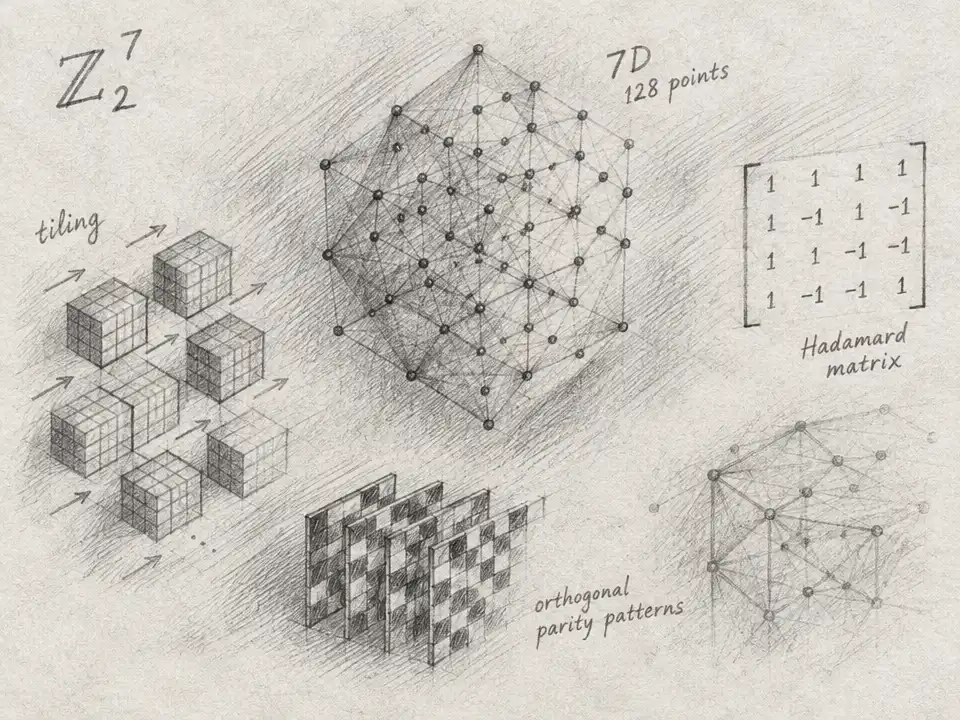
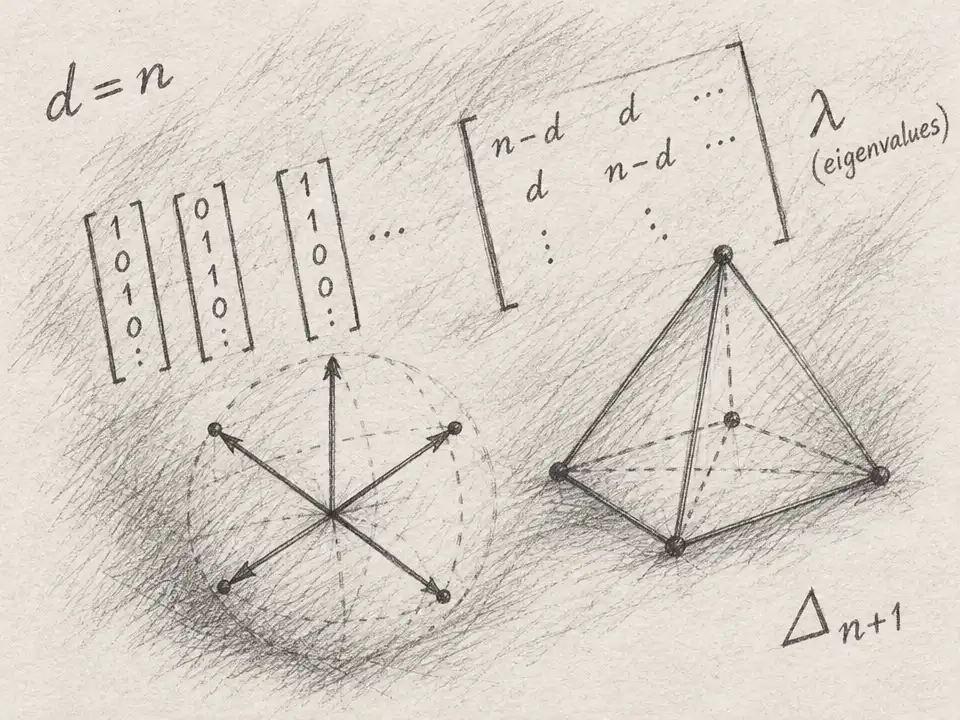
To see the change of viewpoint, replace each zero in a message with minus one and each one with plus one. A string of length n becomes a point with n coordinates, each either minus one or plus one. Every such point has the same length. And because the messages all disagree in exactly the same number of positions, every pair of points has the same angle-related score: their dot product is identical.
Now make a table of all those pairwise scores, including each point’s score with itself. Mathematicians call this a Gram matrix. Its entries look repetitive because the original messages obey such a strict rule. Kominers’s key move is to study the matrix’s eigenvalues—the special directions in which the matrix acts in a simple, predictable way—instead of starting with its determinant.
The symmetry separates the table into two kinds of directions. One tracks the collection as a whole; the others describe ways the points can balance against one another. The crucial fact is that all those balancing directions carry the same positive eigenvalue. That forces the matrix to have at least one independent direction for every point except one. But the points live in n-dimensional space, so there cannot be more than n such independent directions. In effect, equal spacing spends dimensions.
That argument allows at most n plus one points at first. The remaining question is whether the extra point can fit. The eigenvalues answer that too: if a collection actually reaches n plus one, its one collective direction must collapse to zero. That can happen only at the exceptional distance. Rather than prove a general cap and then run a separate test for the edge case, the proof gets both conclusions from the same eigenvalue calculation.
The exception is easy to see in a tiny example. Consider four three-bit strings: 000, 011, 101, and 110. Every pair differs in exactly two positions. Four messages fit even though their length is only three, and two is half of one more than three. In the geometric picture, the four points sit like the corners of a regular tetrahedron in three dimensions. The unusual distance is not a loophole in the reasoning; it is the exact spacing that lets the tetrahedron close.
The same strategy works when each position can hold one of q symbols, not just zero or one. A single symbol can be represented by a corner of a regular simplex, a balanced geometric arrangement of q points. Each position then occupies q minus one dimensions, so a message of length n is represented in a space with n times q minus one dimensions. The proof gives a matching size limit—except at a corresponding balance distance, calculated by multiplying the length by one fewer than the alphabet size, adding one, and dividing by the alphabet size.
For a simple check, let the message length be one. Every symbol is then its own message, and any two distinct messages differ in that one position. With q symbols, there are q equally distant messages, one more than the ordinary geometric cap of q minus one. This is precisely the balancing case. The example shows why the exception matters, and why a threshold that works for binary strings cannot simply be copied unchanged to larger alphabets.
The broader lesson is about what a mathematical tool can reveal. A determinant can tell whether a matrix is singular; eigenvalues expose how many independent directions remain, and when one of them disappears. Here, that finer view turns a coding puzzle into a geometry problem with a clear picture: points spread equally around a space, with one exceptional arrangement that just fits. The bound itself was already known. The new approach makes the reason behind it more visible—and carries that explanation across alphabets with different numbers of symbols.