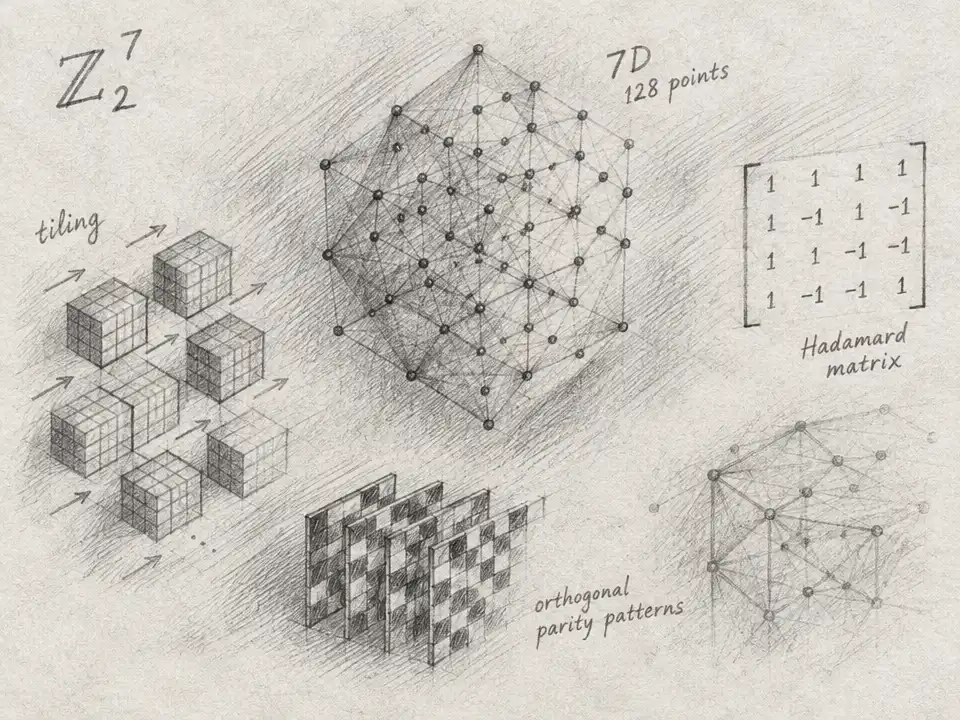
Imagine a world made of 128 dots. Each dot is a seven-character string of zeros and ones, and moving a shape means flipping the same chosen bits in every one of its points. It is a small universe, but it poses a deep question: if you can copy a shape around until every dot is covered exactly once, must that shape also support a perfectly balanced set of patterns?
A new mathematical result says yes in this seven-bit world. Every set of points that tiles the space by shifted copies also has a complete set of mutually orthogonal frequency patterns—and every set with those patterns tiles. The result settles a case that had resisted a full answer after the smaller binary spaces were handled.
The two sides of the statement sound as if they belong to different disciplines. Tiling is about arranging pieces. A tile is a set that can be shifted around so every location is covered once, with no gaps and no overlap. In this binary universe, a shift is an especially simple move: add the same seven-bit pattern to every point, which flips selected coordinates.
The other property is about soundless cancellation. A frequency pattern assigns each point either a plus or a minus sign, according to a parity rule. A collection of such patterns is orthogonal when, across the chosen shape, every pair cancels perfectly. If there are as many mutually orthogonal patterns as points in the shape, they form a complete basis: a way to represent any function on that shape without redundant directions.
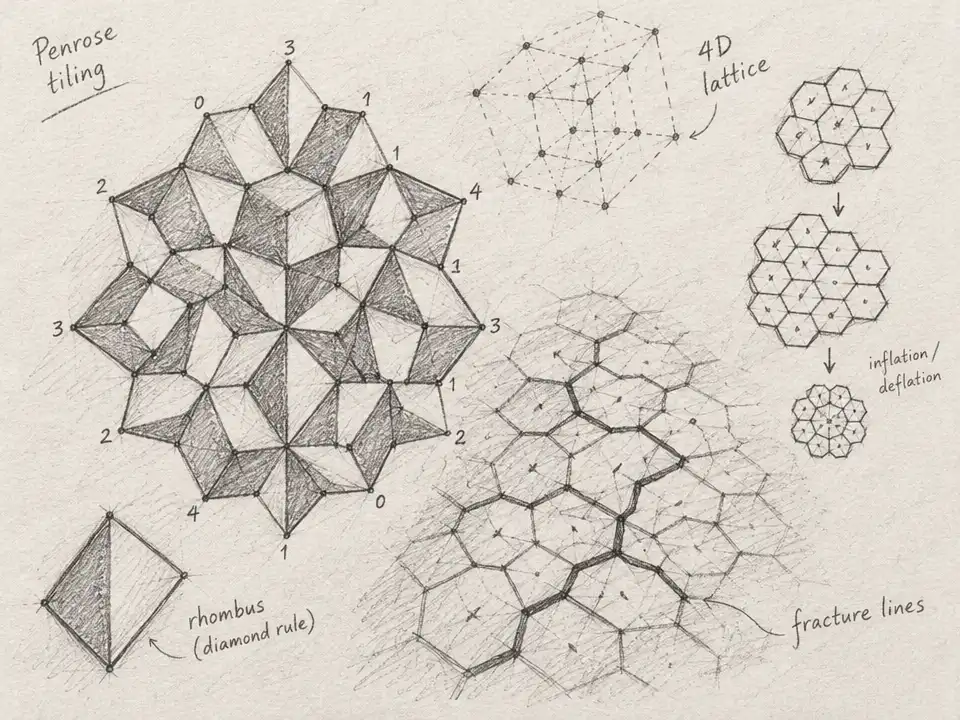
So the puzzle asks whether an exact packing in space and a perfect system of waves are two faces of one structure. The question is part of Fuglede’s conjecture, first posed for shapes in ordinary Euclidean space. There, the proposed equivalence does not hold in dimensions three and higher: tiling and spectral structure can come apart. Finite binary spaces offer a different setting in which the relationship can be tested point by point.
For the seven-dimensional binary space, the new theorem closes the loop. It is a precise result about a finite setting, not a claim that every shape in the physical world has a matching set of frequencies. Its broader appeal is that it reveals how geometry and harmonic analysis can constrain each other: knowing how a set repeats can tell you whether it has a complete orthogonal language of patterns.
The proof travels in both directions. Start with a tile. Its complementary shifts must fill the whole space alongside it. The researchers show how to build frequency patterns that work for every possible complement of certain small sizes. Because the tiling forces a cancellation between the tile and its complement, those patterns become orthogonal on the tile. The construction is a little like finding a master key: one frequency set works regardless of which compatible arrangement completes the tiling.
Now reverse the journey. Start with a set that already has a complete orthogonal family of patterns. The first question is how many points it can contain. Here the authors use a hidden arithmetic constraint in a large matrix of plus and minus signs, the Walsh matrix, which records the parity patterns of the whole binary space. A determinant argument rules out many possible sizes. In seven dimensions, the surviving sizes are powers of two.
That narrows the difficult cases to sets with 16 or 32 points. For those, the proof translates the frequency relationships into special Hadamard matrices, where every row and column is orthogonal to the others. The authors then compress each matrix into a smaller binary point set. If that compact set tiles its smaller space, the original set inherits a tiling in the full seven-dimensional one.
This is where the proof’s price becomes visible. The order-32 Hadamard matrices had already been classified, but the list is enormous: the researchers scanned 6,857,010 classes, then found just sixteen with the low binary rank needed for the argument. They checked both orientations of those matrices and supplied explicit tiling certificates. Three independently written programs agreed on the rank scan, and separate checkers verified the certificates using integer arithmetic.
That combination of structural reasoning and exhaustive computation is powerful, but it marks a boundary as well as a victory. The proof relies on an existing classification of finite matrix families and on the correctness of the data representing it. The authors make those dependencies explicit and provide material for checking the finite cases. Still, the method is not a single shortcut that automatically settles every larger binary space.
Dimension eight is the next test. Some cases are already controlled, but the paper identifies specific gaps: whether every 16-point tile has a spectrum, and whether every spectral set of size 32 or 64 tiles. These are not just leftover bookkeeping. They ask whether the same bridge between packing and orthogonal patterns survives when the space doubles in size and the matrix structures become harder to classify.
If the bridge can be extended, it could sharpen our understanding of exact Fourier decompositions on finite spaces: when a pattern can repeat without overlap, and when its points also admit a complete set of independent oscillations. The immediate prize is conceptual, not a ready-made technology. In this small universe, geometry and frequency are not merely compatible; they are equivalent. The frontier is finding out how long that agreement lasts—and what new structure appears when it finally breaks.