Start with a shape, not a sequence. A researcher wants an RNA molecule to fold into a particular pattern: paired stretches, loose loops, perhaps a branching junction. The puzzle is to choose the chain of four chemical letters—A, U, G and C—that will fold into that shape. Many different sequences can produce the same structure, but most won’t. For a 74-nucleotide example discussed by the researchers, the possible sequences number about 1036.
That scale makes brute force hopeless. And the usual instinct in artificial intelligence is to give one powerful model the whole challenge: let it search the enormous space and learn which choices lead to the desired fold. A new approach tried something less obvious. It split the design work among four cooperating AI agents—and, in computer tests, the team was much more successful than established methods given comparable time.
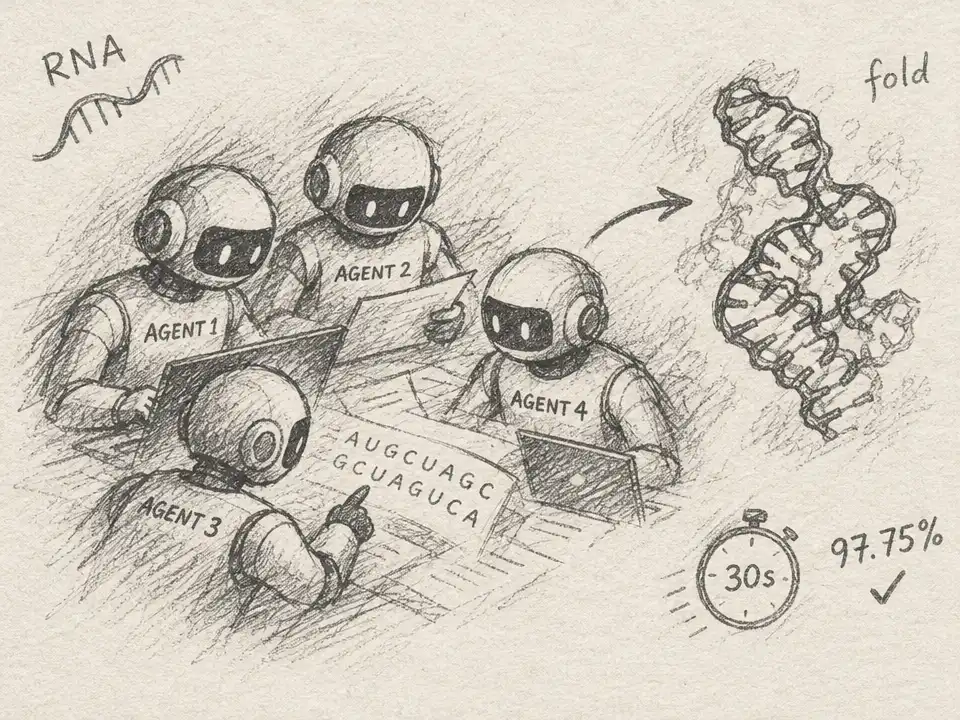
The system, called CocoRNA, treats sequence design as a shared construction job. Each agent is assigned a section of the RNA and chooses letters for positions in that section. Its view is local: it sees a nearby window of the partially built sequence and the target structure, rather than making every decision for the whole molecule. During training, a central evaluator can inspect the full design and help guide the agents toward the shared goal.
The agents are not four biological specialists, and they do not pass messages like people around a table. They are separate learned decision-making policies, each working on part of a single computational task. The important design choice is the division of labor: rather than asking one policy to manage every position and dependency at once, the researchers let several policies handle smaller pieces while training them toward the same outcome.
That outcome is checked by a folding program. After the agents make design choices, ViennaRNA predicts how the sequence will fold. If the predicted structure moves closer to the target, the team receives an intermediate reward; if it matches exactly, the design succeeds. Early in training, the researchers also add a limited local search: it checks whether a nearby alternative choice would improve the result and uses better examples to help the agents learn. This search aid is used during the first 30% of training.
The test was demanding in a useful way. The researchers drew structures from the Rfam database, grouped them by structural similarity, and held out a cluster for testing. They also removed highly similar structures from the training set. In the main setup, training used 60,000 structures and the test set contained 650. The four-agent system trained for 25 million steps; when asked to design a sequence for a test structure, it had a 30-second limit and up to 15 attempts.
Under those rules, CocoRNA achieved a 97.75% success rate. The best-performing baseline under the same 30-second limit, SAMFEO, reached 70.50%. Even when a strong baseline was given 600 seconds—20 times CocoRNA’s time limit—CocoRNA still had an 8.21-percentage-point advantage over the best result in that longer-budget comparison. The researchers also reported an average solution time of 3.24 seconds for CocoRNA’s successful designs.
Another comparison sharpens the surprise. OmniGenome, a 186-million-parameter model used to assist a genetic algorithm, reached a 40.22% success rate in its 60-second setting. CocoRNA’s result was higher despite its 30-second cap. That does not establish that smaller AI systems generally outperform larger ones: these are different methods, and performance depends on the task and test setup. But it does show that, for this particular design problem, dividing decisions among cooperating policies could matter more than relying on a large model alone.
The researchers tested whether the result depended on an unusually convenient train-test split. Across six alternative splits, CocoRNA averaged 97.44% success. They also compared it with a single-agent version that controlled all positions; that version reached 52.43% in the reported comparison. The contrast supports the value of the multi-agent design, though it is not a perfect contest between equally tuned systems: the paper notes that its single-agent variant lacked some optimizations and extra training used in the main system.
The story goes beyond one test set, but the extensions bring their own caveats. Without retraining, CocoRNA achieved a 92.4% success rate on 500 RNA sequences ranging from 500 to 971 nucleotides, using a sliding-window approach and a longer time limit. A separate version adapted to represent pseudoknots—a more complicated kind of crossing base-pair pattern—reported a mean success rate of 92.67% on three held-out sets. And when trained using one folding program but evaluated with a different structure predictor, its reported success was 94.90%. These are computational results, not proof that the designed molecules were synthesized or behaved as predicted in a laboratory.
That distinction matters. CocoRNA’s central judge is a computer model of folding, and the paper identifies reliable biological reward signals as a limitation. A sequence that scores well under a prediction tool still needs experimental checks before anyone can conclude that it performs a biological job. More agents are not automatically better, either: the authors found that performance can slip when the team grows too large, as coordination gets harder.
Still, the unexpected result is worth pausing over. A vast search problem did not yield simply to a bigger computational brain. It yielded, in this benchmark, to a carefully organized team: agents taking on local pieces, a shared evaluator keeping the larger objective in view, and a modest search procedure helping the team get started. The next question is whether this kind of division of labor will prove useful for other biological design challenges—and whether its predicted successes will hold up when the molecules leave the computer.