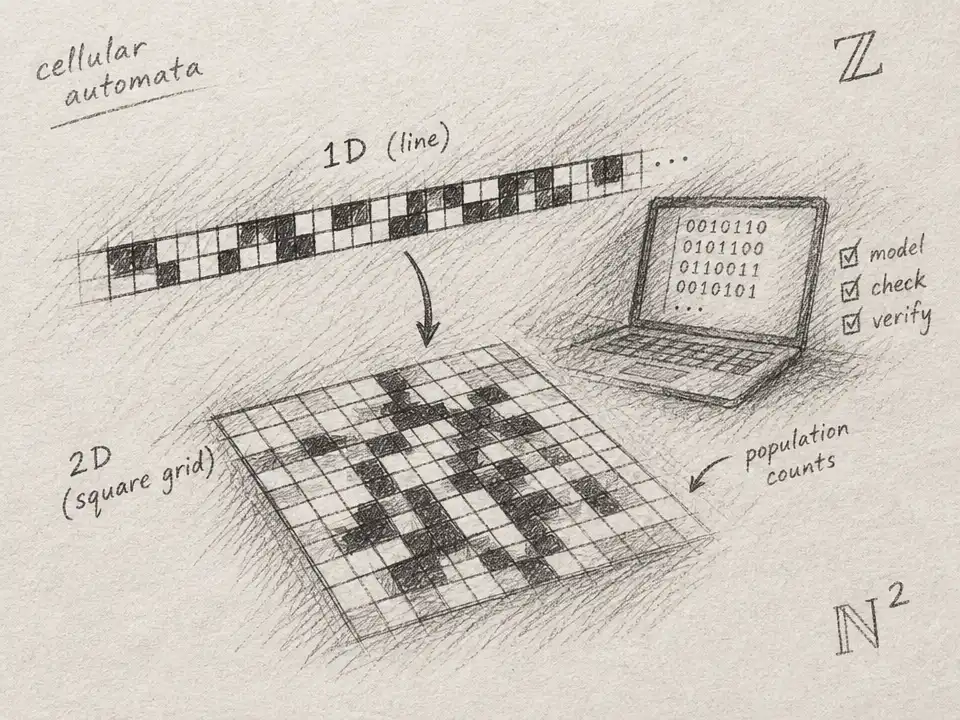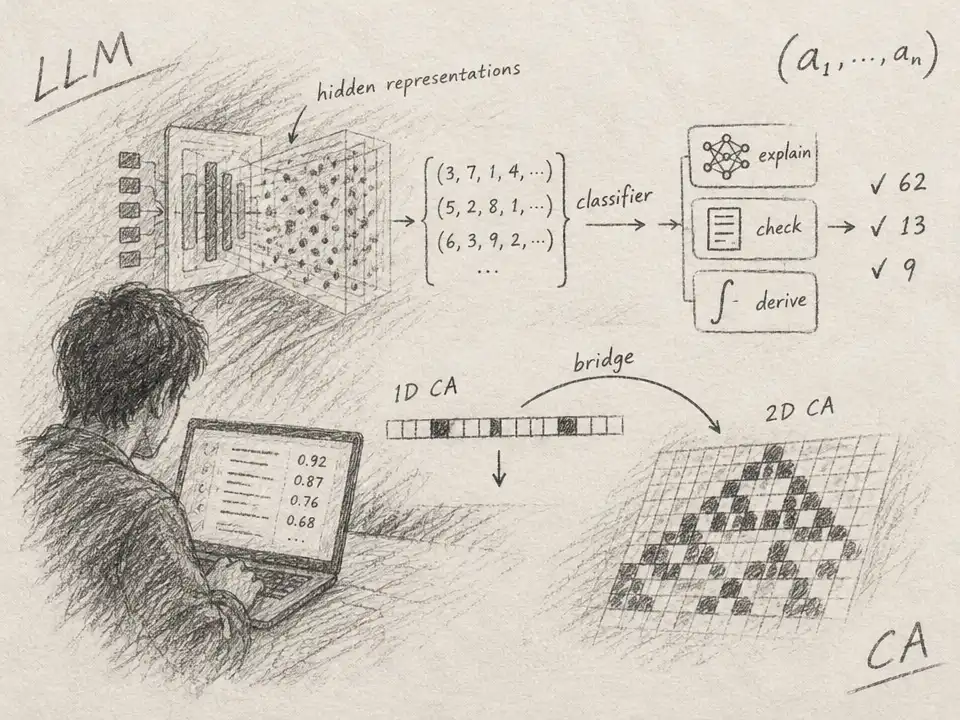
Start with one lit cell on a line of dark ones. At each tick, every cell checks itself and its two neighbors. The next state is set by a simple rule: the cell lights up when an odd number of those three were lit. This is Rule 150, a one-dimensional cellular automaton—a system that makes patterns by repeatedly applying the same local rule.
Now move from the line to a square grid. In the Fredkin replicator, a cell lights up when an odd number of its eight neighbors are active. The rules differ, and one pattern spreads along a line while the other fills a plane. Yet a surprising question has a precise answer: can the number of lit cells in the two-dimensional pattern be worked out from counts in the one-dimensional one?
A recent study suggests that a language model’s hidden representations can help find such unexpected pairings. Its system, LANTERN, searched the On-Line Encyclopedia of Integer Sequences, or OEIS, a vast catalog of number sequences and the mathematical objects behind them. The researchers focused on 10,000 frequently referenced entries. That made nearly 50 million possible pairs—far too many for someone to inspect one by one.
The team’s first move was not to ask a language model to explain every pair. Instead, they used Qwen3-32B to turn each entry’s definition into a set of internal representations: numerical patterns formed as the text passes through the model’s layers. The system kept 65 snapshots for each definition, then compared pairs of entries across those snapshots. A relatively simple classifier learned which patterns tended to accompany substantive mathematical connections already recorded in the encyclopedia, while the training process distinguished them from routine links.
This hidden map did not prove anything. It ranked pairs worth investigating. LANTERN sent its highest-ranked candidates through successive checks: a quick filter, then a stronger model that could inspect the entries and propose a relationship. The proposed claims were tested against every stored sequence term and checked analytically. Across three search configurations, the process produced 62 verified relations between entries the OEIS did not cross-reference. The complete pipeline took under eight hours.
One of the clearest bridges joined the two cellular automata. The line-based sequence counts how many cells are active in Rule 150 after each step; the grid-based sequence counts active cells in the Fredkin replicator. Their patterns look like products of different worlds. But both sequences can be broken into factors according to the lengths of runs of ones in the binary form of the step number. For each run, the grid’s factor can be calculated from the line’s: take the square of one line-based count and subtract the square of a related count from two run-lengths earlier.
At step 13, for example, the binary number is 1101. It contains runs of ones of lengths two and one. For the line, the corresponding factors are 5 and 3, giving 15 active cells. For the grid, they are 24 and 8, giving 192. The one-dimensional counts, combined through the shared pattern in the binary digits, recover the two-dimensional total exactly. No one has to trace every lit cell across the spreading grid to get the answer.
The connection is not a claim that a new theorem has been proved. The component counting laws were already known; a related identity also appeared in the OEIS in another mathematical form. What the search surfaced was a useful interpretation linking those laws to two automata with different dimensions and local rules. That distinction matters: finding a bridge between familiar results can be valuable without making the results themselves new.
LANTERN also surfaced a connection between two expressions from analysis—a continued fraction and a theta quotient—and the counting of 5-core partitions. A partition is a way to arrange an integer as a sum, with order ignored. Draw each sum as rows of cells; for a 5-core partition, no cell’s hook length—the cell itself plus the cells to its right and below—can be divisible by five. The paired expressions combine to generate the counts of these arrangements, giving the analytic objects a concrete combinatorial meaning.
How much of the search signal came from mathematical structure in the model, rather than from words that happened to look alike? The researchers compared their activation-based rankings with a scorer that read the definitions’ surface text. On 42 later-added pairs judged to have substantive relations, the text scorer reached an area-under-the-curve score of 0.61, while the activation-based models reached 0.67–0.69. On a broader set of 793 later-added links matched to unrelated entries from the same topics, the text scorer was at 0.51 and the activation models at 0.57–0.58. The advantage was real, but the scores are a ranking signal, not a guarantee that the top candidate is meaningful.
The final sieve was stricter than mathematical correctness alone. Of the 62 verified relations, researchers retained 13 after removing routine transformations, simple bookkeeping and other connections they considered uninformative. Nine were judged informative or insightful. Four of those were not found in the OEIS or in the team’s targeted literature search. That search does not establish that the connections are unquestionably new; it describes what the researchers could locate.
There are boundaries to this hidden map. The OEIS is unusually structured: its entries come with definitions, formulas, initial terms and cross-references, and the study favored frequently mentioned sequences. The researchers also tested only one family of pretrained language models. The method may not transfer to less formal mathematics or knowledge bases whose relationships are not already recorded in links.
Still, the perspective shift is striking. A model’s internal patterns, usually treated as an opaque step between reading text and producing an answer, became a way to sort a mountain of possible questions. Other systems and mathematical checks did the work of turning promising pairings into verified statements. LANTERN’s most intriguing role may be neither mathematician nor oracle, but a lantern-holder: illuminating a corner of the landscape that a person might not have thought to search.