When a language model writes a sentence, the visible trick is words appearing one after another. Hidden underneath is a much less literary task: a vast stream of arithmetic, repeated for every new token. A recent hardware study asks what happens if that arithmetic is rebuilt around an unexpected fact: some neural-network weights need only take three possible values.
Those values are negative one, zero, and positive one. A model using them is called ternary; each weight carries about 1.58 bits of information on average. That is a remarkably compact description. But compact numbers do not automatically make compact computing. Ordinary processors are designed for general-purpose multiplication, so they often convert these tiny weights into larger numbers before using them. The simplicity vanishes in translation.
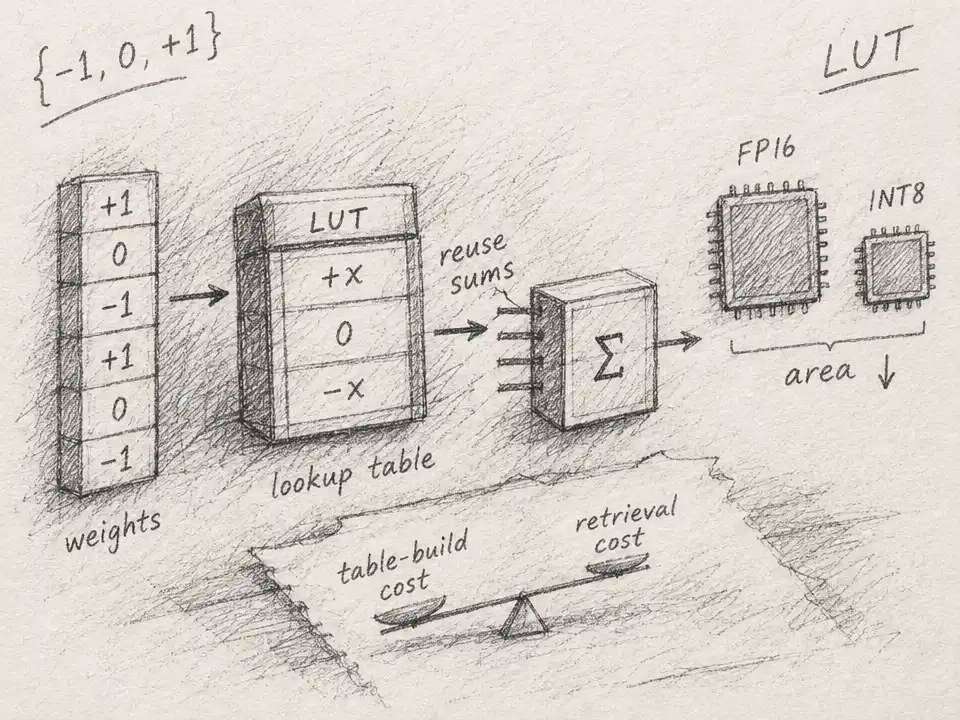
Robin Geens, Joran Heldens, Joren Dumoulin, and Marian Verhelst explore a different route: make a specialized processor that does not multiply those weights at all. Instead, it builds a small lookup table—a ready-made menu of possible sums—and lets the weights select the answer they need.
Picture two incoming activation values, each carrying a number from the model’s current calculation. A pair of ternary weights can ask for the first value, the second, their sum, their difference, or nothing. Rather than calculate each request from scratch, the hardware can prepare the possible combinations once, store them, and retrieve the right one as the weights arrive. The lookup table is not a shortcut around the model’s computation; it is a way of arranging repeated pieces of that computation so the same work does not have to be done over and over.
The trick has a hidden cost of its own. Group more activations together and the table must cover many more combinations. Group too few, and the processor spends more effort adding retrieved pieces back together. The authors’ design therefore has to balance the cost of building the menu against the cost of using it. For a 32-by-32 design with FP16 activations, their synthesis results put the best group size at three—not the largest possible table, but the point where preparation and retrieval balance.
That balance changes with the kind of numbers flowing through the processor. The team compared FP16, a floating-point format, with INT8, an eight-bit integer format. In FP16, adders are relatively costly, so reusing precomputed sums can pay off. With INT8, the operations needed to select or flip values are less favorable by comparison; the lookup-table approach provides much less benefit. The headline is not that lookup tables always win. It is that the best hardware depends on the arithmetic surrounding the tiny weights.
The researchers built an open-source hardware generator and an analytical model to map this design space, then checked the model against synthesized circuits using a TSMC 16-nanometer process. Their designs were fully pipelined to meet a 500-megahertz timing constraint. In one specific comparison—a 32-by-32 tile using FP16 activations—the optimized lookup-table design had an area of 0.120 square millimeters. That was 2.23 times smaller than a baseline that first converted ternary weights to FP16, and 1.64 times smaller than a more efficient baseline using sign flips instead of full multipliers.
Those numbers describe synthesized designs, not a new chip fabricated and tested in a data center. The paper studies the matrix-vector calculations that dominate the token-by-token decode stage, and its area comparisons are tied to the stated design assumptions. It does not establish that a full language model runs faster, uses less total energy, or keeps the same quality on real tasks. Those questions would require evidence beyond the hardware-area exploration reported here.
One counterintuitive result concerns scale. It might seem safer or more flexible to spread a processor’s work across many small cores. But in the team’s area-efficiency analysis, larger lookup-table cores made better use of their hardware: fixed overheads for building tables and storing results became less significant as the core grew. The best tile shape also shifted with the activation format. In other words, the invisible machinery has its own geometry, and changing the numbers changes the shape that makes sense.
That is the deeper perspective hidden in this study. A model’s weights may look like a storage problem, and its calculations like a multiplication problem. But when the weights collapse to three choices, the processor can be redesigned around repetition: prepare a compact menu, reuse it, and arrange the hardware so that its overhead does not overwhelm the savings. The paper’s strongest result is not a universal new accelerator. It is a map of where this unusual arithmetic helps—and where the apparent shortcut stops being one.