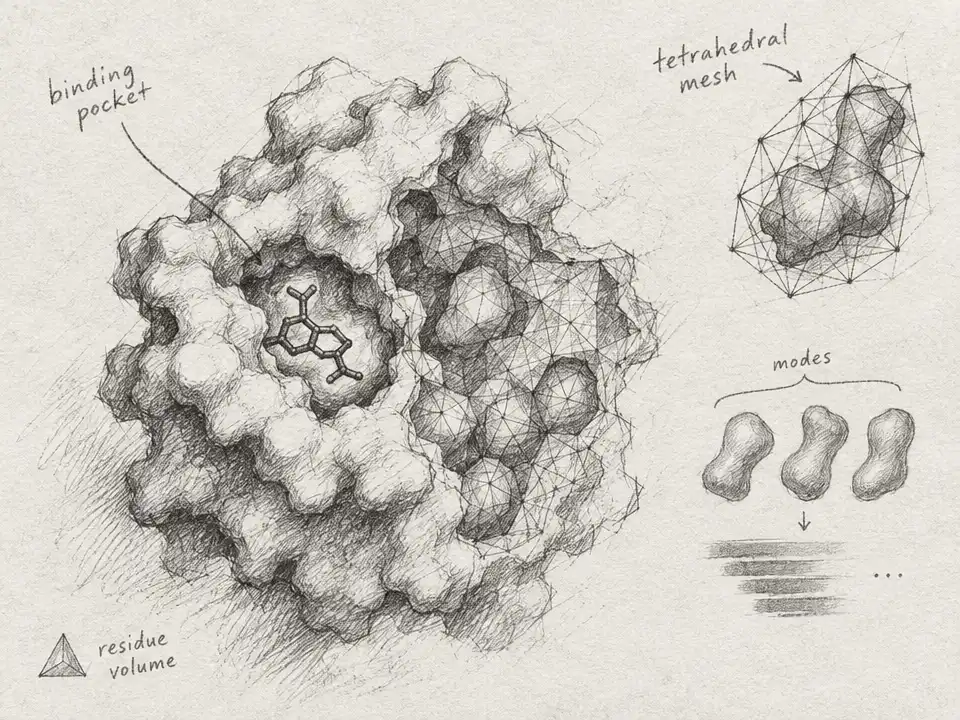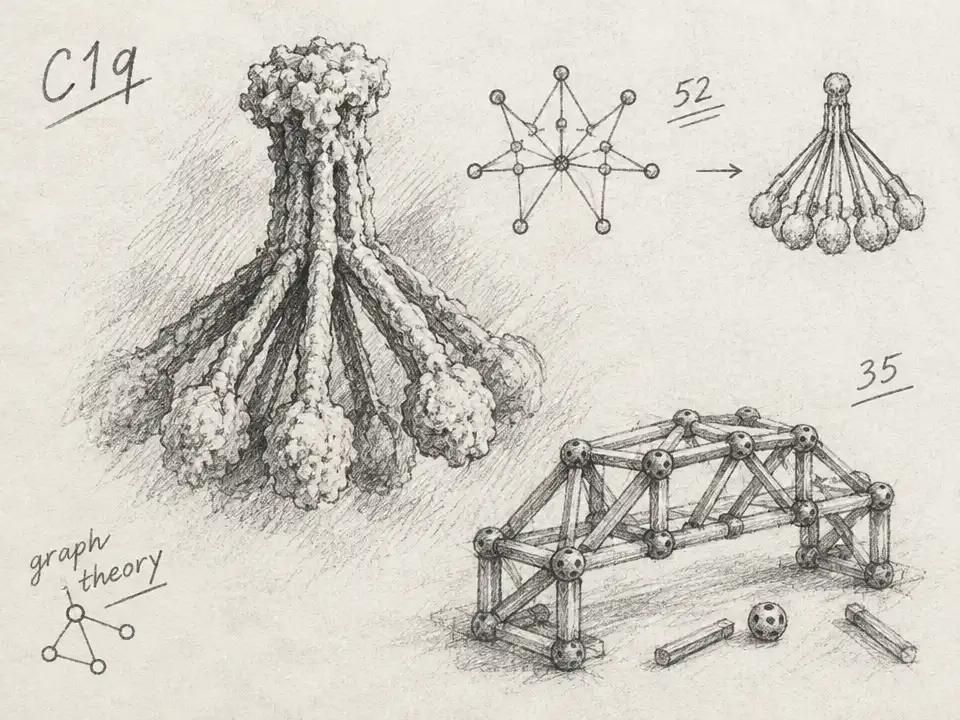
Somewhere in the body, an 18-protein complex called C1q takes shape like a tiny bouquet. Its parts could, in principle, connect in 52 topologically different ways, according to a new mathematical analysis. Yet the immune system repeatedly builds the same overall arrangement. The puzzle is not just how the proteins fit. It is how local connections repeatedly produce one reliable whole.
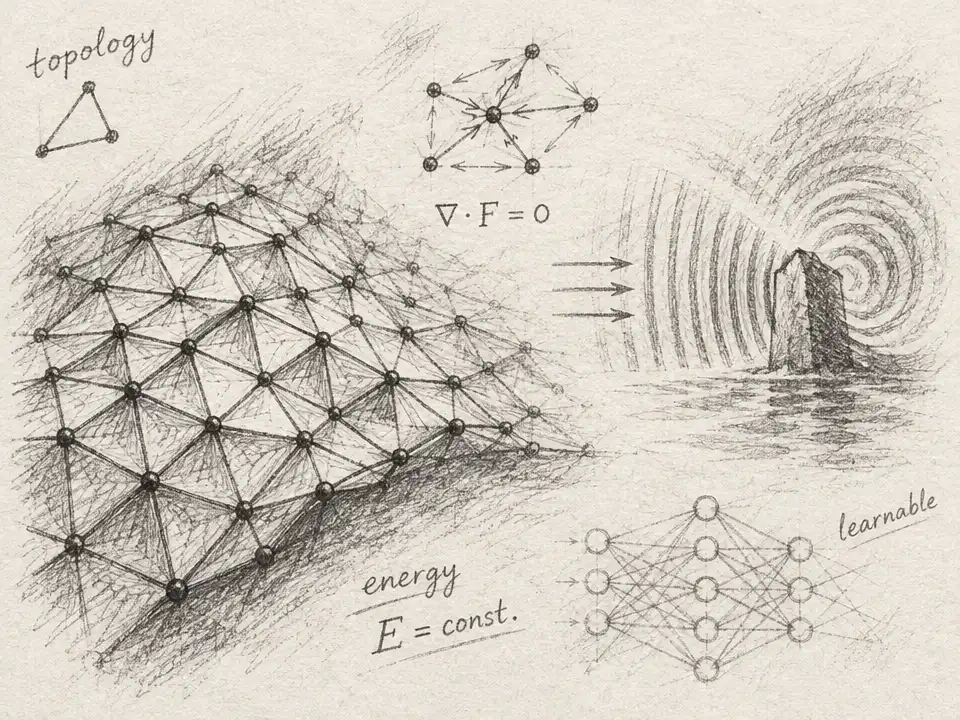
The answer, researchers suggest, may lie in a meeting between biology and graph theory. A graph is simply a map of connections: dots stand for components, and lines show which ones are linked. Strip away a protein’s chemistry and three-dimensional form, and you can still ask a useful question: given these parts and these rules for connecting them, how many different finished maps are possible?
To make that question precise, the team described each system with a “design set”: an inventory of components, a count of how many connections each type can make, and rules specifying which types may connect. It is a deliberately spare description. It does not capture every molecular force, assembly speed, or spatial constraint. It does let mathematicians test whether the allowed connections leave room for more than one finished network.
Sometimes, they don’t. Imagine five components, each needing two neighbors. If every finished network must use all five, there is only one possible pattern: a loop. The researchers call a design set unigraphical when its rules permit just one completed network, regardless of the path taken to assemble it. Their Unigraphical Design Theorem identifies conditions under which local rules guarantee that uniqueness.
But C1q presents a twist. Its encoded rules alone permit 52 possible network patterns—not one. Biology supplies another ingredient: order. First, three protein chains form a triangular unit. Two such units join into a doublet; then three doublets come together to make the final bouquet. The researchers show that each stage can be uniquely assembled on its own. A sequence of individually constrained steps can therefore reach a single outcome even when the full parts list, considered all at once, allows many.
They call this route guided assembly. It gives the graph-theory framework a crossover role: mathematics can help describe not only what a system’s parts could make, but how an assembly sequence narrows the possibilities. For C1q, the researchers did not discover a new biological pathway; they used a documented sequence of assembly as a case where staged construction resolves the ambiguity that the parts-and-connections map leaves open.
Then they put the framework to a broad test, analyzing 3,618 networks drawn from proteins, molecules, electronic circuits, robots, furniture, and fragmented images. Of these, 813—23%—were compatible with just one network under their design rules. Another 1,661 could reach a unique result through guided assembly. Together, those two routes accounted for about 69% of the systems studied. The remainder were not necessarily irreproducible; their assembly may depend on details the model leaves out.
That qualification matters. The framework focuses on which finished networks are allowed by the encoded rules, not on the full physical process that creates them. In proteins, for example, spatial fit, helper molecules called chaperones, or the timing of protein production may restrict outcomes further. The authors note that roughly 31% of the studied networks needed such additional, system-specific constraints to explain their unique structures. The theorem is a way to ask a sharply defined question—not a claim that every molecule assembles by graph theory alone.
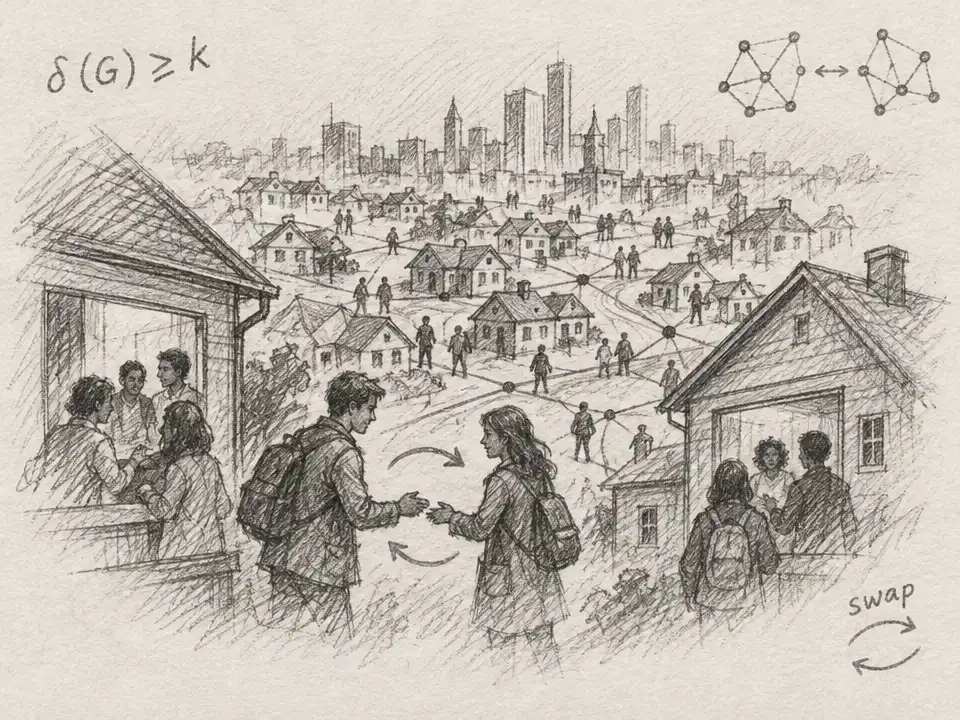
A second pattern hints at why some systems are easier to build uniquely. The researchers compared diversity—how many different component types a network contains—with redundancy—how many components can swap places without changing the network’s structure. They found that 758 of the 813 unigraphical networks, or 93%, sat near a boundary where these features balance. A system can use many distinct parts, or repeat parts that play interchangeable roles; either strategy can help keep the finished arrangement determined. The boundary is a useful clue, not a guarantee: being near it does not by itself prove that a design has only one possible outcome.
The team also used the idea to redesign a familiar kind of construction set. Ordinary Duplo pieces are versatile: under the researchers’ model, a 35-piece set could be compatible with at least about 100,000 structures on average. They added four custom 3D-printed adapters linking Duplo pieces to K’nex components, and imposed a rule that only pieces of the same color could connect directly. With the modified inventory and rules, the 35 pieces had just one possible completed network: a bridge.
The significance is not that a toy bridge behaves like an immune protein. It is that the same mathematical question can illuminate both: when do local rules make one global arrangement inevitable? In the team’s construction-set tests, adapters also made it possible to design many more unique structures than Duplo pieces alone could produce. Graph theory, usually used to describe networks after they exist, becomes a tool for thinking backward from a desired structure to the parts and rules that would make it reproducible.
Nature and engineering still have plenty of ways to complicate that picture, and some systems benefit from producing many possible arrangements rather than one. But for structures that must be rebuilt reliably, C1q offers a suggestive lesson: uniqueness can come from the parts themselves—or from the order in which they meet.