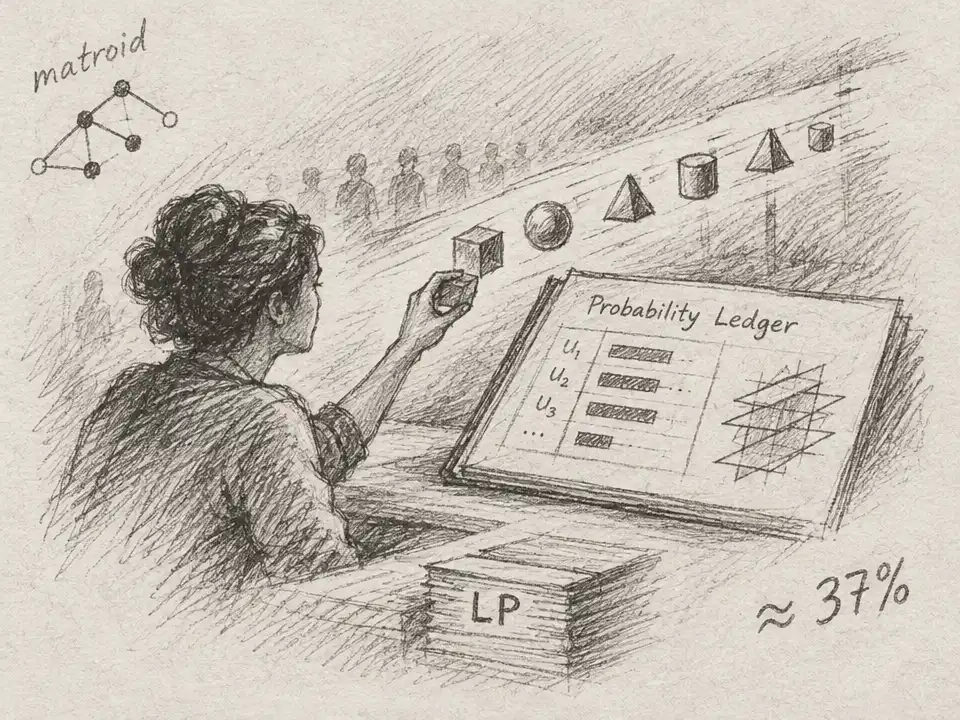
Imagine hiring from a parade of applicants when you must decide on each person immediately. You can learn how strong the current candidate is, but you cannot call back someone you passed over, and you have no idea who is still coming. The classic secretary problem asks how to choose the single best applicant. Now make the task harder: choose a whole set of valuable items, while ensuring that none makes another redundant. A new mathematical result finds a way to preserve surprisingly strong odds in that more crowded game.
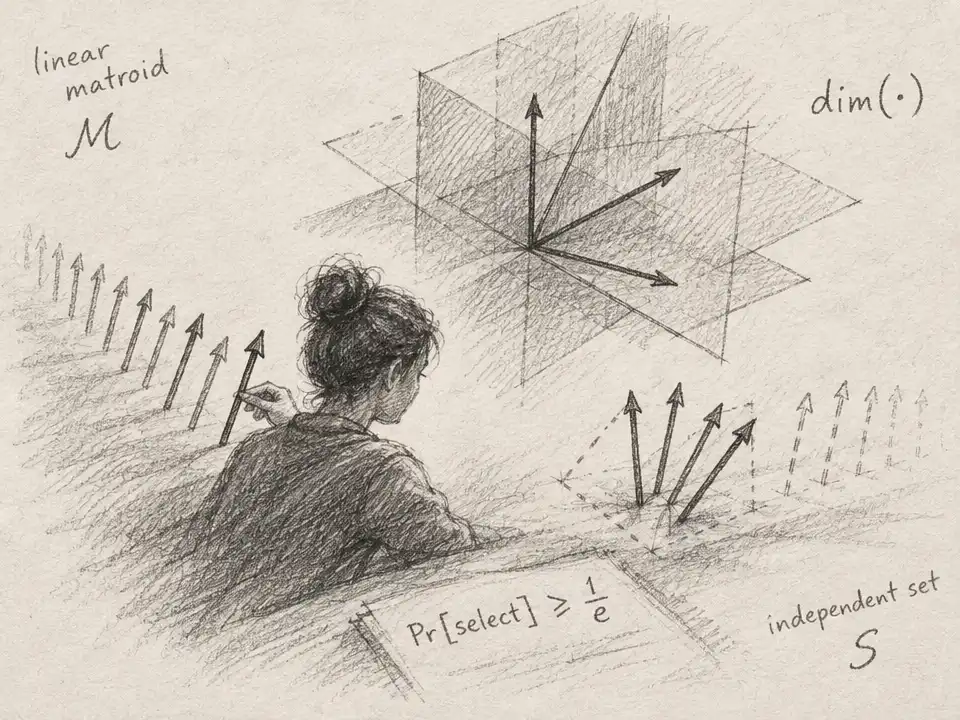
The researchers study a structure called a linear matroid. Its items can be represented by vectors, and a set is allowed when those vectors are linearly independent: none can be assembled from the others. Think of each vector as a direction in a geometric space. Choosing one direction can limit which later choices remain useful. The complication is not just that one item may block another. A choice can affect an entire hidden family of combinations, all at once.
In the online version, items arrive in uniformly random order. Their weights and vectors are revealed as they appear, but decisions are final. In one model, the algorithm does not know the full matroid beforehand; it learns the vector representation one arrival at a time. The authors prove that, for linear matroids, a randomized algorithm can give every item in a fixed, best-possible independent set at least a one-over-e chance of being selected. The same guarantee implies that the expected total value is at least a one-over-e fraction of the best set’s value.
That guarantee has a sharper edge than it may first appear. An algorithm could do well on average by reliably choosing a few especially valuable items while routinely missing the rest. Here, the claim applies separately to every item in the optimal set. It extends the benchmark from the one-prize secretary problem, where one-over-e is the best possible general guarantee. The new proof reaches that benchmark for linear matroids, not for every conceivable matroid.
The route to the result begins with a familiar tactic: watch an initial sample of arrivals, rejecting them, then use what they teach you about the competition. In the classic problem, a later candidate who beats everyone seen so far has a carefully controlled chance of being selected. The researchers design their algorithm to preserve the same kind of opportunity for an item that belongs to the best independent set among those observed so far. But they cannot simply accept every new record. A record vector might already lie in the span of previously selected vectors, making it impossible to add without breaking independence.
So the proof changes scale. Instead of asking only whether a particular arriving vector is still available, the algorithm monitors how much of every subspace is occupied by the span of its accepted vectors. A subspace is a smaller geometric world inside the whole space: a plane, a line, or a higher-dimensional region of possible directions. The algorithm keeps an upper bound on the expected amount of each such world that has been filled. It does not promise that every individual run stays balanced. The constraint is on the average across random arrival orders and the algorithm’s own randomness.
Why watch all those spaces? If a promising vector arrives, it can be accepted only when it adds a genuinely new direction. By controlling how much of each subspace is already occupied in expectation, the algorithm can ensure that enough room remains for such an arrival to have the needed chance of acceptance. It is like managing a budget not for individual seats, but for every possible overlapping region of a vast seating chart. A rule that protects only one direction at a time could miss a larger bottleneck formed by several interacting directions.
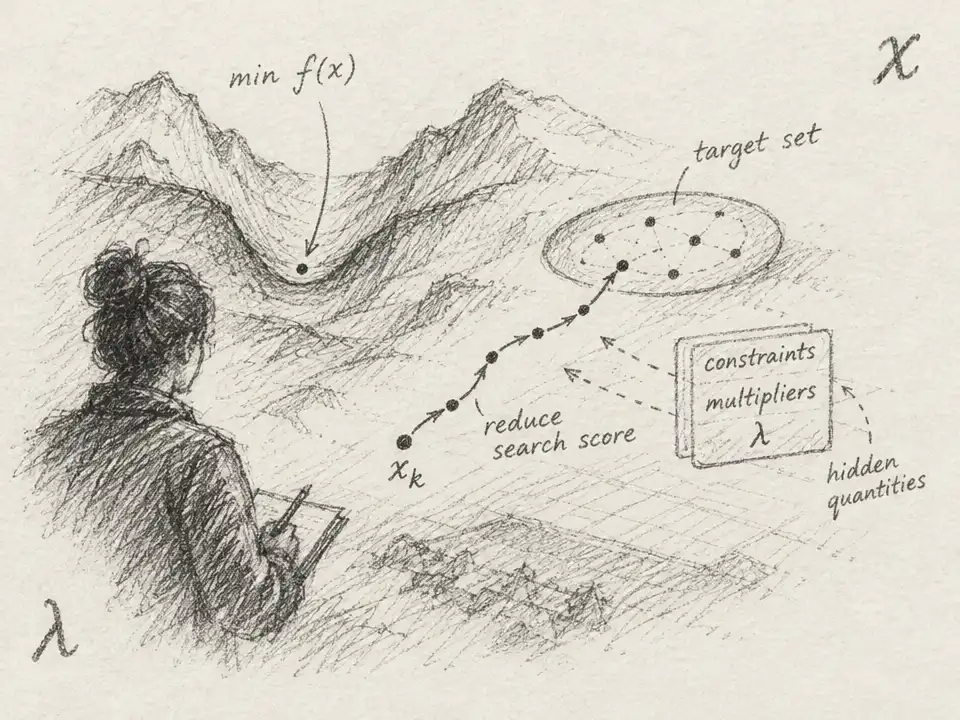
Turning that geometric bookkeeping into decisions is the paper’s main technical feat. The authors set up a linear program to choose acceptance probabilities that do two things at once: give improving items the desired chance and preserve the bounds on every subspace. At first, the program appears to face a tangle of constraints. The proof uses a technique called uncrossing to simplify the tangle. When two subspaces compete as potential trouble spots, their intersection and their combined span reveal a more orderly structure. The argument reduces the hard cases to nested chains of subspaces, where the probabilities can be assigned explicitly.
This works because vector-space dimension has a precise balance: the sizes of two spaces are related to the size of their overlap and the space they generate together. General matroid rank does not always obey that exact relationship. That is why the method does not automatically cover every matroid. Still, the paper shows it reaches beyond ordinary vector representations in certain cases, and it carries the basic strategy into settings where groups arrive together or agents receive bundles. For linear matroids, those extensions also achieve one-over-e guarantees under the models the authors define.
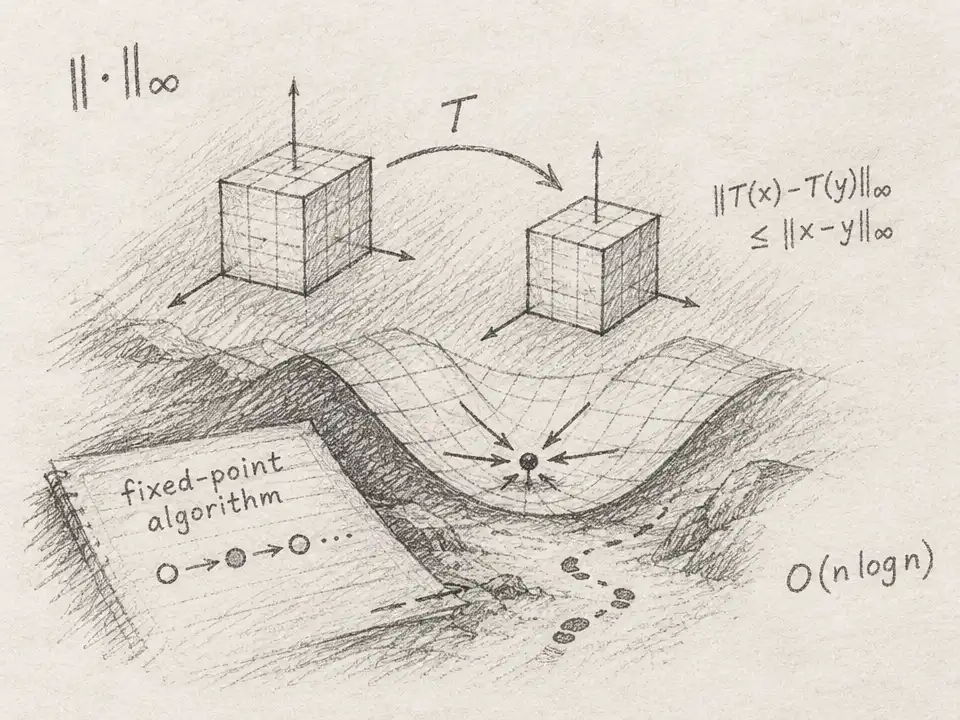
There is an important catch: this is a mathematical guarantee, not a ready-to-deploy hiring or allocation tool. The algorithm maintains distributions over many possible spans and solves large linear programs as new items arrive. The paper does not claim a polynomial-time implementation, so its procedure may be computationally impractical. The result is instead a proof that the desired online choices are possible under the stated assumptions.
The hidden world in this problem is not a secret list of future items. It is the geometry of all the dependencies that those items might create. Looking at that structure, rather than at isolated candidates, lets the researchers keep the whole choice process in balance. The surprising lesson is that a fair chance for each valuable item can emerge not from predicting the future, but from carefully accounting for the invisible spaces every decision touches.