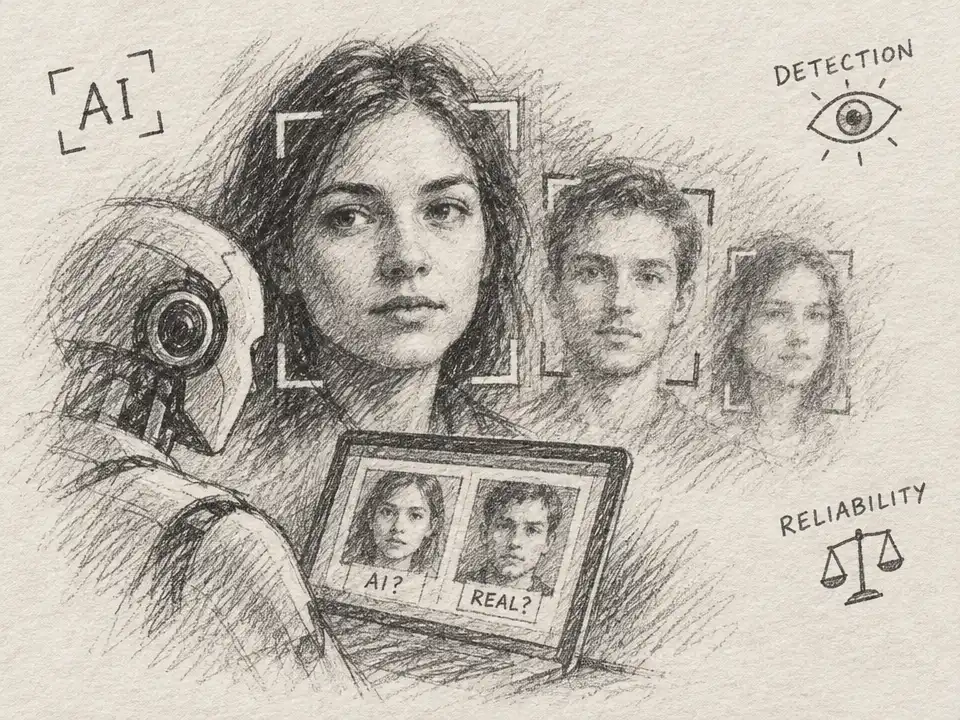
Put a face on a screen and ask one question: REAL or AI? It sounds like a small test, but the answer increasingly matters wherever a portrait might be used to create a fake profile, advertisement, or news image. In an arXiv study, researchers gave people and vision-language models—the AI systems that process images alongside text—the same faces and the same basic task. The latest models cleared a human benchmark. The more revealing discovery was what happened when they did.
The test was deliberately narrow. Researchers assembled portraits of 70 real people, then paired each identity with AI-generated versions made by ChatGPT-4o and Imagen 3. The models saw one portrait at a time and chose REAL or AI. They received the same four labeled practice images, and researchers scored them against results from an earlier study of 1,667 adults, ages 20 to 69. Because the human and machine judgments concerned the same image pool and response task, this was a closer comparison than simply placing scores from unrelated tests side by side.
The first set of 14 models, tested in June 2026, reached roughly the level of adults in their 20s and 30s, but did not clearly surpass them. Then, about four weeks later, five newly released models were tested under the same protocol. One, identified in the paper as gpt-5.6-sol, scored 92.8 percent on the researchers’ balanced-accuracy measure—above the 88.5 percent average for adults in their 20s. Across different sets of practice images, it averaged 92.1 percent. Another, claude-fable-5, averaged 91.9 percent.
That is a real result, but not a license to call these systems universal fake detectors. The score belongs to this particular portrait test: a curated set, two image generators, and a forced choice between real and AI at balanced rates. The researchers did not establish how the models would perform on every kind of synthetic image, on heavily edited pictures, or amid the clutter and uncertainty of social media. The finding is more precise—and more interesting—than a general claim that machines can now spot fakes better than people: on this controlled task, the best tested models could distinguish these portraits exceptionally well.
Even here, seeing the difference and making a fair decision were not the same skill. Consider claude-fable-5. It identified every AI image in the test, all 132 of them. But it also labeled 22.7 percent of the real photographs as AI. A detector can look impressive if you count only the fakes it catches; from the other direction, it can wrongly cast doubt on genuine images. The researchers found that the top models differed in which way they leaned. One favored calling images AI; another leaned more toward calling them real. Human participants, by comparison, were much more balanced between the two choices.
That imbalance is the catch with turning visual sensitivity into a useful warning system. A person checking a suspicious account might welcome a tool that catches more synthetic faces. But if its threshold is too aggressive, authentic portraits may be flagged; if it is too forgiving, fakes slip through. The right setting depends on what happens after the alert. The study measured accuracy and decision bias on a research benchmark; it did not test how people or platforms would use such alerts in practice.
There was another complication: the models’ answers could depend on which examples they saw first. Researchers repeated the test with different labeled practice images. Across the 19-model group, about 25.7 percent of items received different judgments at least once across the repeated passes. That number includes some run-to-run variation as well as sensitivity to examples, so it cannot be attributed entirely to the examples. Still, even the leading model’s score fell to the level of the June group on one pass. A detector that performs brilliantly once may not be equally dependable when a seemingly minor part of the setup changes.
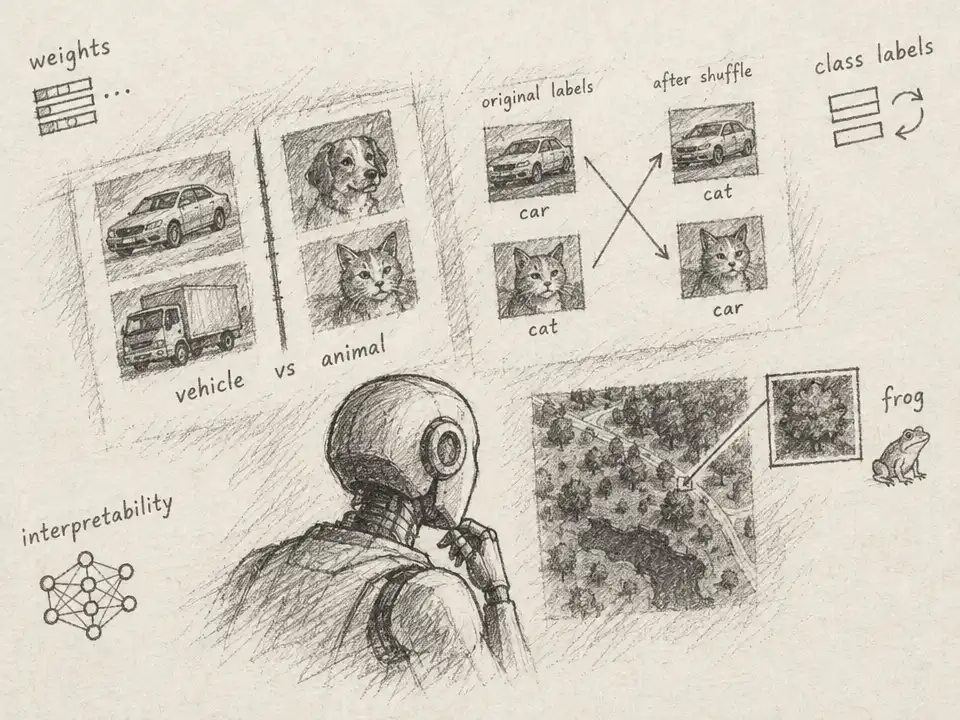
The models could also explain their answers, often by pointing to smooth skin, unnatural details, or a polished look. But an explanation is not automatically a window into what actually drove a decision. In this test, the rationales often followed the verdict: when a model called an image AI, it might describe it as overly smooth; when it called one real, it might call it natural or realistic. Those descriptions did not consistently distinguish real from generated faces. The researchers’ analysis therefore raises a practical caution: a convincing-sounding explanation should not be mistaken for independent proof that a portrait is fake.
This is where the next frontier lies. A useful detection system would need more than a high score: it would need to hold up across different images and examples, avoid lopsided false alarms, and show when its judgment deserves trust. The study offers a promising sign that visual models can pick up distinctions that young adults miss in a controlled comparison. It also shows why a single leaderboard number can hide the qualities that matter when someone must act on a result: stability, balance, and an honest account of uncertainty.
For now, the machine has won a face test, not the broader contest over what is real online. The paper’s results are a snapshot of 19 models, two image generators, and a limited set of portraits—not a settled ranking or a guarantee about future performance. What they reveal is a shift in the hard question. It is no longer only whether an AI can detect a synthetic face. It is whether the system can make that call consistently, and whether its mistakes are safe enough for anyone else to rely on.