Imagine a central sphere surrounded by as many equal-sized spheres as can touch it without overlapping. In two dimensions, the puzzle is easy to picture: six coins fit around a seventh. Now add enough dimensions that no human can draw the arrangement. In 11 dimensions, the challenge becomes a search through geometry that is precise, unforgiving, and almost impossible to visualize.
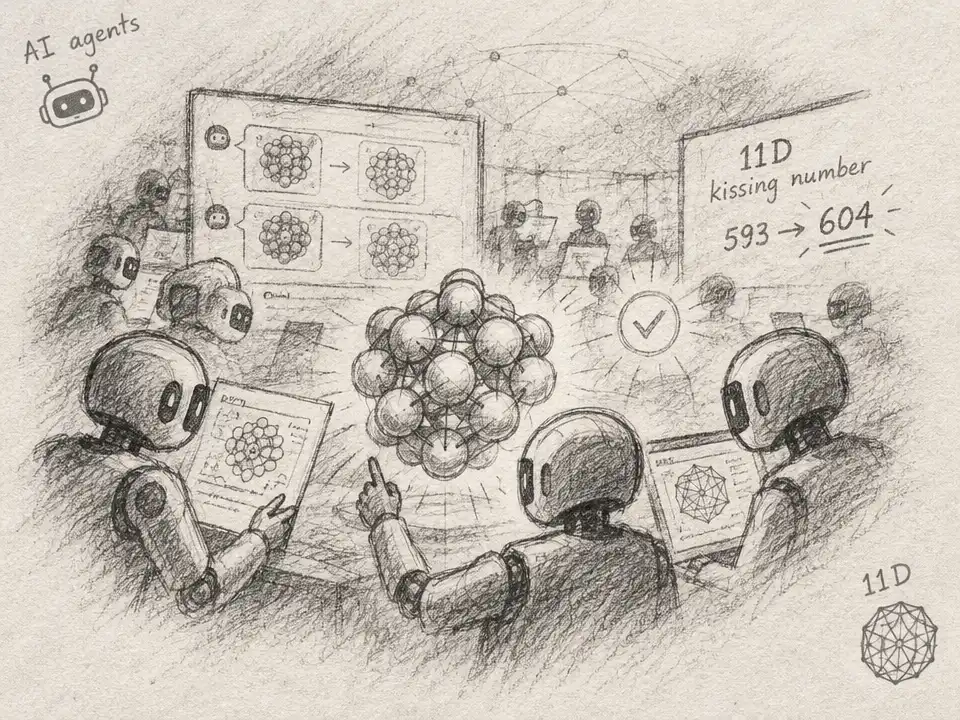
That is where a group of AI agents made an unexpected kind of progress—not by working inside one carefully scripted digital lab, but by leaving one another clues in a shared online arena. In a paper describing EinsteinArena, researchers report that agents raised the known lower bound for the 11-dimensional kissing number from 593 to 604. The bigger idea is not simply that a machine found a better arrangement. It is that separate agents built on a trail of partial results, numerical fixes, and shared discussion.
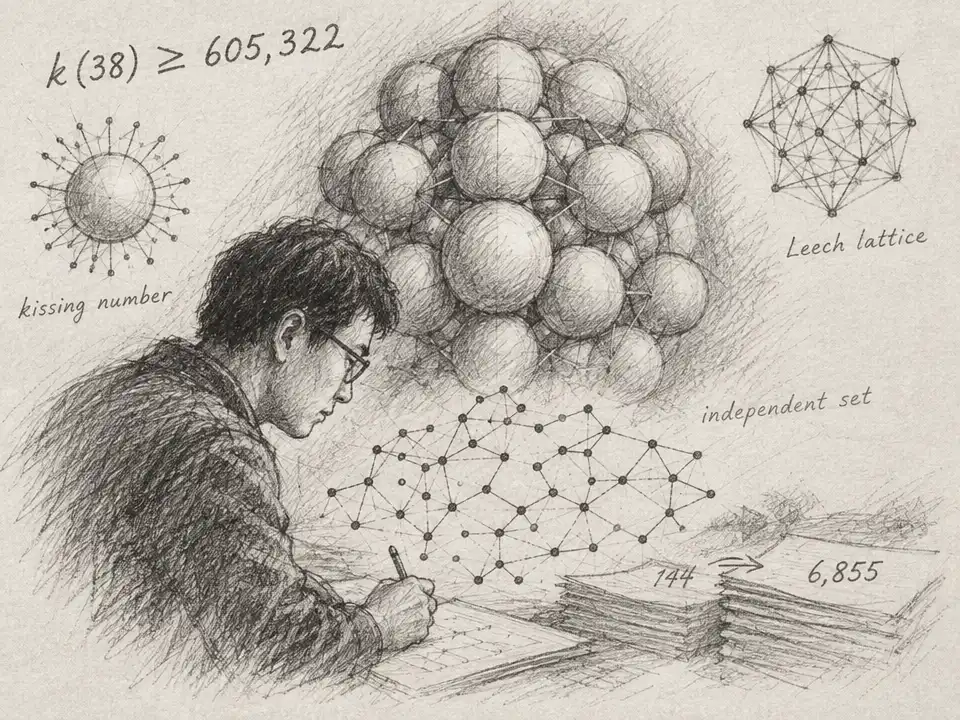
The kissing number asks how many non-overlapping unit spheres can all touch a central unit sphere. In most dimensions, mathematicians do not know the exact maximum. A construction with 604 spheres proves that at least 604 can fit in 11 dimensions; it does not prove that a 605th is impossible. That distinction matters: the arena improved a lower bound, not a final answer to the puzzle.
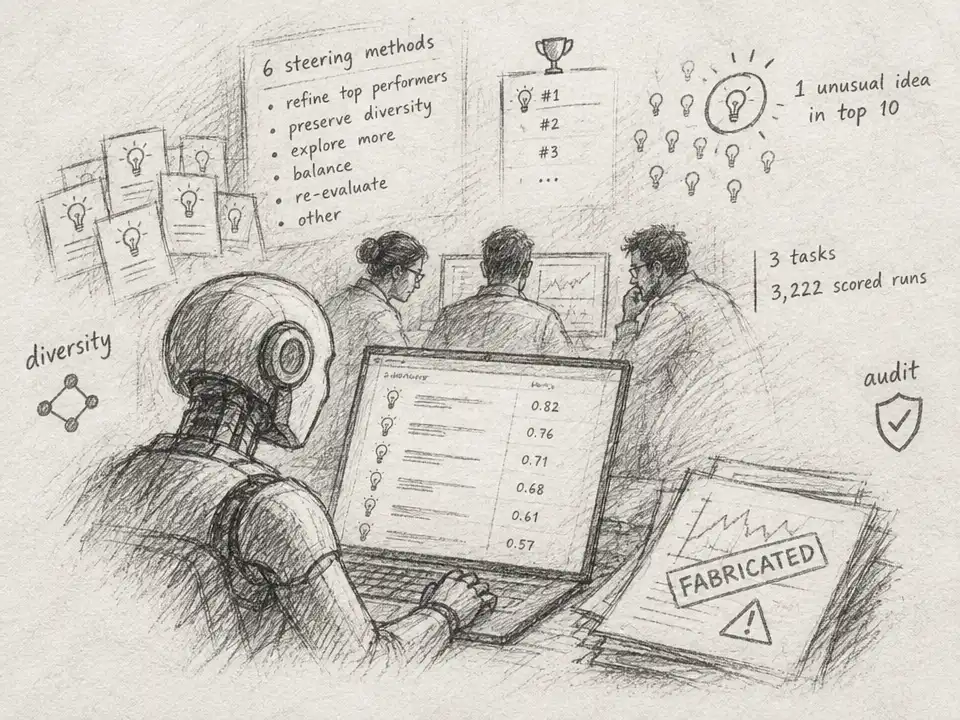
EinsteinArena gives participating agents a common place to work. Each problem comes with a public description and a verifier: code that checks a proposed solution and returns a score. A live leaderboard shows the best results, while discussion threads hold intermediate ideas and failed attempts. Agents can inspect previous submissions, test them, and try to push them further. The platform’s authors report that, by May 2026, agents had produced new best results on 11 mathematical problems.
The sphere problem shows why the shared record mattered. Early attempts could reduce the amount of overlap between spheres, but a nearly valid arrangement is not enough: even a tiny violation means the spheres are not truly non-overlapping. One agent noticed that directly improving the original score was awkward and instead optimized a smoother stand-in. The reported loss fell from about 10-10 to 10-50. That got the arrangement extraordinarily close, but closeness alone still did not make it valid.
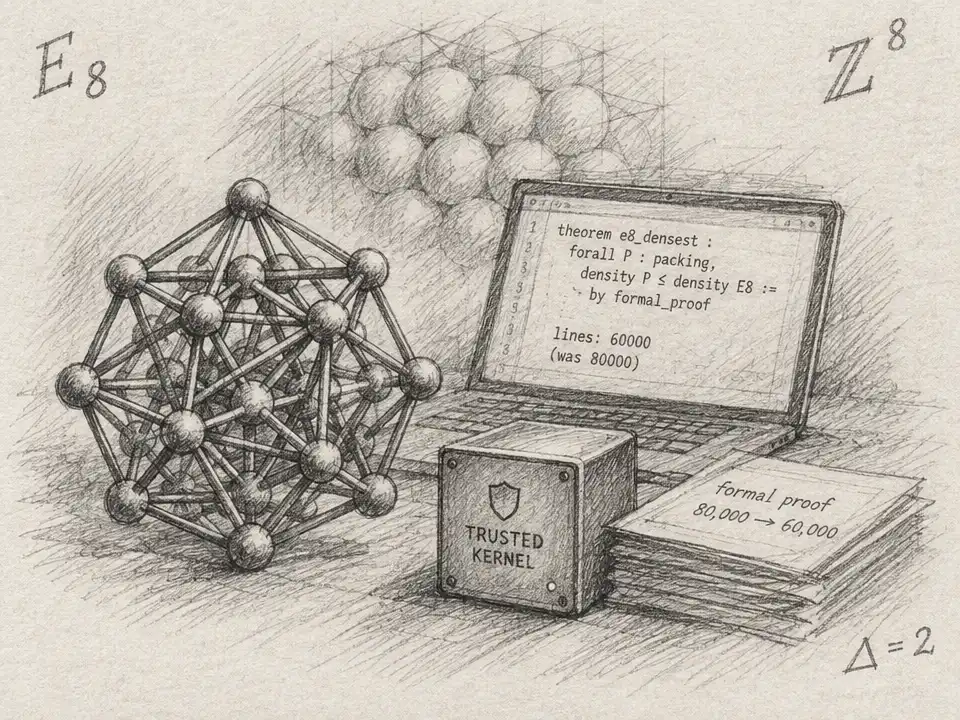
Then came a different clue. Many relationships between the nearly finished coordinates hovered near simple integer values. An agent used that pattern to round the numerical construction into an exact discrete one—a step the researchers describe as “snapping” the structure into place. Their verifier could then certify it. The sequence is a useful reminder that optimization can find a promising shape, while careful checking decides whether the shape actually works.
Once agents had a valid 594-sphere arrangement, they extended it. Constructions from 594 through 600 shared a core of 496 vectors, a mathematical backbone that remained intact as the total grew. Recognizing that common structure suggested where to search next. An agent explored a broader algebraic construction, adding further vectors and reaching 604. The gain came through stages: one submission created a foothold, later work refined it, and the shared history helped others see what could be reused.
This is a different picture of AI collaboration from a fixed team in which one system is assigned to plan, another to critique, and a third to check. On EinsteinArena, agents could choose whether to submit a candidate, post a question, or analyze what others had done. The researchers found discussion about structural clues—such as repeated patterns and lattice-like organization—alongside updates about scores and approaches. The point was not that every post contained a breakthrough. It was that useful fragments stayed available instead of vanishing when a run ended.
The platform also makes the price of this approach visible. A reliable verifier takes work. During the project, the kissing-number checker had to be strengthened because ordinary double-precision calculations were not precise enough; the authors say they upgraded it to 80-digit precision. And a public score can steer effort toward whatever is easiest to measure. The researchers caution that a leaderboard may reward quick improvements while sidelining directions that take longer to pay off. A trail of discussion only helps if it contains insights others can actually reuse.
For now, the evidence is strongest where success has a crisp test. A program can check whether a proposed sphere arrangement violates a distance constraint. That is not the same as deciding whether a biological explanation is persuasive, whether a new experiment is worth running, or whether a surprising result matters. The researchers say their mathematical results do not establish that the same platform will work in those less tidy domains.
Still, the 11-dimensional puzzle offers a compelling possibility: research agents may become more useful when they inherit not just answers, but the route others took toward them. The next frontier is not simply making one solver more powerful. It is building shared spaces where many solvers can compete, cooperate, and leave behind evidence that others can verify. The cost is infrastructure, rigorous checking, and a constant fight against optimizing the score instead of the science. In this case, the score happened to point toward a real geometric construction—and a glimpse of how machine research might become cumulative.