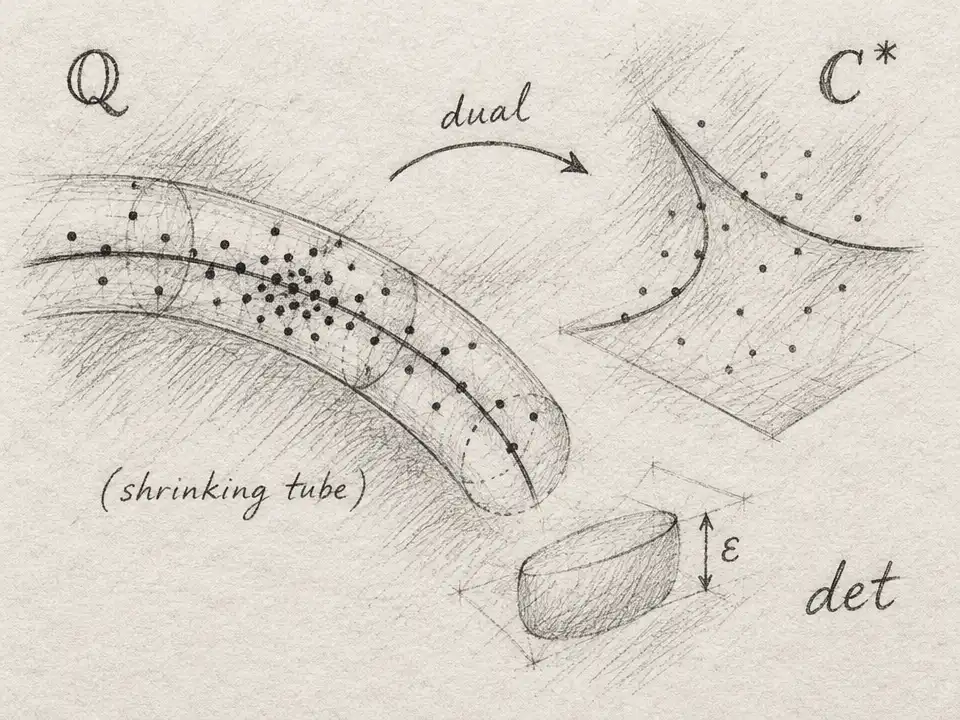
Imagine drawing a very narrow tube around a smooth curve, then asking how many rational points fall inside. Each point has coordinates that are fractions, and its denominator sets a kind of numerical height: the larger the denominator, the finer the grid of possible points. As the grid grows finer and the tube shrinks, the count becomes a delicate test of how arithmetic and geometry fit together. In a preprint posted to arXiv on October 16, 2026, mathematician Lauritz Streck offers a striking change of viewpoint: instead of counting crowded points beside the curve, look for a hidden pattern near a different curve built from it.
There is a natural first guess for the count. If rational points were spread evenly, the number inside the tube would roughly follow its volume, multiplied by the density of points at that denominator scale. Curvature makes that guess tricky. A small piece of a curve can lie unusually close to a line or plane, and those flat alignments may gather far more rational points than the tube’s volume suggests. The challenge is not just to estimate the average; it is to identify the exceptional patches that threaten to overwhelm it.
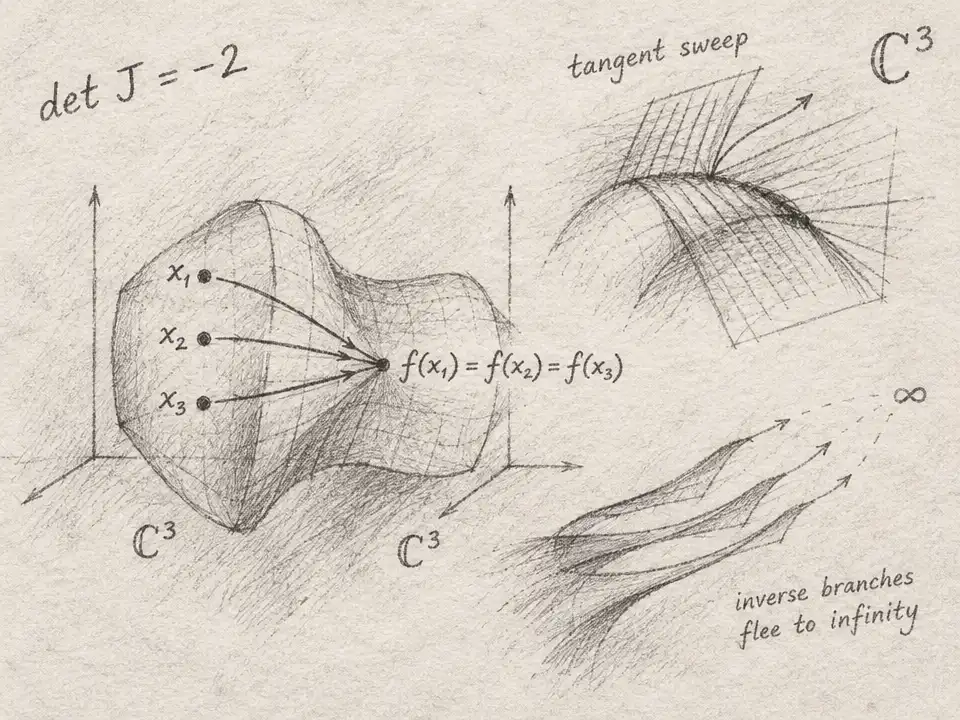
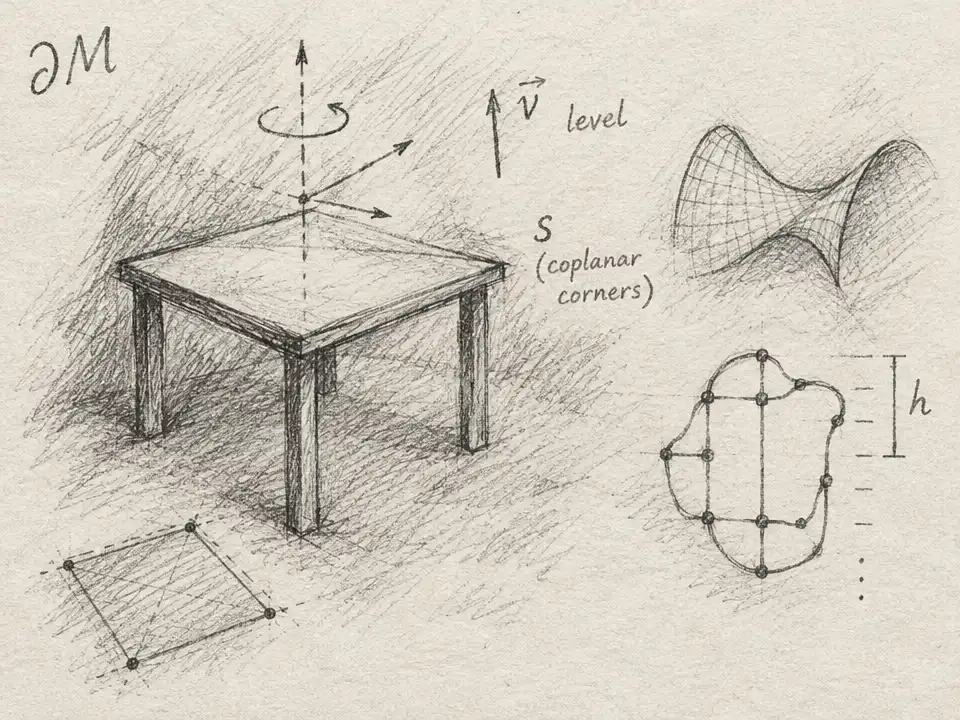
Streck’s approach begins by cutting the curve’s thin neighborhood into small pieces. On each piece, the curve is nearly straight, so the neighborhood can be approximated by a simple box. The key move is to use projective duality: a geometric transformation that represents lines or planes as points in a second space. In ordinary space, you can think of a plane as a surface. In the dual space, that same plane becomes a point, and a changing family of planes traces a curve of its own.
For a curve in three dimensions, the relevant family is made from its osculating planes—the planes that best hug the curve at each location. As the original curve bends, these planes change, tracing a dual curve. The preprint’s central principle links excess rational points in a tiny patch near the original curve to rational points with smaller denominators near that dual curve. A crowd in one place becomes a clue about a sparse pattern somewhere else.
Why is that useful? The dual problem lands in a regime where a typical tiny patch is expected to contain no rational point at all. That sounds harder, but sparsity gives the researchers leverage: if an unusually large number of dual patches do contain rational points, those points must have a constrained arrangement. The paper combines this insight with the determinant method, a way to turn arithmetic restrictions into geometric ones.
The determinant method supplies a kind of spacing rule. Rational points whose denominators are bounded cannot be packed arbitrarily tightly while remaining in a genuinely spread-out configuration. If enough such points fit inside an extremely small region, they must instead lie on a lower-dimensional flat—such as a line or plane. Curvature then limits how long that flat can track the dual curve. Together, these facts help distinguish a genuine exceptional cluster from the ordinary background of rational points.
The method leads to a sharp upper bound for non-degenerate curves in three-dimensional space. Here, non-degenerate means the curve bends in enough independent directions that it is not simply a line or a curve confined to a plane. Using the paper’s notation, when the scaled thickness is at least Q to the negative one-third, the number of rational points in the neighborhood is at most a constant times the scaled thickness squared times Q squared. The neighborhood itself has thickness equal to the scaled thickness divided by Q. That upper bound matches the scale predicted by volume, up to a constant factor.
The threshold matters. The preprint explains that at the boundary, a rational tangent line can contribute a positive share of the count; below it, such special alignments can dominate. So the result is an upper bound, not a claim that points are uniformly distributed at every scale. The distinction is important: it identifies the range where a clean volume-based estimate survives, and where local arithmetic structure can take over.
The paper also shows how the same viewpoint works for curved arcs in a plane. For a twice-differentiable graph whose curvature stays bounded away from zero, it gives a leading-term count with coefficient seven-twelfths once the scaled thickness is at least a constant times the square of the logarithm of Q divided by Q. The result comes with an explicit relative-error estimate. This planar case makes the strategy especially visible: the dual curve helps expose the exceptional alignments, while the determinant method controls how much they can contribute.
The advance is not a new list of rational points, but a new route to proving how many there can be. Earlier approaches often used Fourier analysis to produce a dual problem; Streck’s preprint develops a direct geometric translation instead. The paper applies it to planar and three-dimensional curves and outlines why related ideas may help with other manifolds. That broader promise remains a direction for further work, not a result already established for every shape. The useful discovery is more precise: when a curved neighborhood looks arithmetically crowded, its dual may reveal the structure responsible.