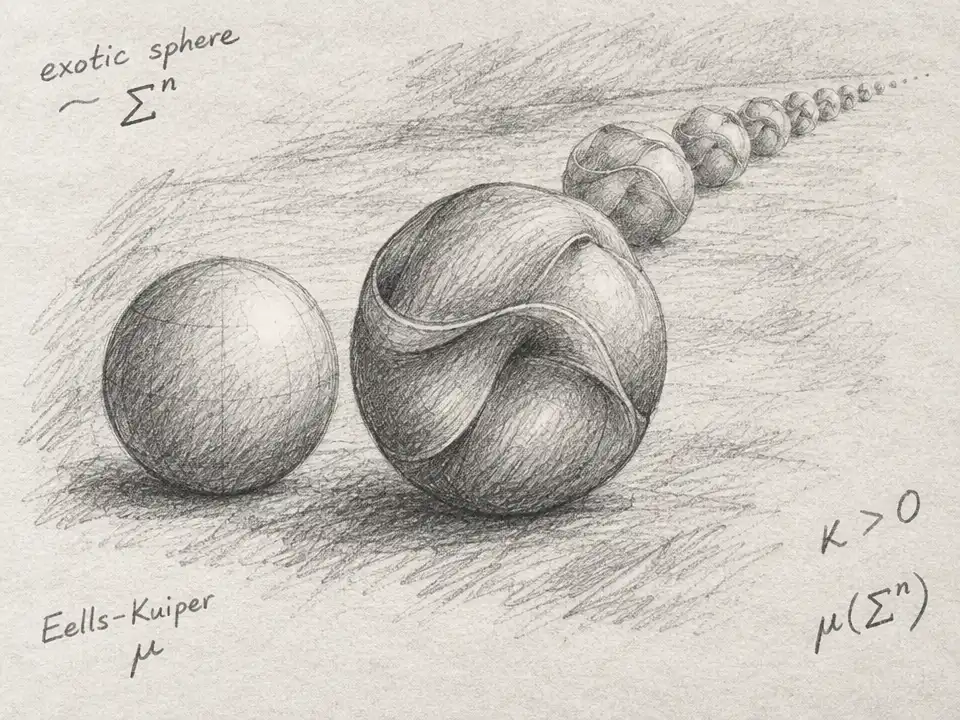
Positive curvature has a reputation for imposing order. In a long-standing question in geometry, that order takes the form of a smooth circle action: does every closed manifold that can be given a metric with strictly positive curvature also have a continuous circle symmetry? The claim sounds plausible. A recent construction shows it is false—at least when the manifold is allowed to have a nontrivial fundamental group.
The distinction matters. The question is not whether the particular positively curved metric has to look the same when rotated around a circle. It asks whether the underlying manifold admits any effective smooth circle action at all, even one that has nothing to do with its curved metric. Xiaoyang Chen, Xiang Jiang and Kaiwen Yang construct a seven-dimensional example that has strictly positive sectional curvature and no such action.
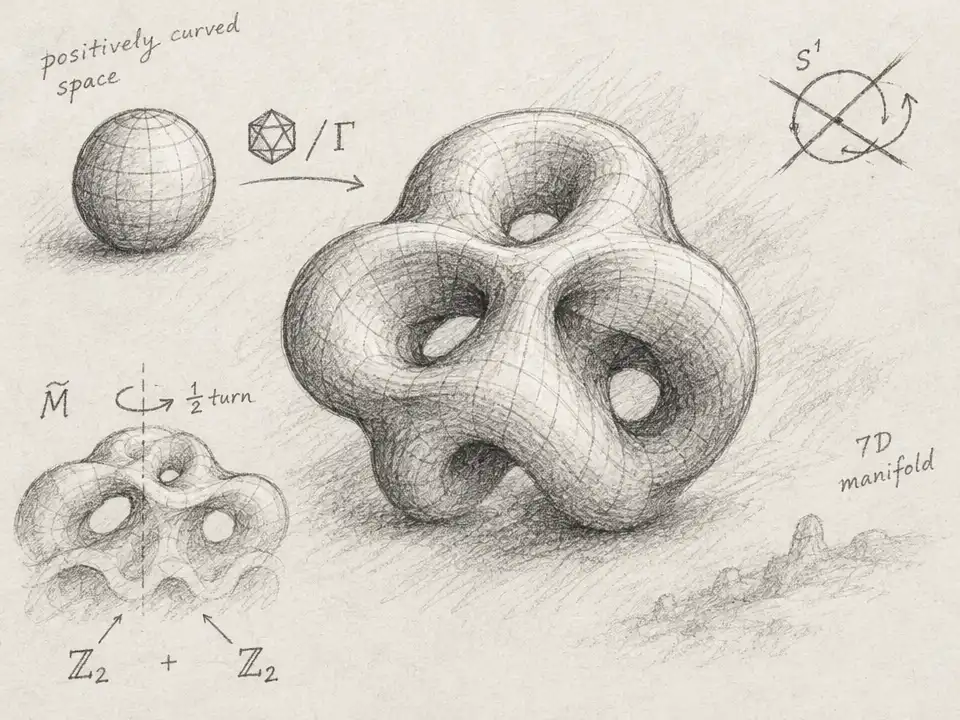
The route to it begins with a space geometers already know how to curve positively: an Aloff–Wallach space, built from the special unitary group of three-by-three matrices by dividing out a circle subgroup. The resulting space is seven-dimensional and simply connected. The researchers then arrange two families of finite symmetries on it. One consists of two independent transformations of order three, acting from the left; the other consists of two half-turns, acting from the right. These actions commute, and together they act without fixing any point.
Now divide by those finite symmetries. The new manifold keeps the positive curvature: because the quotient has no points where the symmetries collide, it is locally identical to the original curved space. The construction also gives the quotient a finite fundamental group, the product of two cyclic groups of order six. That detail will matter—not for the curvature, but for the argument against circle symmetry.
At first, the quotient’s lack of a circle action is not visible in its shape. The proof finds it indirectly, by supposing a circle action exists and following what that assumption forces upstairs, on the simply connected covering space. After possibly changing the circle’s period, the imagined action lifts and must commute with both families of finite symmetries. The two groups then impose incompatible demands on the same half-turn inside the circle.
The left-hand symmetries deliver the first demand. The researchers show that any lifted circle action commuting with the order-three group must have no fixed points; in technical language, it is locally free. More sharply, the circle’s unique half-turn must itself act without fixed points. Reaching that conclusion takes more than visualizing rotations: the proof uses the topology of the covering space and rules out possible fixed sets using their cohomology, a way of recording the space’s holes and how they fit together.
The right-hand symmetries force the opposite. For any circle action that commutes with the pair of half-turns, its own half-turn must fix at least one point. Here the authors use a calculation that tracks how the group actions interact with cohomology. A key ingredient is a subtle relationship between two cohomology classes of the covering space: one in degree three and another in degree five. That relationship helps restrict which fixed sets are possible and eventually makes a fixed point unavoidable.
These are not two different half-turns that happen to share a name. They are the same element of the one hypothetical lifted circle action. It cannot both act freely and have a fixed point. The contradiction rules out the original circle action on the quotient. The paper’s conclusion is stronger than saying the displayed curved metric lacks rotational symmetry: the underlying manifold admits no effective smooth circle action, regardless of which metric one considers.
What does this result open up? It draws a sharper boundary around the idea that curvature enforces symmetry. Researchers can now ask more precisely which extra conditions, if any, bring symmetry back—and whether methods that combine finite group actions with cohomology can uncover other manifolds that hide from continuous symmetries. It also warns geometers that relying on circle actions may miss examples when studying positive curvature.
But the construction comes with a clear price. The manifold is not simply connected. The result overturns the unrestricted version of the conjecture attributed to Shing-Tung Yau, but it does not settle the more demanding question of whether every simply connected, closed, positively curved manifold admits a circle action. Nor does it classify positively curved manifolds or explain why this particular space can curve positively. The example is carefully assembled from known geometric and algebraic ingredients; the frontier is to learn whether its trick generalizes, and whether the simply connected case obeys a different rule.
That makes the counterexample both a destination and a starting point. Positive curvature, once treated as a reliable invitation to search for continuous symmetry, no longer guarantees one in full generality. The next challenge is to find out whether the missing symmetry is an exception created by finite topology—or a clue that geometers have been looking for order in the wrong place.