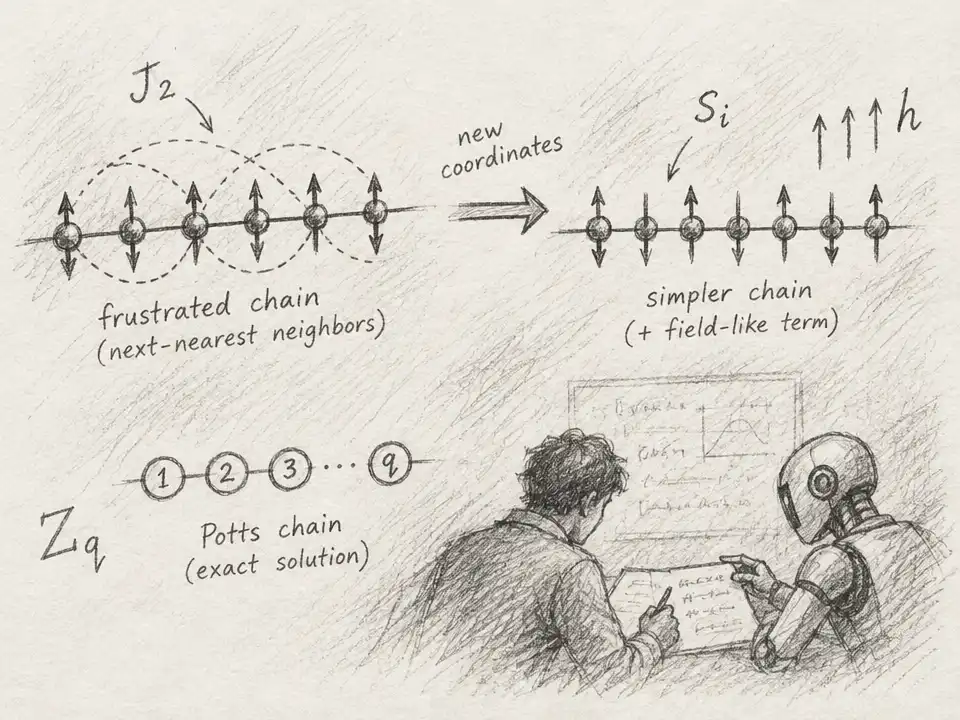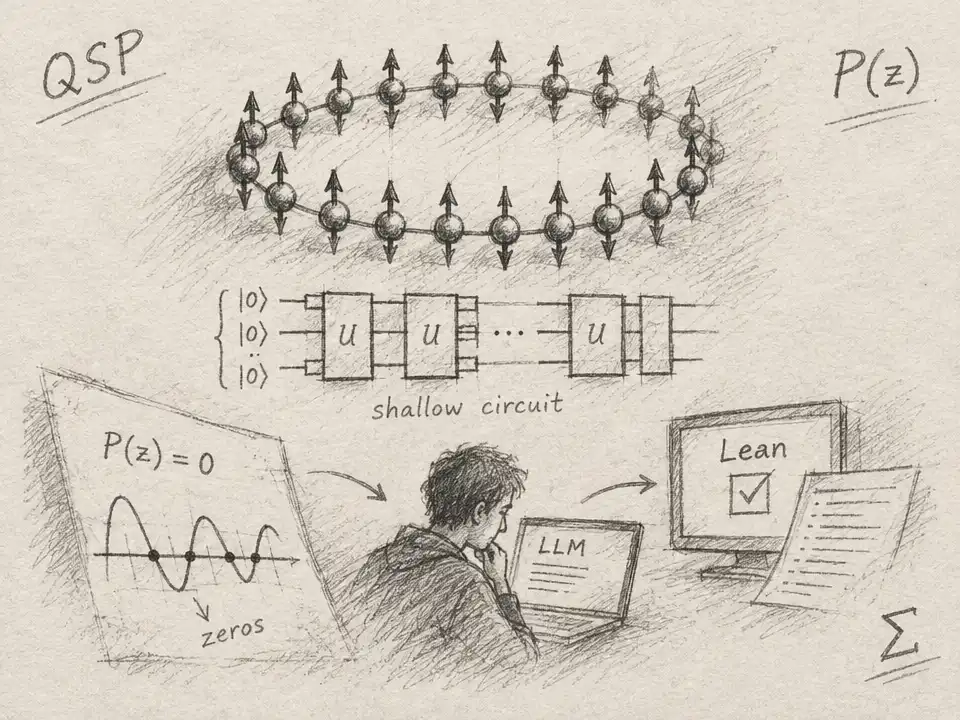
Picture a ring of tiny arrows, each pointing either up or down. The goal is to make as many neighboring arrows as possible point in opposite directions. On an even-sized ring, the best arrangement is simple: alternate up, down, up, down, all the way around. But a quantum computer does not simply choose that pattern. It uses a sequence of controlled operations to search for a good arrangement—and a basic question about how well that search can work remained open for more than a decade.
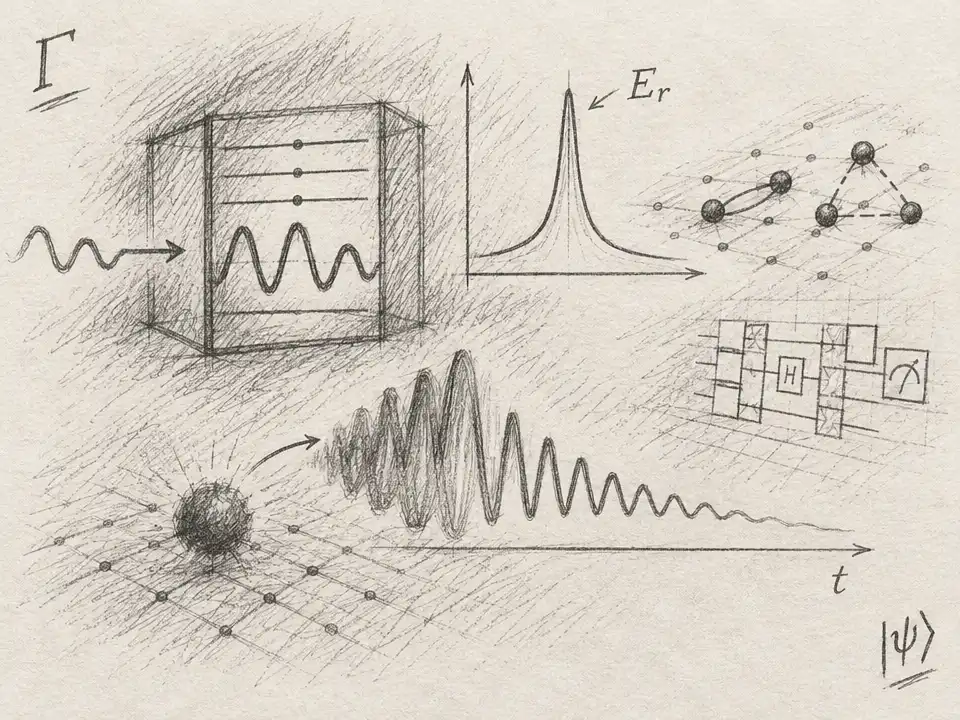
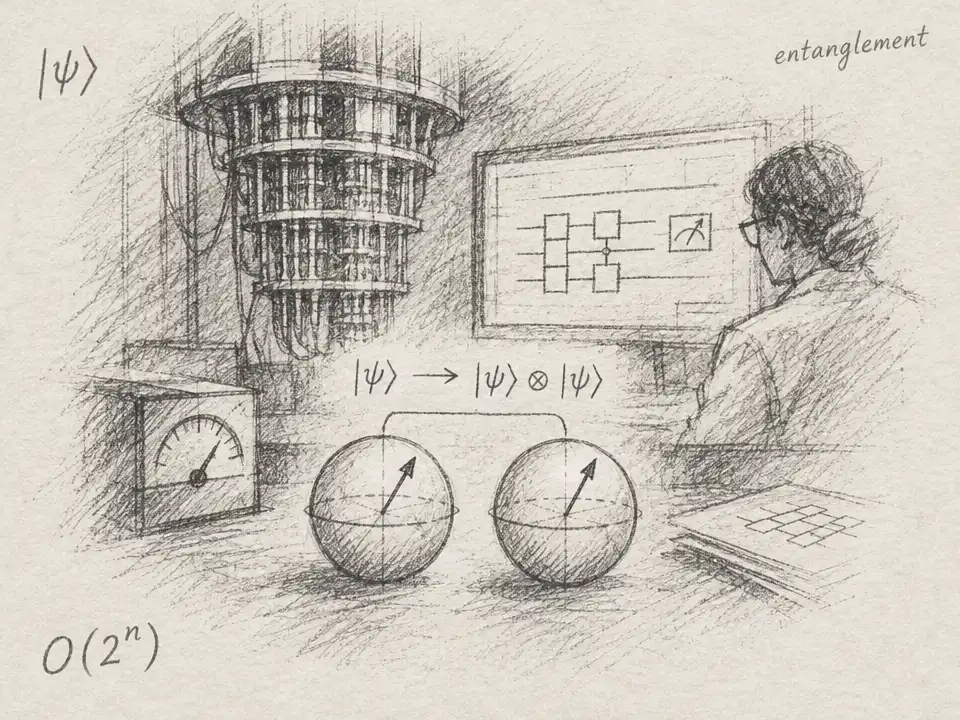
The puzzle is a clean test of the Quantum Approximate Optimization Algorithm, or QAOA. The algorithm alternates between operations that encode the goal and operations that mix possible answers. Each round adds another layer of control. More layers can, in principle, improve the answer, but how good can a circuit with a fixed depth actually get? Researchers had conjectured an exact answer for this ring problem. A new proof settles it by importing a mathematical perspective from quantum signal processing, then having a proof assistant check the argument line by line.
The result concerns rings with an even number of spins, when the ring is at least two larger than twice the circuit depth. Under those conditions, the circuit reaches precisely the performance the conjecture predicted. That sounds like a narrow win. The route to it is more striking: a question about choosing a set of circuit controls becomes a question about where a polynomial must vanish.
Why is that transformation useful? The ring’s symmetry lets researchers split its complicated motion into simpler, independent pieces called modes. Instead of tracking the entire quantum state at once, they can ask how each mode moves under the alternating operations. Each mode behaves like a small spinning arrow being turned by successive rotations. To reach the conjectured optimum, the circuit’s controls must steer almost all of these arrows exactly onto their targets.
There is one exception. A particular mode has its target direction directly opposite the direction favored by the mixing operation. No choice of the circuit’s controls can steer that mode into alignment. Its leftover error sets an unavoidable floor on the total shortfall. The proof problem is therefore not to eliminate every error, but to show that all the other modes can be steered perfectly, leaving only the unavoidable one.
That is where quantum signal processing enters. In that field, a sequence of carefully arranged quantum operations can be described using a polynomial. The paper’s authors and their AI-assisted prover recognized that the mode-by-mode steering sequence has this same structure. Once represented as a polynomial, the requirement that a mode land on its target becomes a requirement that the polynomial be zero at the corresponding point.
Instead of solving a tangled collection of angle equations directly, the proof can now focus on a single object: a polynomial with prescribed zeros. Symmetry supplies more of those zeros than the original steering conditions appear to demand. The required roots, along with their mirrored partners, form a highly organized pattern around the unit circle. One exceptional point remains—the unsteerable mode. Its role changes from nuisance to anchor: the polynomial’s value there fixes its scale, and that scale determines the exact residual error that the conjecture predicted.
Finding the right polynomial is not quite enough. It must also correspond to a sequence of valid quantum operations, and that sequence must translate back into actual QAOA controls. The researchers use established factorization results to build that bridge: first complete the polynomial into a valid quantum transformation, then break the transformation into the elementary pieces that make up the circuit. The argument does more than say suitable controls exist; it gives a constructive route to recovering them.
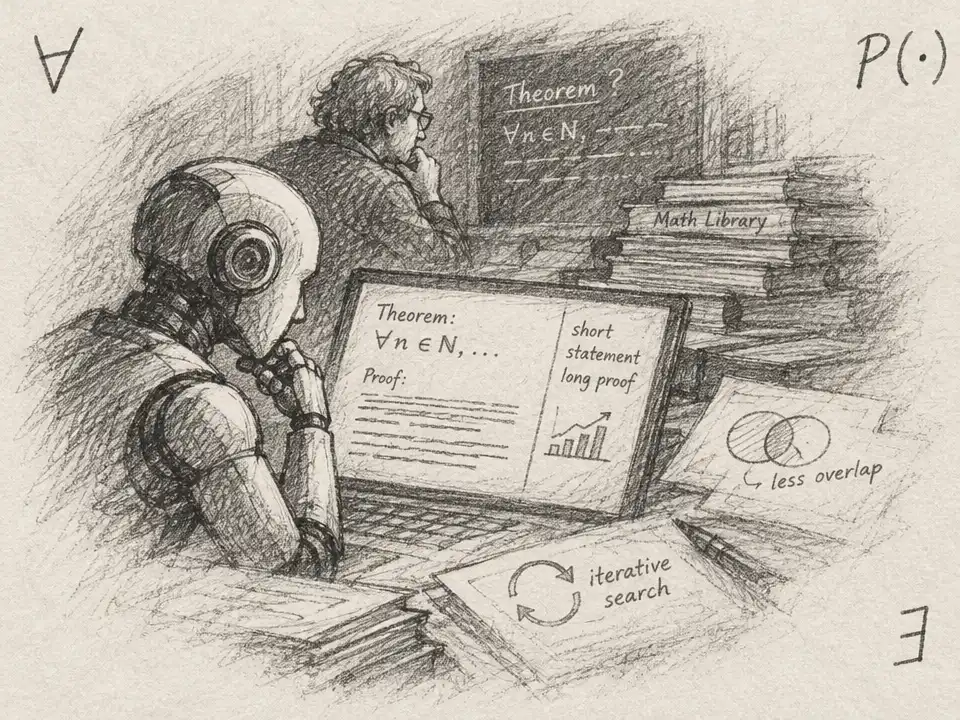
The proof also has an unusual second crossover, between mathematical discovery and formal computer verification. The team prepared a formal version of the conjecture and the supporting quantum machinery in Lean 4, a proof assistant that checks whether each step follows from the definitions and assumptions. Claude Fable 5, the language model used in the study, was given the remaining mathematical gap. It proposed proof plans, tested ideas numerically during its search, and revised its Lean code in response to the checker’s feedback.
That division of labor matters. A fluent explanation from a language model is not, by itself, evidence that a proof is correct. Lean accepted the completed argument, so its chain of formal steps passed the system’s mechanical checks. But the researchers still had to ensure that the formal statement actually represented the intended conjecture. The computer checks the proof inside the stated mathematical world; humans remain responsible for checking that the world was described faithfully.
The result is not a demonstration that a quantum computer has solved every optimization problem, nor that the same trick works for arbitrary networks. It settles one sharply defined conjecture and points toward a possible method for other systems whose dynamics break into similar independent modes. In this ring, the decisive move was to stop treating every circuit setting as a separate knob. Viewed through signal processing, the knobs became a polynomial, the desired alignments became roots, and the one impossible alignment fixed the answer.