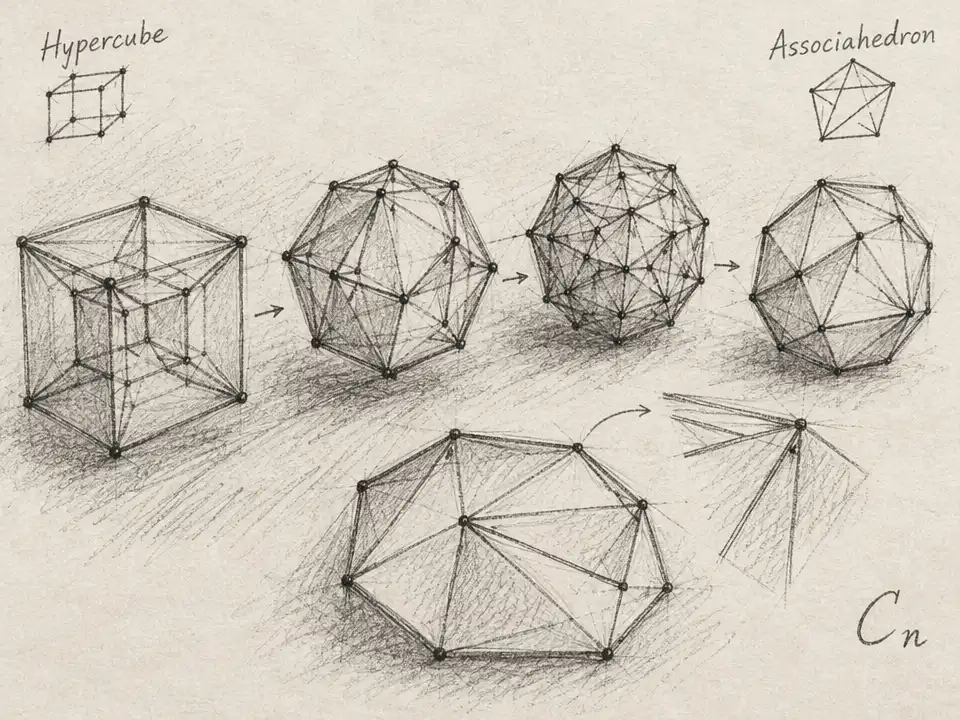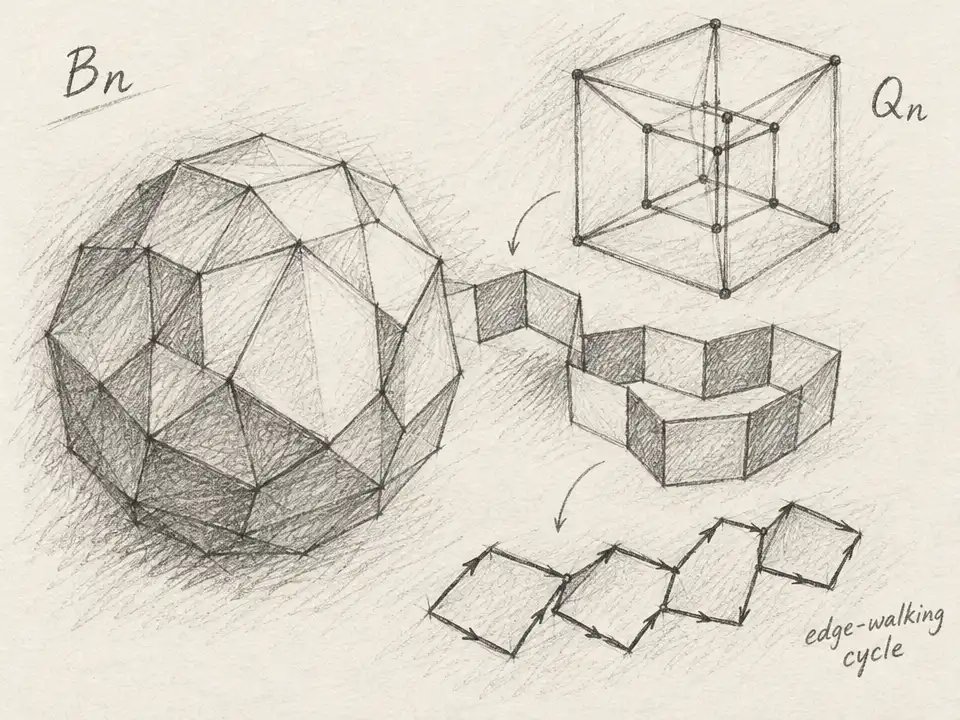
Imagine trying to walk the walls of a many-dimensional maze without leaving any wall behind. The maze is not a physical building but a B-permutahedron, a geometric object whose corners encode signed permutations: arrangements of numbers in which each number can carry a plus or minus sign. Its edges represent small edits, such as swapping neighboring entries or flipping the sign of the first one.
The challenge is to find a closed route along those edges that visits every facet—a highest-dimensional flat face—without breaking the visit to any facet into separate pieces. This is called a facet-Hamiltonian cycle. It sounds like a variant of the familiar problem of touring every city once, but here the targets are not the corners. They are the polytope’s walls, and each must be met along one uninterrupted stretch of the route.
For the B-permutahedron, mathematicians had conjectured that such a cycle exists in every dimension at least two. Nastaran Behrooznia and colleagues proved the conjecture. The twist is where they looked for the route: not among signed permutations themselves, where the geometry can feel like a thicket of cases, but inside the face structure of a simpler object, the hypercube.
A cube is easy to picture; its higher-dimensional relatives are built from binary choices. A face can be described by saying which coordinates are fixed and which are free. These faces fit together in layers: a corner lies below an edge, an edge below a square, and so on. The researchers used that layered map—the cube’s face lattice—as a hidden blueprint for moving through the more complicated polytope.
The blueprint is a structure they call a rhombic strip. Picture a ribbon made of connected four-sided loops. Each loop links two neighboring faces in one layer to a shared face just above them and another shared face just below. In the face lattice, these loops are diamonds. Thread enough diamonds together in the right order and the ribbon winds through the layers of the entire cube-face system.
Building that ribbon for every hypercube dimension is the key construction. The authors do it inductively: when adding a new binary coordinate, they assemble mirrored copies of the previous structure and connect their edges in a zipper-like pattern. The new dimension does not require inventing a route from scratch; it inherits a carefully arranged scaffold from the one below.
Why should a route through cube faces solve a problem about signed permutations? Because the B-permutahedron can be made by successively cutting off faces of a hypercube. In this relationship, a corner of the B-permutahedron corresponds to a maximal chain of nested hypercube faces. Its facets, in turn, are associated with faces of the original cube. The complicated object is therefore carrying a record of the simpler one inside it.
Now sweep a maximal chain through the rhombic ribbon. As the chain crosses each diamond, it changes one face at a time. Those small changes correspond to moves along edges of the B-permutahedron, so the sweep becomes a walk on its surface graph. Because the ribbon’s diamonds are arranged across the cube’s face layers, the resulting walk passes through the facet associated with each face in one connected stretch. And because the ribbon closes around, the walk closes too: a cycle, not a route with loose ends.
That translation is the unexpected payoff. A problem framed as keeping track of signed arrangements becomes a problem of organizing squares in a binary hierarchy. The authors prove that the construction works in every dimension covered by the conjecture, rather than merely displaying tours for a few small examples. Their paper also gives efficient procedures for generating related cycles, turning the structural proof into a way to list combinatorial objects in a controlled order.
The result is part of a larger question: can the faces of a polytope generally be arranged in a cycle so that each step moves between neighboring faces? The paper establishes such orderly cycles for several important families, including hypercubes, permutahedra, associahedra, and the B-permutahedron. It does not settle the question for every possible polytope. That boundary matters: the proof is a strong construction for a broad collection of shapes, not a universal theorem about all convex geometry.
Still, the B-permutahedron shows how complexity can conceal a simpler route. Its corners encode signs and order, but its successful tour is guided by the humble geometry of a cube’s faces. Instead of forcing a path through the maze one corner at a time, the mathematicians found a ribbon in the map—and let the map dictate the walk.