Imagine a geometric universe where coordinates wrap around at a prime number, p. You can subtract two points and measure their squared distance, but the answer must be one of only p possible values. Here is the puzzle: how large can a crowd of points grow while revealing almost nothing about the distances between them?
The rules look familiar. A quadratic form is a generalized squared-length rule: feed it the difference between two points, and it returns a distance label. But arithmetic modulo a prime has a strange loophole. A nonzero difference can have squared length zero. In this universe, distinct points can be separated by a direction that registers no distance at all.
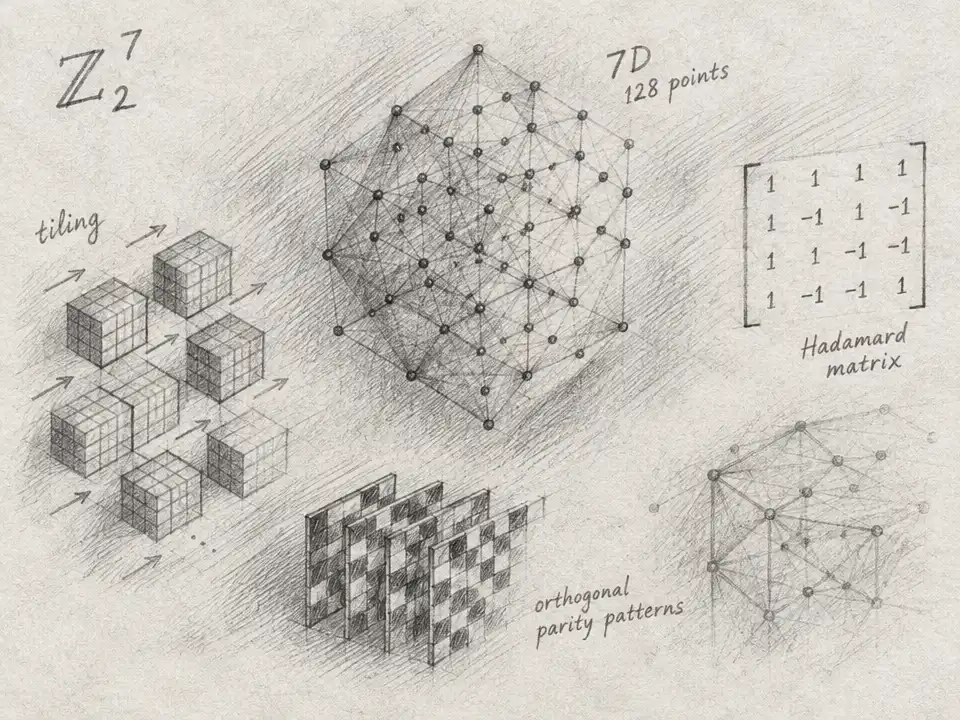
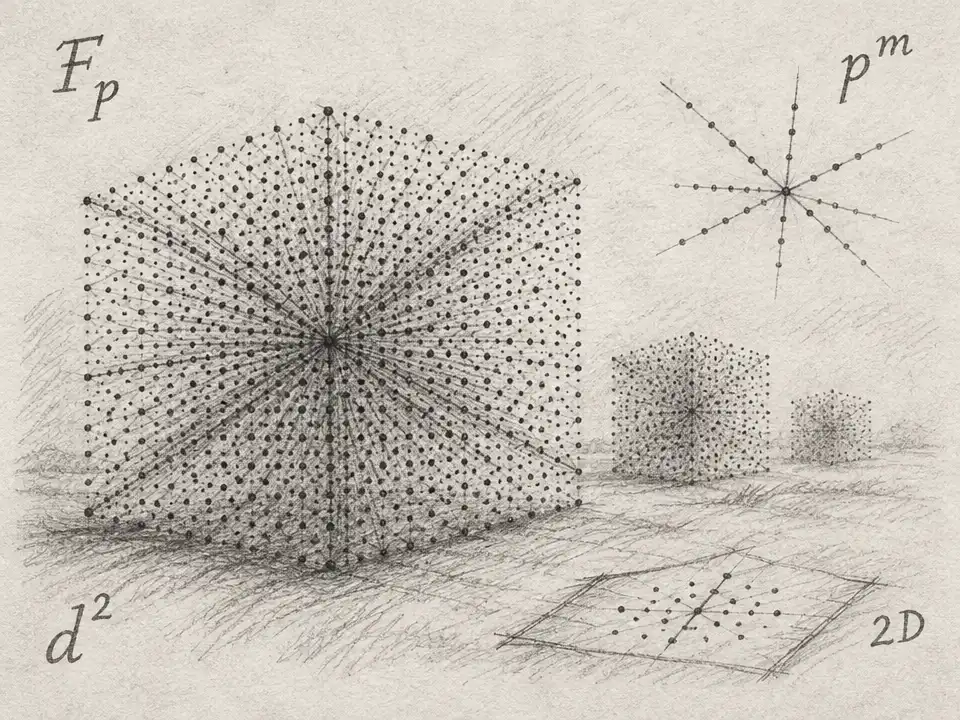
That loophole creates a striking hiding place. In certain even-dimensional spaces, a special flat region can contain exactly p to the mth power points, where the full space has dimension twice m. Every difference between points in that region has squared length zero. The entire crowd—however large—produces just one distance label.
Now move the boundary by a single point. Is that hiding place just one example, or can a carefully arranged crowd with more than p to the mth power points still avoid most distances? A new result by Thang Pham, Chun-Yen Shen, Dung The Tran, and Boqing Xue answers the question for even-dimensional spaces over odd prime fields: once a set is larger than that threshold, it must determine many distinct squared distances.
At the very first size above the boundary—p to the mth power plus one—the theorem guarantees at least a constant times p divided by the square of log p distinct distance values, for large p. The bound includes zero, which every set has automatically, so removing that one value does not change the scale. This is almost linear growth in the number of available labels, though not a fixed fraction of all p possibilities. And the statement is about every set of that size, not only a crowd built by adding a point to the special flat region.
The first clue is that the troublesome geometry has a precise shape. The flat region is called totally isotropic: the quadratic rule vanishes on every direction inside it. Such a region has the largest possible dimension in one of the two types of quadratic geometry considered in the paper. Its size is not an arbitrary accident; it is the exact point at which the distance-free construction can fill a whole maximal region.
But counting points in the full space does not directly count distance labels. Many pairs might repeat the same value. The researchers’ next move is to compress the problem. They extract a smaller, two-dimensional set whose pairwise distances are also distances in the original set. If that smaller set is forced to have many distances, the original one must have them too.
That reduction turns the puzzle into a question about repeated distances in a plane. To count repeats, the proof translates equal-distance pairings into a configuration of lines in three dimensions. Intersections where many lines gather correspond to many pairs that fit together with the same distance-preserving motion. So the investigators ask a new question: how many points can be incident to lots of these lines?
Here the line arrangement becomes a kind of bottleneck. The paper proves a bound on “rich” points—places where many lines meet—using polynomial methods and incidence geometry. The details involve controlling exceptional configurations, rather than pretending every line behaves generically. But the guiding idea is intuitive: if too many pairs repeat too many distances, the associated lines must pile up in an organized way, and the incidence bound limits how much piling-up is possible.
The split geometry, the case with the biggest zero-distance hiding place, demands another clue. Ordinary Euclidean intuition fails because zero distance can link distinct points. The authors average over the symmetries of the finite space and examine how the set occupies certain parallel slices. An exact counting identity compares occupancy in two kinds of slices. At or below the threshold, a maximally isotropic region can make the balance tight. Above it, the balance forces at least one useful slice: its projected points include a nonzero-distance pair and cannot all sit in a zero-distance line. That slice supplies the planar configuration the incidence argument needs.
This is why the threshold feels like a cliff. At exactly the boundary, a set can hide inside a maximal zero-distance region. Above it, the averaging argument finds structure that cannot be hidden in the same way, and the planar distance machinery turns that structure into many labels. The theorem does not say every possible distance must appear, or that the bound is optimal. Logarithmic losses remain, and removing them would sharpen the picture.
Still, the puzzle now has a surprisingly crisp answer: in this modular geometry, a set can be enormous and distance-silent right up to a natural size. Beyond that size, even the most cleverly arranged points cannot keep their pairwise squared distances confined to a tiny list. The remaining mystery is whether the logarithmic gap marks a real limit—or merely the last hiding place mathematics has yet to uncover.