Imagine trying to find three numbers that add to zero when the numbers can lie anywhere on an unbroken line, with no smallest unit between one value and the next. Now imagine that the same search is easier when every input is an integer. The puzzle is not just how to find a matching trio. It is whether the endless precision of real numbers creates a genuinely harder problem—or merely hides a simpler structure.
This is the question behind 3SUM, a basic problem in theoretical computer science: given a list of numbers, determine whether some three entries add exactly to zero. A familiar approach checks pairs and looks for a matching third number, taking roughly the square of the list’s length in time. For integer inputs, clever hashing and compact representations can shave off more time. Real inputs resist those tricks: they do not naturally fall into a finite grid of buckets, and rounding can turn a near-match into a false answer—or blur a true one.
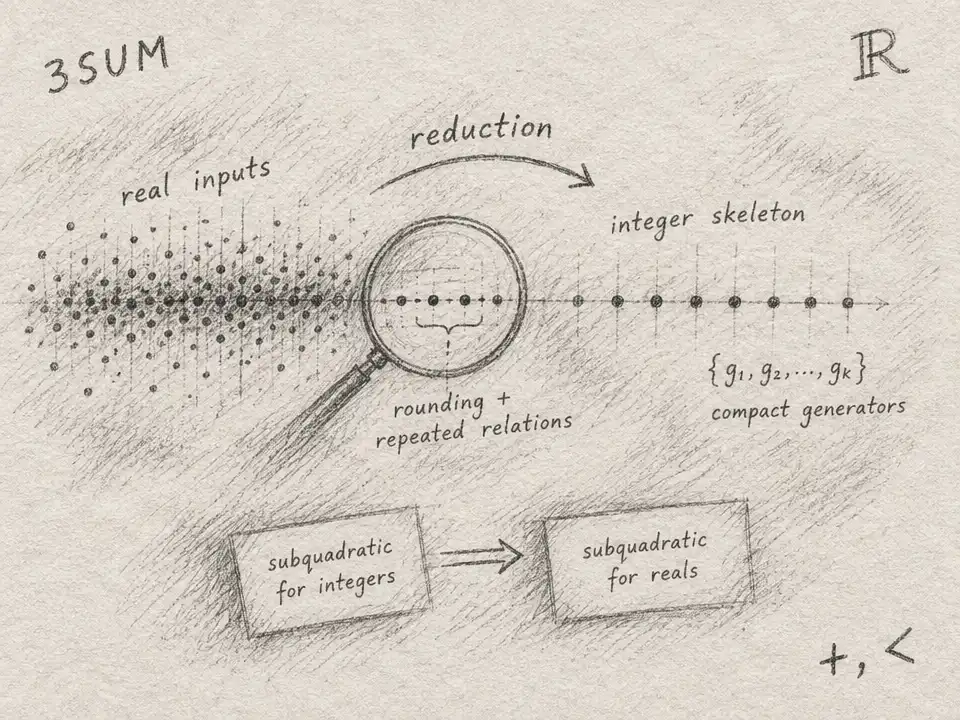
A paper posted to arXiv on October 7, 2026, by Nick Fischer, Adam Polak, and Jonas Schmidt reveals a hidden bridge between the two versions. Their result is conditional, not a new fast solver: if Integer 3SUM has an algorithm that runs truly subquadratically, then Real 3SUM does too, with a smaller but still meaningful improvement. The reduction works in a restricted comparison-and-addition model, rather than granting an algorithm unrestricted powers over infinitely precise real numbers.
The first clue comes from an unexpected place: optimization. A theorem of Frank and Tardos says, in essence, that a collection of real values can be replaced by integers while preserving the signs of a huge family of simple weighted sums. If a tested combination was positive before the translation, it remains positive; if negative, it remains negative. For a zero-sum search, keeping those comparisons intact is exactly the sort of guarantee an integer version needs.
But applying that theorem to every input number would be like building a separate key for every grain of sand. Its computation grows too costly for the speedup the researchers are trying to establish. The key question becomes one of scale: can the numbers be described using a much smaller set of ingredients, without losing the relationships that matter?
Here additive combinatorics enters. Some collections of numbers produce relatively few distinct results when you add their elements together. An arithmetic progression is the simplest example: many pairs can produce the same sum, so the set of possible sums stays compact. Such a collection has what mathematicians call additive structure. A result known as Freiman’s theorem says, roughly, that sets with this kind of structure can be described using a small number of generators and their combinations.
The paper develops an algorithmic shortcut to that insight. The authors look for differences that occur again and again between pairs of numbers. Each popular difference acts like a link: once one value is represented, another value separated from it by that difference can be represented too. Repeatedly collecting these links builds a compact set of ingredients—a subset-sum cover—that can describe a much larger collection. The authors analyze the process using an idea reminiscent of Borůvka’s algorithm for finding a minimum spanning tree: connect pieces in stages until relatively few components remain.
That compression works when the input already has additive structure. A real 3SUM instance, however, may look like a scatter of unrelated points. So the researchers make a delicate move: approximate the values at a chosen scale. Rounding tends to create repeated sums and a more organized pattern. Yet it also creates danger. If three rounded values appear to cancel, the original real numbers may not sum to exactly zero. Those near-matches are false positives, and an algorithm cannot simply treat them as answers.
The solution is not to choose one universal rounding and hope for the best. The reduction handles different scales in stages, creating smaller modeled instances. Each model groups some original values together while retaining enough information about which triples could have been genuine solutions. Then the algorithm separates frequent, structurally useful relationships from rare ones. It converts the structured core into integers; the sparse, awkward cases can be enumerated and checked against the original values. In other words, approximation helps organize the search, but exact checks keep approximation from rewriting the answer.
A second layer of hashing connects the integer representation to a related problem called Convolution 3SUM, where the positions of the numbers obey an additional additive rule. The paper first reduces real 3SUM to this real-valued convolution problem, then shows how the structured portion can be handled using Integer 3SUM. The full argument combines scale selection, additive structure, preserved comparisons, hashing, and careful accounting of the false candidates left behind.
The result does not mean real arithmetic has become easy, and it does not prove that a faster 3SUM algorithm exists. The speedup in the conclusion is conditional: if an integer algorithm improves on quadratic time by a fixed power, the implied real-number improvement is weaker—the exponent is degraded by the reduction. Still, the conceptual shift is striking. A continuum of possible values can conceal a discrete skeleton, built from repeated differences and compact additive patterns. What looked like a gap between real and integer computation turns out, under restricted rules, to be a change of viewpoint and scale.